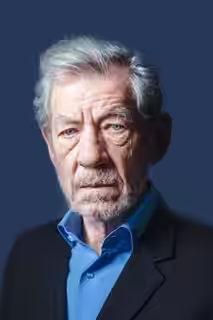
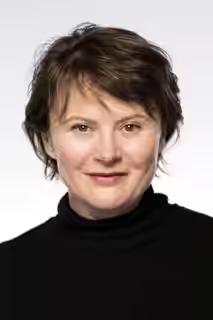
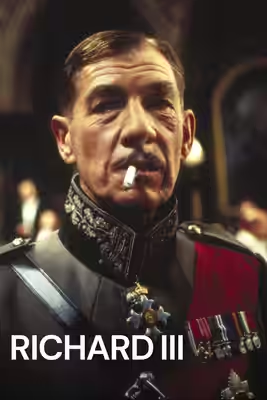
Trevor Nunn’s television King Lear is a filmed stage production in all but name: dark, close and plainly spoken. The camera adds little. Ian McKellen adds a great deal, and so do Frances Barber and Monica Dolan as the daughters who get tired of him.
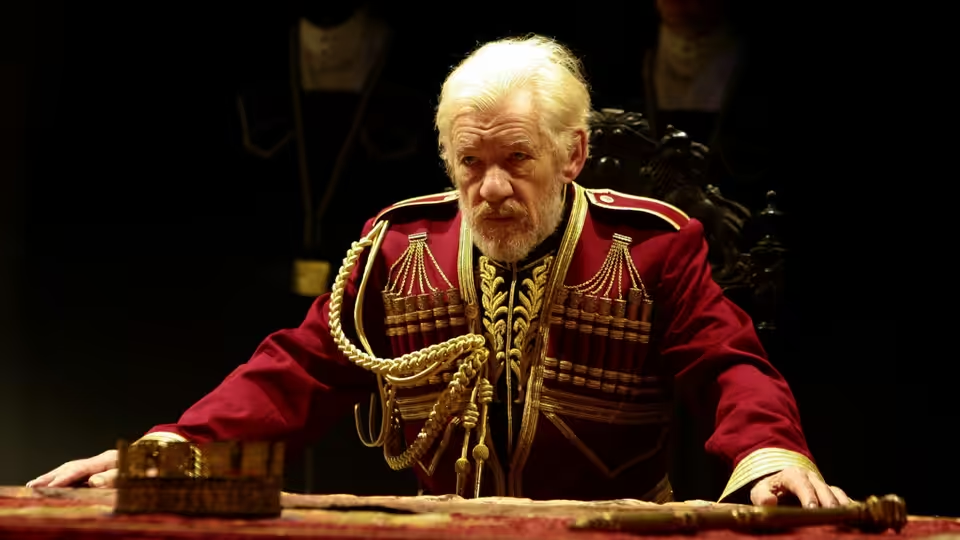
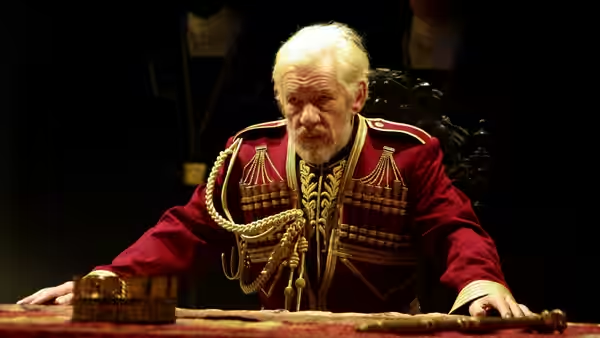
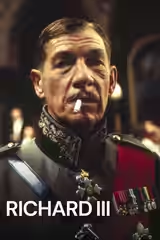
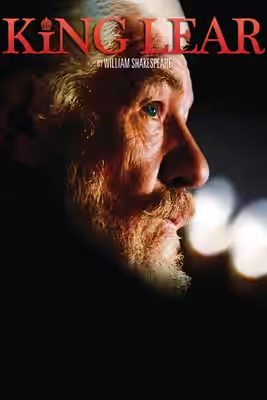
Trevor Nunn’s King Lear is Shakespeare’s play made for television in 2008, running 150 minutes, with Ian McKellen as the king. It opens on a court got up in dress uniform, braid and epaulettes and polished boots, and an old man who has decided to retire and wants to be thanked for it. The question with any filmed Lear is whether the camera gives you something the stalls would not. Here the answer is mostly no, and the reason to watch is McKellen, who would be worth watching in a car park.
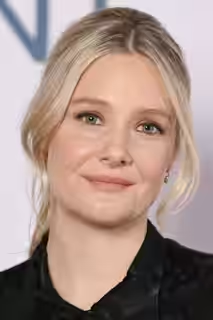
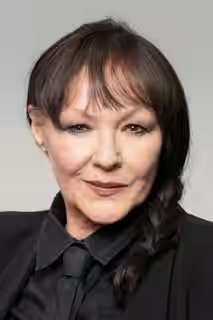
He starts the play vain and pleased with himself, a man who has staged the love test as a treat and expects to enjoy it. The pleasure drains out of his face in the time it takes Cordelia to say her one word. From there he plays the decline not as a slide but as a series of drops, each one landing a little harder. Frances Barber’s Goneril is not a villain but a daughter who has been waiting a very long time for her father to stop. Monica Dolan’s Regan is the nervous younger sister who discovers, to her own surprise, that she likes being cruel. Romola Garai’s Cordelia has less to work with and plays her stiff, which is defensible, since the part is mostly about refusing.
The scene that got us is the one where the two elder daughters strip Lear of his knights, haggling him down from a hundred to fifty to none. We were moved more than we expected, and it was not the speech. It was the moment before it, when McKellen looks from Barber to Dolan and back, does the arithmetic, and his mouth goes slack. He has understood that he is nobody’s father now. Then the words come, and they come as if he were finding them for the first time.
Paul Wheeler’s photography is television photography: close, dark, a face in a pool of light against black. It serves the actors well and the kingdom badly. There is no horizon anywhere, so when Lear is turned out into the storm the heath is a wind machine, a rain rig and McKellen’s head, and the madness has nowhere to go but inward. McKellen makes that work, roaring at weather we cannot see, but it is his doing and not Wheeler’s. Steve Edis’s music is brass and drum for the court, low strings for the heath, and too often it tells us a scene is sad a bar or two before the actor has had the chance.
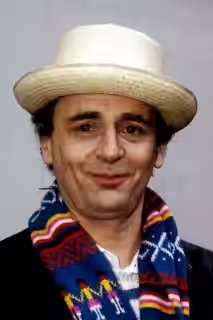
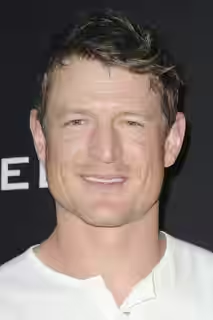
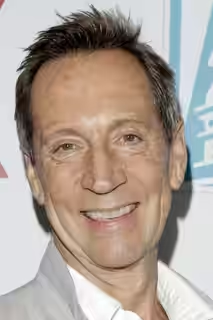
The men around the king are a mixed bag. Sylvester McCoy’s Fool is a music-hall act, cap and patter and a turn with a pair of spoons, and we warmed to him once we stopped waiting for him to be sad. William Gaunt’s Gloucester is the best of them: bluff, decent, slow on the uptake, a man you would trust with your house and not with a letter. Jonathan Hyde’s Kent is sturdy and clear. Philip Winchester’s Edmund has the smile and the shoulders but delivers his soliloquies to the lens as if pitching us something, and Ben Meyjes’s Edgar is sound without ever being alarming.
At 150 minutes it feels every one. The second half, which we will not describe, slows badly in the stretch where the play moves towards the coast, and the television frame, which flatters a face, shrinks a battle to a few men and a flag. Nunn knows where to put the camera for a speech and is less sure where to put it for a crowd. Against other filmed Lears this one is for people who want the words spoken plainly and the lead seen close, and on those terms it delivers.
Most critics so far like it a shade less than we do, and on the production they are right. Watch it at home, where it was made to be watched, in one sitting, with the subtitles off. The verse is so clearly spoken you will not need them, which is the thing this version does best after McKellen.