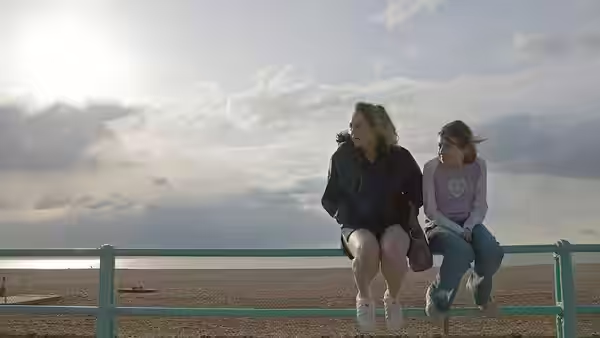
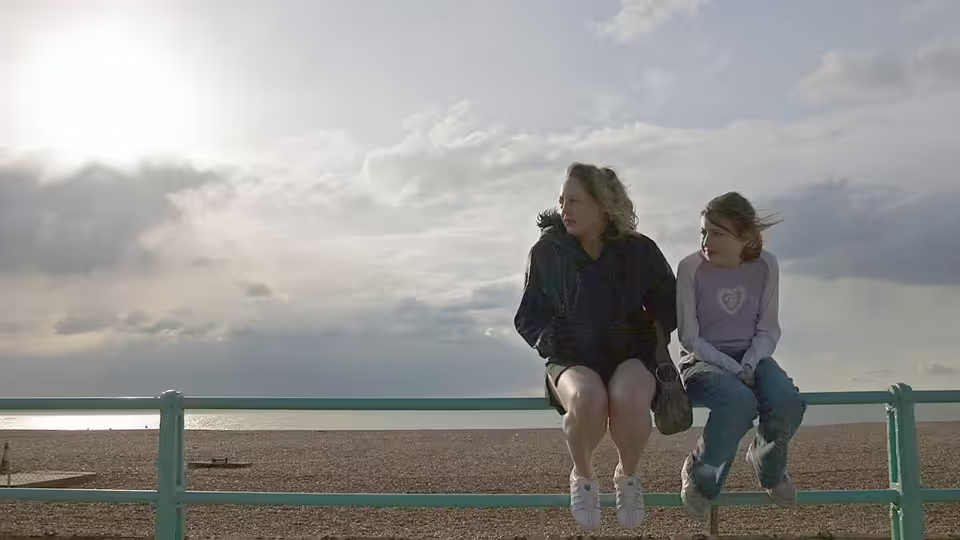
Kelly (Lorraine Stanley) and Joanne (Georgia Groome) sit on a seafront railing overlooking the beach
Film review

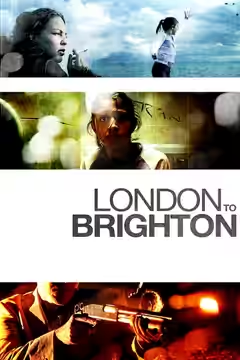
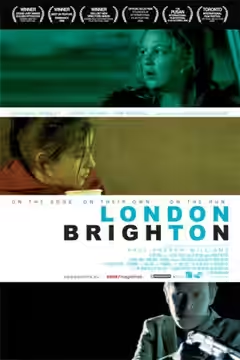
London to Brighton

2006 · Directed by Paul Andrew Williams · 1h 25m

In a sentenceA British gangster film in which the gangsters are the least interesting people in it

Three in the morning in a London public toilet. Kelly (Lorraine Stanley), a prostitute with a fresh black eye, is trying to quiet Joanne (Georgia Groome), an eleven-year-old runaway who will not stop crying. Kelly turns one trick for train fare and they take the first service to Brighton. Behind them, Kelly’s pimp Derek (Johnny Harris) is being leaned on by Stuart Allen (Sam Spruell), whose father Duncan (Alexander Morton) was the client Kelly was sent to find a young girl for the night before. Derek has until the end of the day to produce both of them. The film moves between the two on the run along the seafront and the previous night in London, filling in what happened at Duncan Allen’s house piece by piece.

Fi1m review

Paul Andrew Williams’s first film is lean, frightening and acted by near-unknowns who carry it with ease. It keeps its worst moment off screen and is the better for it; only a final stretch that reaches for tidiness lets it down.

British crime films in the years after Lock, Stock were mostly about men in pubs threatening other men in pubs. Paul Andrew Williams, writing and directing his first film, has made one about the people those men use up: a working prostitute, a child she was paid to find, and the small-time pimp who sent her to do it. London to Brighton runs 85 minutes and does not waste any of them. It is a chase, with the gangsters behind and the sea in front, and it is a reconstruction of one night, assembled out of order and withheld until the film is good and ready.

The acting is the reason to see it. Lorraine Stanley plays Kelly with a swollen eye and a voice that has given up on being listened to, and she makes the character’s decency a practical matter rather than a sentimental one: she buys chips, she finds a bed, she lies to the child when lying will help. Georgia Groome, as Joanne, does nothing an eleven-year-old would not do, which is harder than it sounds; she sulks, she asks the wrong questions, she wants her mum. Johnny Harris gives Derek the twitchy, aggrieved energy of a man who has always been the one getting hit and has just realised he is about to be hit much harder. Sam Spruell’s Stuart Allen is quiet and tidy and unpleasant, and Spruell has the sense not to raise his voice.

It was plainly made cheaply and it never once looks poor. Christopher Ross shoots London at night under orange street lamps and Brighton by day in flat grey light off the sea, and the switch between the two is how we always know where we are in time. The camera is handheld and close, often on the back of a head going somewhere in a hurry. Tom Hemmings cuts between the night and the morning so that each half answers a question the other has just raised, and he holds the key scene back for as long as the structure can bear. Laura Rossi’s score is a few strings and a lot of silence. Jane Levick, credited for both costume and production design, puts Kelly in one outfit for the whole film, which is correct, and dresses Duncan Allen’s house as the sort of place where nothing has ever been out of place.

The night at the house is kept almost entirely off screen, and it frightened us more than anything we have seen shown in a film of this kind. We watched the scene in which Kelly approaches Joanne outside the station with a dread that did not lift for the rest of the running time; Williams knows what the audience knows, and he lets Stanley’s face do the explaining. Later, a door closes, and the film stays outside with Kelly in the kitchen. We were grateful and we were sick. That is the film working exactly as intended.

What does not work is the gangster plot that surrounds the two women. Alexander Morton’s Duncan is a type we have met before, the soft-spoken boss with the nice house, and the scenes of Stuart and his men driving about and making calls are the one place the film goes slack. Nathan Constance, as Derek’s mate Chum, is good company but exists to be told things. And the final stretch, which we will not describe, tidies matters with a confrontation that needs several people to behave as the plot requires rather than as they have behaved for the previous hour. Most critics are split on this film, and the ones who dislike it are mostly reacting to that ending; we think it is a fault in a good film rather than proof of a hollow one.

Against the genre’s own standards it stands up well. Mona Lisa (1986) is the obvious comparison, another story of a man in the trade who finds he has a conscience, and this is bleaker and less forgiving. It carries an 18 certificate, and the certificate is earned by what it implies rather than what it shows. See it with the lights off and do not expect to feel better afterwards; expect to remember Stanley and Groome on a cold beach, sharing a bag of chips, for some time.

Critical consensus AI synthesised

60
Positive
4
Mixed
1
Negative
3
Empire
24 November 2006 · Alan Morrison
90*

Morrison gives the film a strongly positive verdict, calling it a reinvention of British crime cinema. He praises its lean, fast-moving screenplay for avoiding genre clichés and social-realist preachiness.

Read the full review →
Total Film
1 December 2006 · ★★★★ · Total Film
80

The review calls it a compassionate, steely surprise and praises its taut execution. It singles out the naturalistic performances and the suspenseful use of two timelines.

Read the full review →
The Guardian
30 April 2007 · Rob Mackie
75*

The critic finds the film gruelling but hugely believable and affecting, though its denouement disappoints. They praise the unknown cast and skilful direction for making its tense, offscreen horrors so convincing.

Read the full review →
Screen Daily
18 August 2006 · Allan Hunter
64*

The available page identifies this as a review, but its critical verdict is hidden. No specific element is available to identify as praised or criticized.

Read the full review →
Slant Magazine
29 January 2008 · ★½/4 · Ed Gonzalez
38

Gonzalez finds the film lurid and muddled, calling its kitchen-sink realism hollow. He complains that its shifts between past and present feel like a gimmick rather than meaningful social commentary.

Read the full review →
The Hollywood Reporter
19 February 2008 · The Associated Press
30*

The critic finds the film technically assured but ultimately superfluous, with graphic brutality that lacks emotional resonance. They praise the complex performances of the two female leads and Sam Spruell’s charismatic, understated turn.

Read the full review →

Straight answers AI written, from our review

Is London to Brighton worth watching?
London to Brighton is worth watching for anyone who wants a British crime film about the people gangsters use rather than the gangsters themselves, and we scored it 73. Lorraine Stanley and Georgia Groome carry it with ease and it runs a lean 85 minutes. A final stretch that tidies things too neatly is the one real fault.
How long is London to Brighton, and what is it rated?
London to Brighton runs 1h 25m. It is a crime and drama film.
Where can I watch London to Brighton in South Korea?
London to Brighton is not on any streaming or rental service in South Korea at the moment. It is available in 2 other countries; change your country at the top of the page to see where. Availability is checked daily.
How violent or frightening is London to Brighton, and is it suitable for children?
London to Brighton carries an 18 certificate and is not suitable for children. The subject is a child procured for an older man, and the film keeps the worst of it off screen, which makes it more frightening rather than less; we sat in dread for most of the running time. There is beating and threat throughout, and the squeamish should know the fear comes from what is implied.
How does London to Brighton compare to Mona Lisa?
London to Brighton is bleaker and less forgiving than Mona Lisa, the earlier film it most resembles. Neil Jordan's film is a crime romance, warmed by Bob Hoskins's bruised, hopeful George and his attachment to Cathy Tyson; Williams's film offers no romance and no comfort, only a prostitute and a child running for the sea. Both lose their footing in late thriller business, but Mona Lisa is the gentler evening and this one the harder.
What should I watch after London to Brighton?
After London to Brighton, try Mona Lisa (1986, Fi1m 83): Bob Hoskins drives a sex worker round Soho and grows a conscience; the model for this one. Then Nil by Mouth (1997, Fi1m 87): Gary Oldman’s south London, shot close and shouted, with the same refusal to look away; and Tyrannosaur (2011, Fi1m 81): Paddy Considine’s debut; violence, shame and one unexpected friendship in a Leeds charity shop.

Cast

If you liked this, try…

  1. Mona Lisa (1986, Fi1m 83)Bob Hoskins drives a sex worker round Soho and grows a conscience; the model for this one.

  2. Lilya 4-ever (2002) · not on Fi1m yetA Swedish-Russian film about a trafficked girl, harder to watch and even less forgiving.

  3. Nil by Mouth (1997, Fi1m 87)Gary Oldman’s south London, shot close and shouted, with the same refusal to look away.

  4. Tyrannosaur (2011, Fi1m 81)Paddy Considine’s debut; violence, shame and one unexpected friendship in a Leeds charity shop.

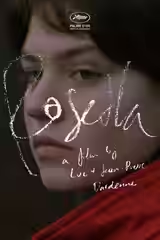
  5. Rosetta (1999, Fi1m 82)The Dardennes follow a girl who wants a job; handheld, relentless and oddly hopeful.