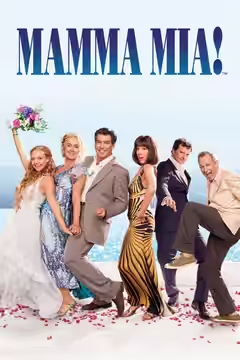
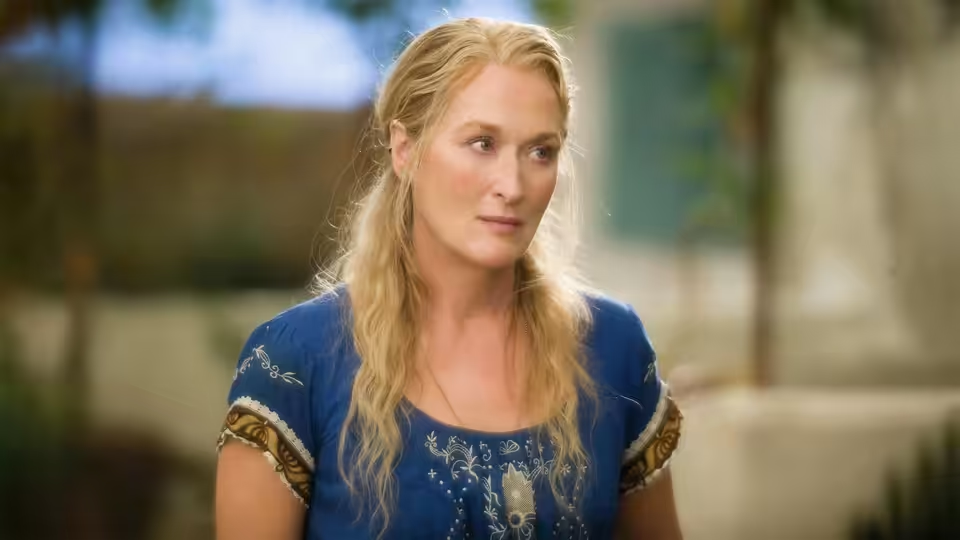
Donna Sheridan (Meryl Streep) stands outside looking to her left
Film review

Mamma Mia!

2008 · Directed by Phyllida Lloyd · 1h 48m

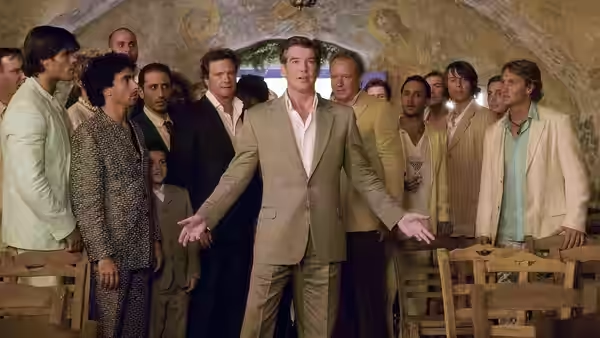
In a sentenceThe wedding guests sing with a confidence their voices do not always justify

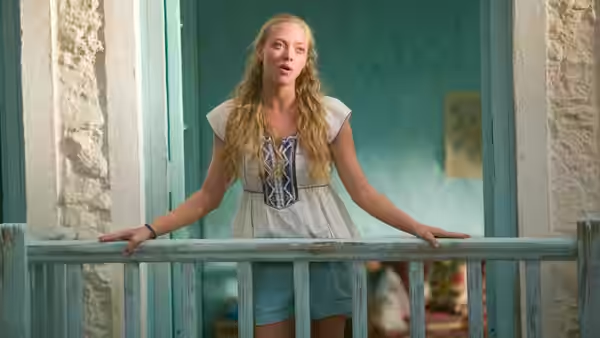
Sophie Sheridan (Amanda Seyfried) is getting married and wants to know who her father is. There are three candidates: Sam Carmichael (Pierce Brosnan), Harry Bright (Colin Firth) and Bill Anderson (Stellan Skarsgård), all former lovers of her mother, Donna Sheridan (Meryl Streep). Donna unexpectedly finds herself facing all three men as her daughter prepares to walk down the aisle. Each could supply the missing part of Sophie’s family, but none comes without a history with Donna. The wedding brings the question of paternity into the middle of a reunion Donna has not planned.

Plays from YouTube when you press play; nothing loads from them until then.

Fi1m review

Phyllida Lloyd’s wedding musical is awkwardly filmed and winningly performed, with Meryl Streep giving the songs more feeling than the plot deserves. We recommend it for the company, provided ABBA already have a place in the evening.

Phyllida Lloyd treats Mamma Mia as an invitation to enjoy people making a spectacle of themselves at a wedding. That is a sound enough ambition for a musical built around ABBA songs, and the film is good company despite some untidy direction. Its affection for the performers matters: nobody seems to have been put before the camera merely to be laughed at. The trouble comes when their enthusiasm is expected to do the work of staging, editing and a more substantial script.

Catherine Johnson’s screenplay gives Sophie Sheridan three possible fathers and Donna Sheridan three former lovers to contend with, which is plenty of trouble for one wedding. Amanda Seyfried makes the daughter’s wish for a complete family easy to understand, even when the plotting around her feels contrived. The songs are often asked to supply feelings that the scenes have barely begun to establish. There are stretches when the next familiar tune arrives so promptly that the characters scarcely have to finish a thought.

Meryl Streep gives the film enough feeling to get through those shortcuts. Her broad comedy can be overemphatic, but she lets Donna Sheridan’s dismay at the reunion interrupt the determined jollity. We were moved by her ‘Slipping Through My Fingers’. She makes a mother’s difficulty in letting go sound painfully ordinary, without needing the plot to become more complicated. That quieter singing gives us a reason to care about the wedding beyond sorting out the possible fathers.

Christine Baranski brings a sharper comic timing to the celebrations, giving the surrounding exuberance some welcome precision. Julie Walters is equally game, and both help to keep the comedy from depending entirely on the central tangle of relatives and former lovers. Pierce Brosnan’s singing is strained enough to distract from the feeling he is trying to convey. His willingness to attempt it is appealing, but goodwill does not make the notes any easier to listen to.

The physical setting does useful work, though the film could trust it more. Haris Zambarloukos makes the locations inviting, and Maria Djurkovic’s production design gives the wedding a pleasingly informal setting. Phyllida Lloyd seems less certain about how to arrange people within it once the singing starts. Lesley Walker’s busy editing keeps interrupting movement when we need time to watch it, so the larger numbers can become tiring despite their cheerful purpose. A musical ought to let us see its performers sharing a space, and too often we are made to assemble that space ourselves.

Benny Andersson and Björn Ulvaeus provide songs with enough lift and sadness to accommodate the comedy and the bruised feelings. Their melodies remain easy to follow even when the staging is busy, which gives the film a steadiness it needs. ‘The Winner Takes It All’ benefits from Meryl Streep’s willingness to give a familiar song an uncomfortable edge. At such moments the music can hold our attention without the film insisting that everyone be having fun.

We would choose it for an evening when nobody needs persuading about ABBA. Come looking for elegant dancing and the restless camera is likely to be a nuisance. Bring company that can forgive a missed note.

Critical consensus AI synthesised

61
Positive
12
Mixed
5
Negative
5

Most critics find something to enjoy in the ABBA songs, enthusiastic cast and cheerful escapism, though approval is far from unanimous. Praise centres on Meryl Streep, whose energy and emotional weight help a thin story hold together. Supporters enjoy the camp humour and the sight of actors committing themselves to the musical numbers without much concern for dignity. Even some less persuaded reviews credit the songs and performances with keeping the film entertaining.

The spread is wide, with direction, editing and singing dividing opinion most sharply. What admirers accept as unpolished fun strikes detractors as clumsy staging, frantic cutting and forced cheer. Radio Times treats the weak vocals as a tolerable part of the cast’s wholehearted approach; Slant Magazine finds the direction and editing inept, with production numbers that fail to connect songs and story. The central disagreement is how much enthusiasm can excuse.

The Hollywood Reporter
28 June 2008 · Ray Bennett
88*

The critic calls it a delightful piece of filmmaking and the most fun to be had at the movies that summer, praising the marvelous cast and especially Meryl Streep's smart and entertaining performance.

Read the full review →
Radio Times
★★★★ · Stella Papamichael
80

The big-screen adaptation takes the stage hit's winning formula up another notch as a shiny, happy romantic comedy. The fun lies in watching straight actors like Streep, Brosnan and company throw caution to the wind with infectious gusto despite weak vocals.

Read the full review →
Time Out
9 July 2008 · ★★★★ · Dave Calhoun
80

The film succeeds by taking the material seriously with strong design, locations, casting and choreography while avoiding gloss, cynicism and irony. It balances the fantasy of the musical numbers with down-to-earth character presentation, resulting in a campy, enjoyable summer movie like a pantomime.

Read the full review →
Evening Standard
10 April 2012
78*

The critic finds the film initially awkward and cringeworthy due to Lloyd's direction struggling with blending drama, songs, and scenery, with Streep appearing uncomfortable. It ultimately becomes a triumph as a camp, ironic musical celebrating human fallibility and pleasure, with an infectious mood that makes one want to dance.

Read the full review →
Total Film
11 July 2008
78*

The review highlights the solid-gold ABBA songbook, the cast's infectious gusto, and clever staging elements like live singing and a Greek chorus as making for a terrifically entertaining experience. It notes the film's appeal may not be universal but encourages giving it a chance for the music and heart provided by Streep.

Read the full review →
Empire
3 July 2008 · Angie Errigo
77*

The critic praises the ABBA songs and energetic performances, especially Meryl Streep and her co-stars, for creating charming, camp fun full of sunshine and toe-tappers. The main complaint is uneven direction mixing realism and theatricality, with some awkward shots and a lack of cinematic polish.

Read the full review →

Straight answers AI written, from our review

How long is Mamma Mia!, and what is it rated?
Mamma Mia! runs 1h 48m. It is a comedy and romance film.
Where can I watch Mamma Mia! in Serbia?
Mamma Mia! is available to rent from Amazon Prime Video from din 2.99. Availability is checked daily; the links above go straight to each service.

Cast

If you liked this, try…

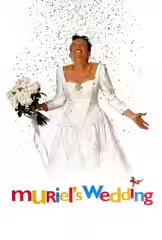
  1. Muriel's Wedding (1994, Fi1m 81)ABBA accompanies another prospective bride, with more loneliness and sharper social observation.

  2. The Young Girls of Rochefort (1967) · not on Fi1m yetFor sunlit streets, romantic confusion and dancing the camera allows us to watch.

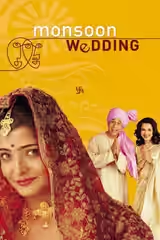
  3. Monsoon Wedding (2001) · not on Fi1m yetAnother wedding gathering, with family friction given more room between the celebrations.

  4. Sing Street (2016) · not on Fi1m yetYoung musicians find confidence through songs, with affection for every awkward rehearsal.

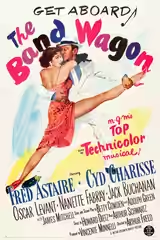
  5. The Band Wagon (1953) · not on Fi1m yetBackstage disagreements and grown-up romance, with dancing given the space it deserves.