Todd Haynes’s drama about an actress researching a woman who went to prison for a relationship with a schoolboy is sly, chilly and funny. Moore and Portman circle each other well; Charles Melton, as the boy grown up, is the reason to watch.
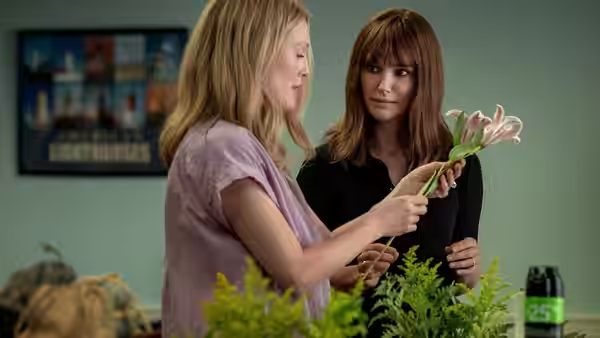
Elizabeth (Natalie Portman) is a television actress with an independent film coming up, and she has come to Savannah to study the woman she will play. More than twenty years ago Gracie (Julianne Moore), married with children and working in a pet shop, was caught with a thirteen-year-old boy who worked there. She had his baby in prison, married him when she got out, and has lived with it since. The boy is Joe Yoo (Charles Melton), now thirty-six. Their twins are about to graduate. Todd Haynes, working from Samy Burch’s script, opens on a barbecue at which a box of excrement is left on the step, and nobody is much surprised.
It is worth your evening, and colder than the reviews make it sound. Haynes shoots a tabloid story in the manner of an afternoon soap. Christopher Blauvelt zooms slowly in on a face, or a fridge; Marcelo Zarvos’s piano, adapted from Michel Legrand’s score for The Go-Between, comes thundering down on nothing at all. The famous instance is Gracie opening that fridge and saying that she does not think they have enough hot dogs. We laughed out loud. Then we noticed that the people we were laughing at had done something terrible and turned it into a household.
Moore has worked with Haynes since Safe in 1995 and knows how much he wants. Her Gracie has a faint lisp, tears that arrive on cue when she is cornered, and a settled belief that she is the injured party. She bakes cakes the neighbourhood buys, we suspect, out of pity. Portman’s Elizabeth takes all of this down in a notebook, and the film’s nastiest pleasure is watching her acquire Gracie’s mannerisms one at a time: the lisp, the tilt of the head, the lipstick. April Napier eases the two women into the same washed pastels, and Blauvelt keeps putting them in the same mirror, so that by the midpoint we occasionally had to check which one was speaking.
We did not expect to be moved. Melton did it. Joe Yoo is a big man who moves through his own house as if nobody has told him he lives there. He raises monarch caterpillars in mesh boxes and talks about them the way other men talk about their children. He texts someone late at night and will not say who. Watching him at the table with his shoulders in, while his wife tells a stranger what a fine father he is, we wanted to look away. Melton plays him almost entirely without raising his voice, and it is the best thing in the film.
Elizabeth is the weaker part. She has a job to do in the plot and not much life beyond it: a boyfriend on the phone, a director who wants the film to be about the boy. Portman is exact, but exactness is all the part allows, and in her set pieces, a talk to a school drama class among them, we could see the writing under the performance. The soap grammar wears too. A zoom that made us laugh in the first twenty minutes is pointing at the joke by the sixtieth. Affonso Gonçalves cuts it briskly and 117 minutes is right. The second half tightens as the research turns into something else, and the last scene we will not describe; we thought it a shrug for a day and have since changed our minds.
Sam Lisenco’s house does a lot of the work: wide, bright, a kitchen island Gracie holds like a pulpit, the twins (Elizabeth Yu and Gabriel Barbosa) packing upstairs. Cory Michael Smith has a couple of scenes as Georgie, Gracie’s son from her first marriage, and makes him the one person in it who says what everyone else has arranged their faces around. Set beside Far From Heaven and Carol, this is the drier Haynes, and the crueller one.
It carries a 15 certificate and nothing in it is graphic; the discomfort is all in what gets said over dinner. Watch it with someone who will argue with you afterwards about which of the two women is worse. The film has decided that is the wrong question, and the answer is sitting quietly at the end of the table.