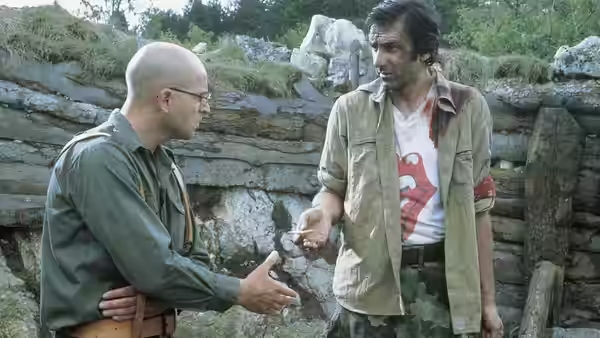
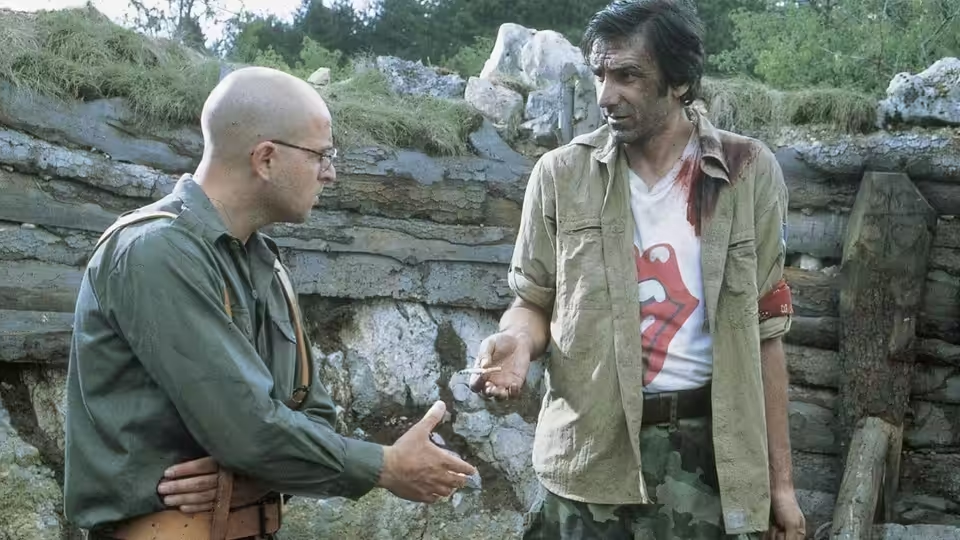
Nino (Rene Bitorajac) reaches toward bloodied Ciki (Branko Đurić) inside a ruined trench
Film review

No Man's Land

2001 · Directed by Danis Tanović · 1h 38m

In a sentenceThe gunfire is frightening; the people explaining why nothing can be done are almost as bad

During the Bosnian war, Ciki (Branko Đurić), Nino (Rene Bitorajac) and Cera (Filip Šovagović) struggle to survive amid gunfire, explosions and arguments between soldiers. Their predicament also involves the UN and the media, whose responses bring further complications. Sergeant Marchand (Georges Siatidis), Captain Dubois (Serge-Henri Valcke) and Colonel Soft (Simon Callow) form part of the military hierarchy, while Jane Livingstone (Katrin Cartlidge) is among those drawn into the situation. The soldiers need a way out of danger, but the conflict continues around them as the international response takes shape.

Fi1m review

Danis Tanović’s war satire is tense, bitterly funny and compassionate towards its soldiers. Its treatment of the media and international intervention is broader and less persuasive, but the humour never makes the suffering seem small.

No Man’s Land is a good war satire with an occasional weakness for stating the obvious. Danis Tanović, who writes and directs, makes the comedy uncomfortable without treating laughter as a lapse in seriousness. The jokes belong alongside the danger: people can be ridiculous while their circumstances remain frightening. We recommend it for that difficult combination, with reservations about how readily its criticism of institutions becomes caricature.

The writing is strongest when it trusts the immediate predicament to hold our attention. Tanović understands how an argument can be funny, exhausting and dangerous within the same exchange, and how little encouragement people need to resume it. There is suspense here, but also the miserable recognition that having something urgent to do does not necessarily make anyone more reasonable. Some of the dialogue sounds familiar, particularly when the film presses its case against war, yet the humour usually gives it sufficient bite.

We flinched at the sudden gunfire and explosions. Their abruptness interrupts the comfortable distance that a satire can establish between its audience and the people being mocked. That matters because the comedy sometimes invites us to feel cleverer than the characters, and the sound quickly makes that position unpleasant. Tanović also supplies the music, though the sharp interruption of weapons makes the stronger impression: the film does not need much assistance in making danger felt.

Branko Đurić, Rene Bitorajac and Filip Šovagović play Ciki, Nino and Cera, and the performances give the film more human variety than its broadest arguments allow. The cast can accommodate the shifts between absurdity and distress without making them feel like separate assignments. Francesca Calvelli’s editing is important to that control of tone; the suspense survives the humour, rather than having to restart after every joke. At 98 minutes, the film gives its central situation room to become uncomfortable without turning concision into haste.

Walther van den Ende is the cinematographer and Dušan Milavec the production designer. Their contributions serve a film whose strongest attraction is the pressure placed on its characters, rather than any invitation to admire warfare as spectacle. The physical danger remains more compelling than the explanations surrounding it. That emphasis works, although the film becomes less convincing whenever people seem to have been included chiefly to demonstrate a professional or institutional failing.

The treatment of the media and the UN is the principal weakness. Tanović’s anger is understandable, but these passages offer fewer surprises than the soldiers’ exchanges, and their targets can feel conveniently arranged. Nor does the film provide enough historical explanation to carry every political conclusion that might be drawn from it. Against the standards of anti-war satire, however, it earns its place through suspense, gallows humour and an unwillingness to let human suffering become merely illustrative. Watch it for the people caught in the conflict; expect less from those appointed to explain or manage it.

Critical consensus AI synthesised

75
Positive
6
Mixed
3
Negative
0

Most critics respond favourably to No Man’s Land, with praise centred on its dark humour and the compassion that survives its cynicism. The reviews find that the comedy sharpens the film’s account of war’s futility without diminishing the human cost. Tanović’s taut script and carefully timed changes of tone draw particular approval, as do the nuanced performances. Several critics also find the film suspenseful, giving its political satire an immediate dramatic pull.

The reservations concern how much that satire explains, and how broadly it draws its targets. Empire finds some characters caricatured and passages bombastic, while still judging the film acute and compassionate. Eye for Film questions the portrayal of the media and UN response and notes familiar dialogue. Slant Magazine offers the clearest dissent, finding the anti-war commentary obvious and politically shallow. The available verdicts range from strong praise to qualified disappointment rather than outright rejection.

Los Angeles Times
14 December 2001 · Kenneth Turan
90*

Turan praises the film as an exceptional, humane comedy that condemns the futility of war without taking sides. He especially singles out its sharp Balkan humor, which works alongside the tragedy without diminishing its real human costs.

Read the full review →
The Guardian
7 February 2003 · Rob Mackie
85*

Mackie finds the film sharp, witty and cynical, and praises its effectiveness both as a standalone story and as an allegory of the Bosnian war. He singles out Tanović’s distinctive, poignant approach to the war-film genre.

Read the full review →
IndieWire
7 September 2001 · festival review · Peter Brunette
80*

Brunette finds the film powerful, suspenseful, and darkly funny, with a profoundly bitter but earned conclusion. He especially praises Tanović’s carefully timed shifts in tone and the cast’s nuanced performances.

Read the full review →
Time Out
· GA
80*

The review presents the film as a successful, suspenseful satire. It singles out Tanović’s taut, witty script as the key to that success.

Read the full review →
Empire
1 January 2000 · Patrick Peters
75*

The review finds the film occasionally bombastic and its characters caricatured, but ultimately acute and compassionate. It singles out the dark gallows humour as a way of sharpening its critique of the conflict.

Read the full review →
RogerEbert.com
64*

The blocked page provides no critic verdict. It also gives no detail about what the review praises or criticizes.

Read the full review →

Straight answers AI written, from our review

Is No Man's Land worth watching?
No Man's Land is worth watching for its tense, bitterly funny treatment of soldiers caught in war, and we score it 77 out of 100. We recommend it for the performances and the uneasy combination of suspense and gallows humour, though its treatment of the UN and the media too often settles for caricature.
How long is No Man's Land, and what is it rated?
No Man's Land runs 1h 38m. It is an action and history film.
Where can I watch No Man's Land in Brazil?
No Man's Land is not on any streaming or rental service in Brazil at the moment. It is available in 4 other countries; change your country at the top of the page to see where. Availability is checked daily.
How violent or frightening is No Man's Land, and is it suitable for children?
No Man's Land has a UK 15 certificate and contains frightening gunfire and explosions, making it unsuitable for children under 15. We flinch at the abrupt violence, which keeps the soldiers' danger immediate despite the humour; older teenagers comfortable with tense war films are a more suitable audience than younger viewers or anyone sensitive to sudden weapons noise.
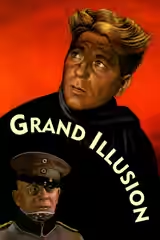
How does No Man's Land compare to Grand Illusion?
No Man's Land is harsher and more immediately frightening than Grand Illusion, which we recommend more strongly for its generosity towards people divided by war. Both find humour among soldiers, but No Man's Land combines suspense with blunt institutional satire, while Grand Illusion offers wiser character observation and a gentler experience, despite a weaker final stretch.
What should I watch after No Man's Land?
After No Man's Land, try The Grand Illusion (1937, Fi1m 92): For another war film attentive to the divisions between individual people. Then Paths of Glory (1957, Fi1m 93): Military authority receives a colder examination, with ordinary soldiers paying the price; and Dr. Strangelove (1964, Fi1m 93): For institutional absurdity pursued further into comedy, without making annihilation comfortable.

Cast

Awards

Academy Awards, 2002

Won
Best International Feature Film

Golden Globes, 2002

Won
Best Non-English Language Film

International Submission to the Academy Awards, 2002

Nominated
International Submission to the Academy Awards

European Film Award for Best Actor, 2001

Nominated
European Film Award for Best Actor

European Film Award for Best Screenwriter, 2001

Won
European Film Award for Best Screenwriter

If you liked this, try…

  1. The Grand Illusion (1937, Fi1m 92)For another war film attentive to the divisions between individual people.

  2. Paths of Glory (1957, Fi1m 93)Military authority receives a colder examination, with ordinary soldiers paying the price.

  3. Dr. Strangelove (1964, Fi1m 93)For institutional absurdity pursued further into comedy, without making annihilation comfortable.

  4. Tangerines (2013) · not on Fi1m yetAnother confined wartime encounter where hostility must contend with unwelcome human obligations.

  5. Quo Vadis, Aida? (2020) · not on Fi1m yetFor a more direct, harrowing examination of protection promised and withheld.

No Man’s Land (2001) review: Sharp humour, broader political satire (Brazil) | Fi1m