Sam Taylor-Johnson’s portrait of John Lennon’s youth is worth watching for its family tensions and three strong performances. Its account of musical beginnings is thinner, and the tidy biographical writing sometimes gets ahead of the boy.
Nowhere Boy is a good family drama with a musical biography attached, and the family is what makes it worth watching. Sam Taylor-Johnson concentrates on the young John Lennon caught between his mother and aunt, giving their differences more weight than his future importance. That is a sensible choice: being young and unsure where affection comes from is enough to sustain a film without constant promises of fame. The trouble is that the musical beginnings can then feel like obligations the screenplay has remembered to fulfil.
Kristin Scott Thomas gives Mimi Smith a restraint that makes the smallest suggestion of tenderness matter. We were moved by her determination to keep Mimi’s feelings contained even when the family tensions press against her. The performance lets us see how affection can become difficult to receive when it arrives with so little encouragement. Anne-Marie Duff’s Julia Lennon is more openly changeable, with pleasure and sadness close enough together to make her warmth uncertain. Both performances give the women lives beyond their usefulness in explaining John.
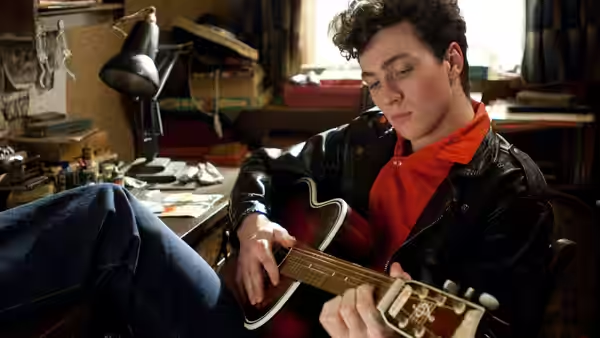
Aaron Taylor-Johnson brings the energy needed to stop John becoming a spectator in his own adolescence. His confidence is persuasive because vulnerability keeps showing through it; the young man can be engaging without always being easy company. He also holds his own alongside the two women, a considerable requirement in a film so dependent on their competing feelings. The performance gives us a restless adolescent when the story could easily have expected the name Lennon to do all the work.
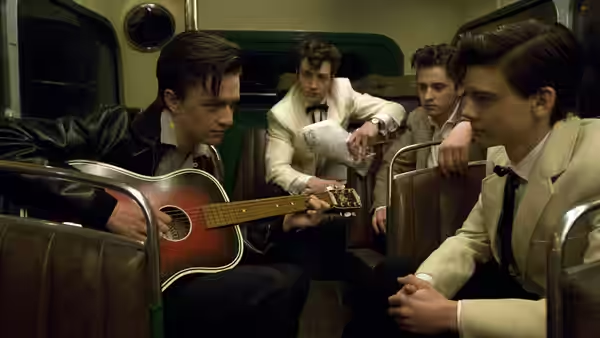
Seamus McGarvey’s cinematography gives the film colour and a finish that is sometimes a little too handsome for the unhappiness it contains. His images of distress are carefully composed, though the polish can make a difficult moment feel too arranged. Alice Normington’s production design makes the period convincing without turning every scene into a history lesson. Julian Day’s costumes help establish the young people’s wish to make an impression. The clothes give their attempts at confidence something visible and recognisable.
Alison Goldfrapp and Will Gregory give the music a warmth that suits the family drama. The film conveys the excitement of getting started, yet it is less persuasive about what distinguishes this particular boy’s musical imagination. Lisa Gunning’s editing allows the domestic exchanges space, but the accumulation of incidents does not always produce momentum. At 98 minutes, it still has stretches where the family difficulties seem to be going round again without becoming any clearer.
Matt Greenhalgh’s screenplay is less convincing when family pain starts to serve as an explanation of personality. These relationships are interesting enough without being made responsible for everything we are supposed to recognise in John. The dialogue can be pointed, but it sometimes states a feeling that the performances have already made clear. Sam Taylor-Johnson’s direction gives the actors room to work, though it rarely disturbs the familiar shape of a musical biography.
For an evening’s family drama, there is enough here to recommend. Anyone coming chiefly for an account of how the music developed should lower their expectations. Give the mother and aunt your attention; they have rather more to say.