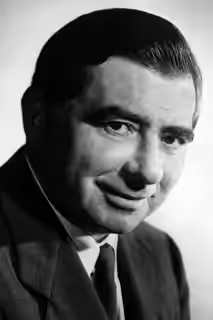
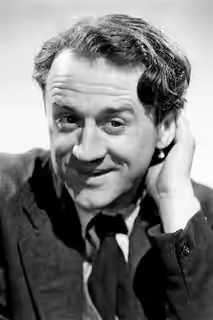
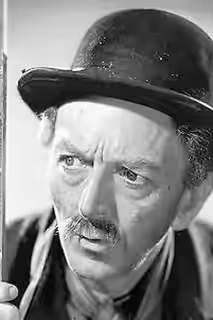
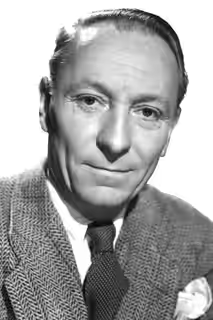
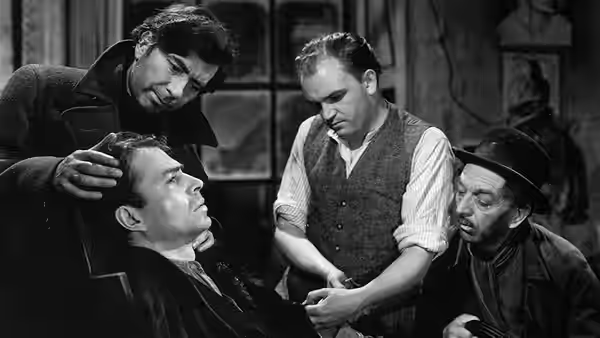
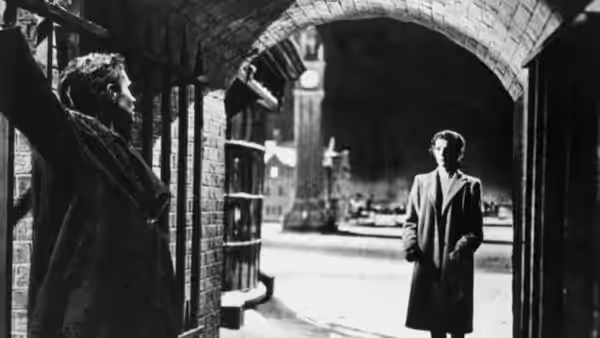
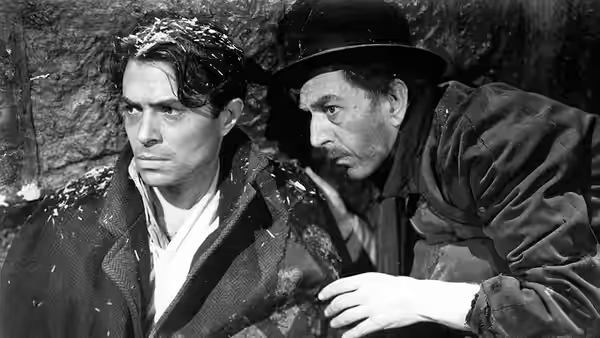
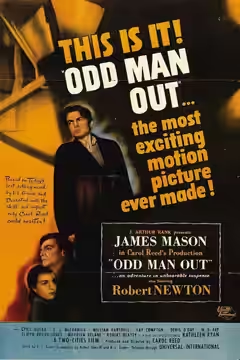
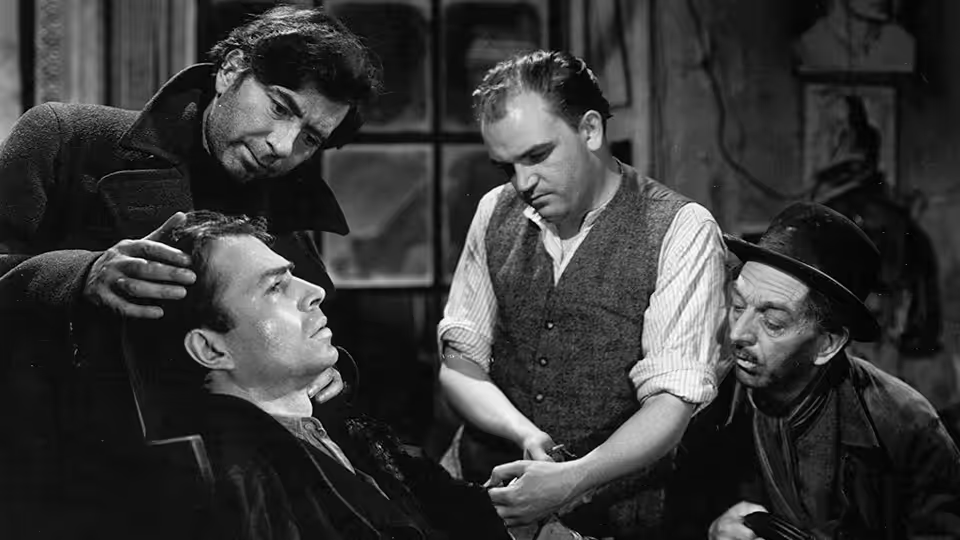
Johnny McQueen (James Mason) lies injured as three men gather around him
Film review

Odd Man Out

1947 · Directed by Carol Reed · 1h 56m

In a sentenceA manhunt that makes us wish everyone would stop and fetch a doctor

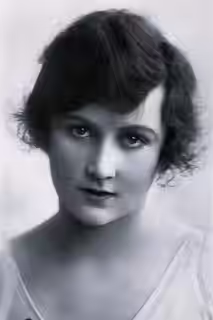
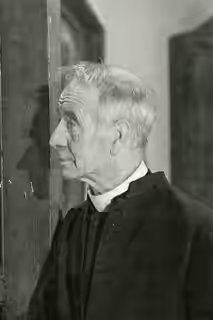
Johnny McQueen (James Mason) is wounded and fading as a manhunt closes around him. His immediate need is to get away, but his condition leaves him less and less able to act. Kathleen Sullivan (Kathleen Ryan), Pat (Cyril Cusack) and Dennis (Robert Beatty) are among the figures in his story, which also includes the barman Fencie (William Hartnell) and Father Tom (W.G. Fay). The pursuit tests more than Johnny’s chances of escape: it brings the private conflicts of the people around him into view.

Plays from YouTube when you press play; nothing loads from them until then.

Fi1m review

Carol Reed’s manhunt thriller is worth seeing for James Mason’s wounded Johnny and Robert Krasker’s oppressive black-and-white photography. The moralising occasionally interrupts the suspense, but Mason makes the man’s helplessness hard to forget.

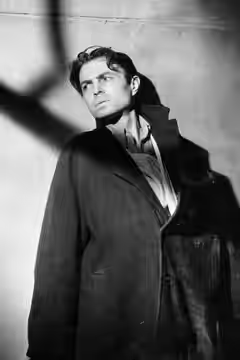
Carol Reed’s Odd Man Out is a tense, humane thriller, with one persistent fault: it sometimes presses its moral concerns harder than it needs to. The manhunt supplies the immediate danger, but Reed keeps directing our attention to the wounded man inside it. Johnny McQueen (James Mason) has less and less strength with which to influence his own story. That is an awkward proposition for a thriller, and a rewarding one for an actor prepared to surrender the usual privileges of a leading role.

Mason makes Johnny’s passivity troubling. We were distressed by his helplessness, because the wounded, fading figure on screen cannot offer the reassurance of a hero taking charge. The performance asks us to keep watching someone whose capacity to act is diminishing, without making that demand feel like a test of patience. Mason gives us enough of a person to worry about even when the role gives him little to do. Much of the suspense depends on our willingness to stay with him.

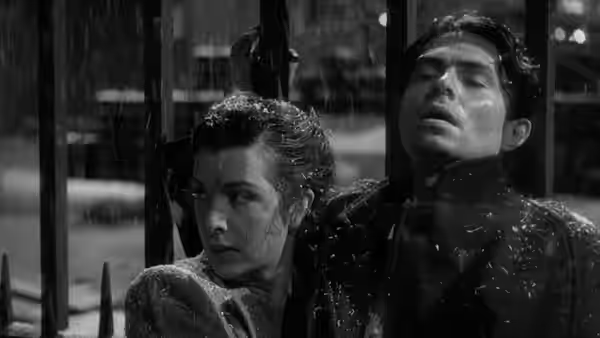
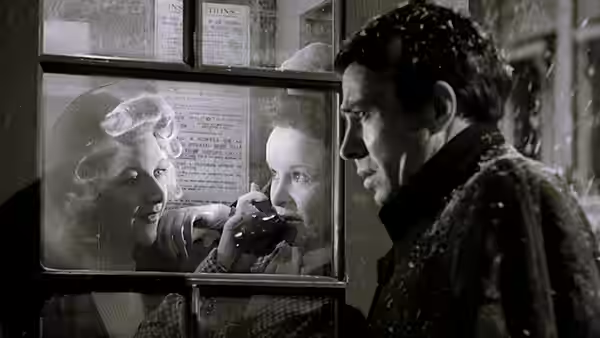
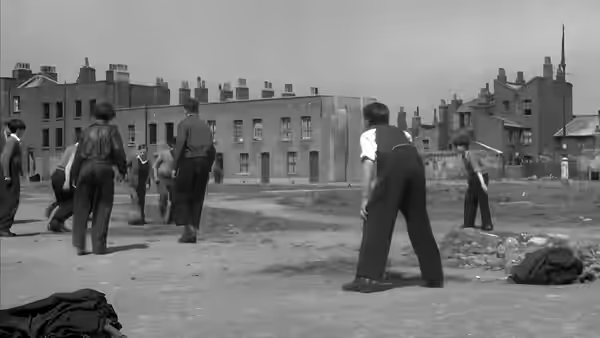
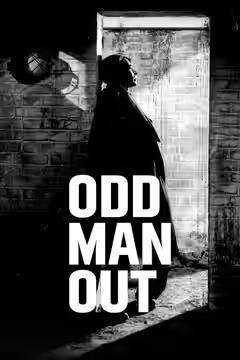
Robert Krasker’s black-and-white photography is the other reason the film holds us so firmly. His expressionistic approach makes the pursuit feel oppressive, giving the images a force that does not depend on Johnny doing anything. This is emphatic filmmaking, suited to Reed’s willingness to make the pursuit morally uncomfortable as well as frightening. The images occasionally come close to making the bleakness too attractive, but Krasker keeps the vulnerable human figure important enough that we do not simply settle down to admire the pictures.

Fergus McDonell’s editing allows the suspense to survive that unusual emphasis. We are given time to register Johnny’s condition without entirely losing the sense of pursuit, although the film becomes less taut when it turns towards moral reflection. William Alwyn’s music contributes to the gravity, fitting a drama that is not embarrassed to ask for a serious response. The combined effect is insistent, sometimes over-insistent, but the care taken over this apparently straightforward thriller is easy to appreciate.

The weakness lies in the moralising. R.C. Sherriff and F.L. Green’s writing can seem anxious that we should understand the significance of suffering we have already recognised in Mason’s performance. We grew impatient when that emphasis interrupted the suspense. The cast’s collective conviction helps, keeping the concern for other people credible even when the film becomes too deliberate about expressing it. These passages make the film feel slower, and give us time to notice how carefully our sympathies are being directed.

A conventional fugitive thriller lets us enjoy somebody thinking quickly under pressure. Reed takes away much of that pleasure and finds something more uncomfortable in its place: the need to care about a person who can no longer entertain us with resourcefulness. That choice makes Odd Man Out worth seeing despite the heavy emphasis, and Mason carries it without needing to dominate every moment. Choose it when there is time afterwards to sit with something bleak.
Critical consensus AI synthesised

79
Positive
7
Mixed
0
Negative
0

The reviews lean firmly positive, with praise clustering around Robert Krasker’s atmospheric black-and-white photography and James Mason’s performance. Most critics see more than a suspenseful manhunt: they emphasise the film’s humane character study, bleak tragedy and attention to conflict within people. Carol Reed’s direction also draws praise, while the expressionistic imagery is repeatedly singled out for its contribution to the atmosphere.

The differences are largely matters of emphasis, though Mason’s performance prompts a clear disagreement. Variety praises the cast’s teamwork but finds him less effective in a largely passive role, and registers a mild reservation about the moralising. Elsewhere, critics respond more warmly to Mason’s wounded Johnny, while the shift from suspense towards metaphor helps explain why several accounts focus as much on the film’s humanity and tragedy as on its thriller mechanics.

Radio Times
★★★★★ · David Parkinson
100

The critic describes the film as agonising and exceptionally powerful. They praise James Mason’s performance and Carol Reed’s direction, alongside Robert Krasker’s atmospheric photography.

Read the full review →
Slant Magazine
14 April 2015 · ★★★★ · Jordan Cronk
80

Cronk finds the film a humane, atmospheric character study wrapped in a sociopolitical thriller. He particularly praises Robert Krasker’s expressionistic cinematography and the film’s evocative black-and-white imagery.

Read the full review →
Empire
1 January 2014 · David Parkinson
75*

The critic views the film as a stark, suspenseful thriller whose suspense gives way to metaphor. He praises James Mason’s performance and the brooding monochrome photography.

Read the full review →
Variety
31 December 1946 · Variety Staff
75*

The review is strongly positive about the film’s careful artistry and storytelling, with a mild reservation about its moralizing. It singles out the cast’s teamwork for praise, while finding James Mason less effective in a largely passive role.

Read the full review →
The New York Times
24 April 1947 · Bosley Crowther
70*

The headline identifies a New York Times review, but the blocked page does not reveal the critic’s verdict. Its praise or complaints cannot be verified from the accessible text.

Read the full review →
Time Out
29 August 2006 · Dave Calhoun
70*

The page presents the film positively, calling it Carol Reed’s first great postwar film. It singles out the opening preamble’s emphasis on conflict within people.

Read the full review →

Straight answers AI written, from our review

Is Odd Man Out worth watching?
Odd Man Out is worth watching for James Mason’s vulnerable performance and Robert Krasker’s oppressive black-and-white photography; we score it 82 out of 100. We recommend it to viewers who prefer humane, bleak suspense to a resourceful hero’s escape story, though the moralising sometimes slows the pursuit.
How long is Odd Man Out, and what is it rated?
Odd Man Out runs 1h 56m. It is a crime and drama film.
Where can I watch Odd Man Out in Mexico?
Odd Man Out is not on any streaming or rental service in Mexico at the moment. It is available in 3 other countries; change your country at the top of the page to see where. Availability is checked daily.
How violent or frightening is Odd Man Out, and is it suitable for children?
Odd Man Out is a frightening, emotionally distressing manhunt thriller, with no UK certificate listed and a US NR designation, neither of which establishes suitability for children. We find the wounded Johnny’s increasing helplessness upsetting; the oppressive atmosphere and sustained concern for his suffering make us cautious about choosing it for younger viewers.
How does Odd Man Out compare to Daybreak?
Odd Man Out and Daybreak both make a cornered man’s predicament painfully absorbing, and we recommend both with a caveat about their insistent bleakness. We favour Odd Man Out for its oppressive photography and Mason’s helpless fugitive, though its moralising interrupts the suspense; Daybreak suits those drawn to claustrophobic drama, Jean Gabin’s wounded force and contrasting performances.
What should I watch after Odd Man Out?
After Odd Man Out, try Le Jour se lève (1939, Fi1m 82): Another cornered man, with the past steadily tightening his predicament. Then The Informer (1935, Fi1m 73): Political loyalties become painfully personal in another oppressive, guilt-ridden drama.

Cast

Awards

BAFTA Film Awards, 1949

Won
Best British Film

Academy Awards, 1948

Nominated
Best Film Editing

If you liked this, try…

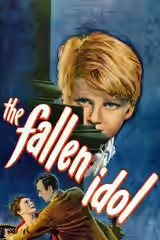
  1. The Fallen Idol (1948) · not on Fi1m yetReed makes adult evasions alarming through a child’s incomplete understanding.

  2. Le Jour se lève (1939, Fi1m 82)Another cornered man, with the past steadily tightening his predicament.

  3. The Informer (1935, Fi1m 73)Political loyalties become painfully personal in another oppressive, guilt-ridden drama.

  4. The Ascent (1977) · not on Fi1m yetA wartime pursuit puts human frailty under an unforgiving moral scrutiny.

  5. Le Havre (2011) · not on Fi1m yetFor a warmer account of a community deciding how to shelter someone.

Odd Man Out (1947) review: A tense manhunt weakened by moralising (Mexico) | Fi1m