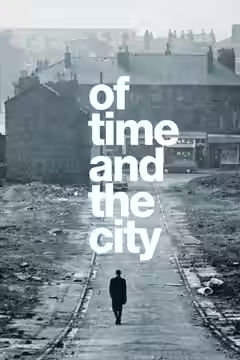
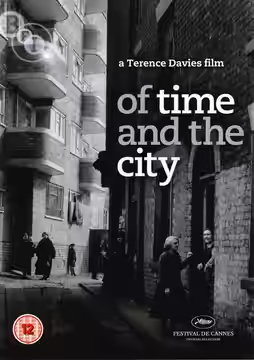
Terence Davies lays old film of Liverpool under borrowed songs, borrowed poems and his own voice, and mourns the city he grew up in. It is sharp, funny and often sour, and we forgave the sourness. It gets through a lifetime in 74 minutes.
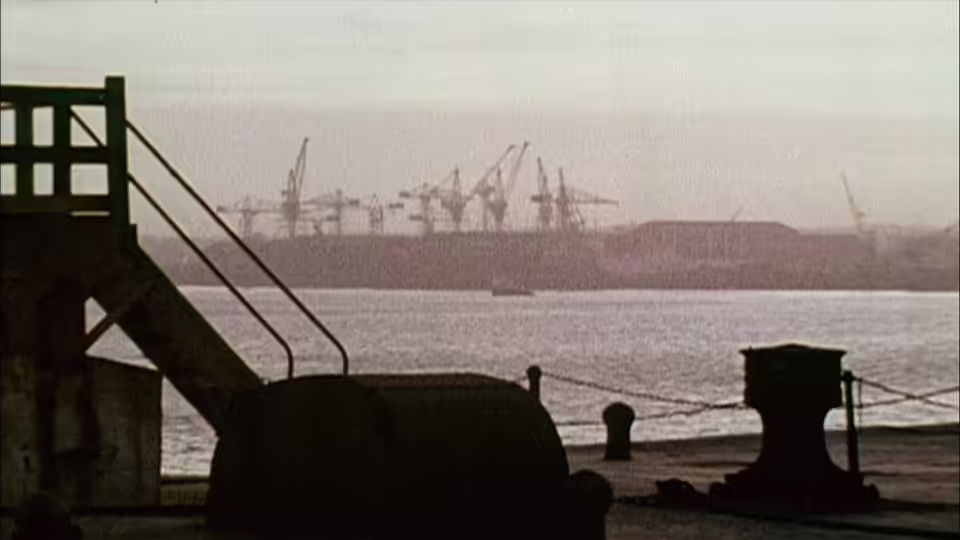
Terence Davies grew up in Liverpool, left it, and in 2008 came back with 74 minutes made almost entirely from other people’s film of the place. Newsreel, council documentaries, amateur film, television: dockers coming off shift, women on their knees scrubbing a doorstep, boys swimming off the landing stage, the ferry crossing the Mersey. Over it he reads, in a voice that has clearly enjoyed a lifetime of being listened to: his own memories, written up with some ceremony, and lines he has borrowed from Eliot, Housman and Chekhov. Under both runs the music he loved. It is the first film he had made since The House of Mirth (2000), and it is a good one, with a sourness in it that we will come to.
It is not a history of Liverpool and does not try to be. The city appears only where it touched him: the church where he prayed hard and got no answer, the cinema, the football terraces, the wrestling at Liverpool Stadium where he watched the men in the ring and understood, as a boy, what he was. He says this plainly, and says what it meant to know it in a decade that sent men to prison for it. The film runs roughly from the war to the present, but it moves by association rather than by date, and anyone wanting to know what happened to the docks will have to look elsewhere.
Liza Ryan-Carter cuts it to the music rather than to the narration, and that is why the film works. The sequence everyone remembers, and that we will not pretend to have been immune to, has Peggy Lee singing The Folks Who Live on the Hill over footage of the new estates: terraces coming down in clouds of dust, then tower blocks going up, then children on the walkways and washing on concrete balconies. Lee is singing about growing old content in a house with a view. The camera is looking at homes nobody would choose to grow old in. We were moved more than we expected, and it was the gap between the song and the picture that did it; the film does not have to say a word, and for once Davies does not.
He is funny, too, and not kindly. The Coronation of 1953 gets a long look and a running sum of what it cost against what the streets around him had. The Beatles get a few seconds and a sniff; he tells us he had moved on to Mahler by then and clearly expects us to agree. We laughed at the Coronation, and then felt a little ashamed, because the people in the newsreel are so plainly happy and he is so plainly not. Most critics have forgiven the tone. One has not, and found the film cynical. We think that is the wrong word. Davies is not sneering at Liverpool. He is angry with it for not having been kinder to him, and the anger is what keeps the nostalgia honest.
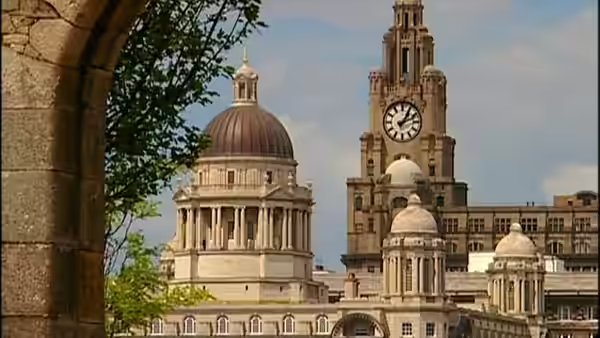
There are faults. The footage Davies shot himself, of the city as it is now, is on clean digital video, and beside the grain and bleed of the archive it looks like a property programme. The spell breaks every time he returns to it. A montage of young men going off to the Korean War is laid under a sentimental pop ballad, and it is the one place where the music tells you what to feel when the pictures already had. And the prose can be purple. Davies writes as though every sentence must be fit to carve, and after an hour we would have taken a few that were not.
Set against his own films, it is a companion to Distant Voices, Still Lives (1988) and The Long Day Closes (1992), which built these streets on sets, cast actors as his family and lit them like memory. Here he has the actual streets and nobody acting, and he has to supply the family himself, in words. It is lighter than those films and quicker, and it lets him be funny about his own misery in a way they did not.
Watch it at home, late, with the lights off and the sound up, and preferably with someone who has left somewhere and not entirely got over it. Roy Boulter and Sol Papadopoulos produced it, and what they got was a film about Liverpool that spends a good deal of its 74 minutes declining to celebrate the place.