Regina King’s drama makes absorbing company of four famous men who cannot agree on what their influence is for. The performances keep its arguments personal, though some exchanges are too neatly written to sound spontaneous.
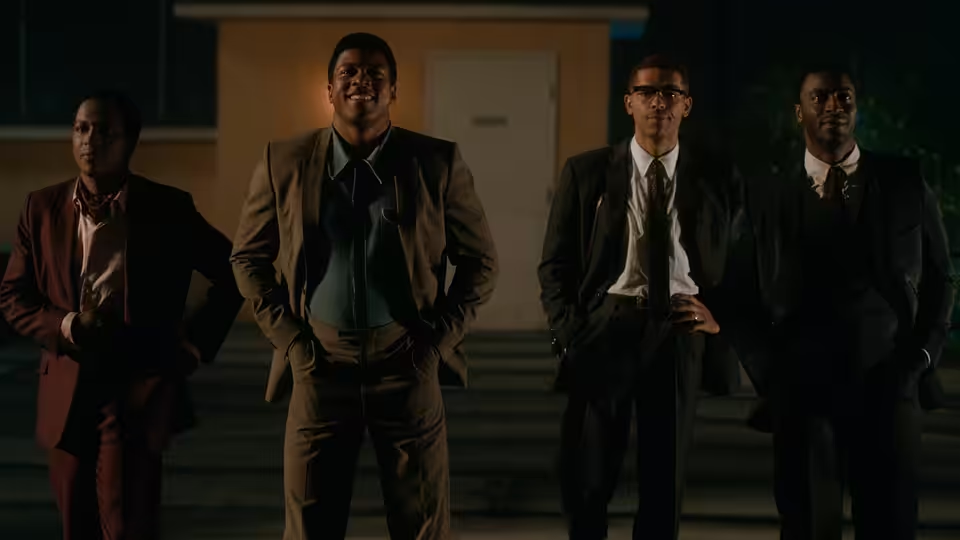
One Night in Miami… is a rewarding drama about arguing with friends. Regina King gives Malcolm X, Cassius Clay, Jim Brown and Sam Cooke enough room to be awkward company, and the actors make that company worth keeping. Their private gathering becomes a discussion of what successful black men owe other black people. The film sometimes sounds too carefully prepared, but we recommend it for the moments when affection makes an opinion harder to say aloud.
Kemp Powers’s screenplay sets public responsibility alongside the ordinary business of being friends: admiration, rivalry and the wish to have one’s choices respected. Nobody can simply dismiss the others as strangers who know nothing. Regina King is attentive to the difference between speaking persuasively and getting through to somebody. Yet some exchanges arrive with their subjects too neatly labelled, and the opening takes too long to settle into the gathering.
Kingsley Ben-Adir plays Malcolm X with an urgency that can make him difficult to be near. We were moved by his weariness: in the exchanges with his friends, persuading them seems to cost him the pleasure of being with them. Leslie Odom Jr. gives Sam Cooke enough self-possession to resist becoming merely the person Malcolm X needs to convince. Their disagreements are involving because both actors let wounded pride show through the reasoning, without asking us to stop taking the reasoning seriously.
Eli Goree’s Cassius Clay brings welcome exuberance to a film that could otherwise become oppressively conscientious. His confidence is enjoyable without making the character seem immune to the people around him. Aldis Hodge gives Jim Brown a quieter presence, and we often found ourselves watching him while somebody else was speaking. The pleasure comes from watching each actor adjust to the other three, especially when somebody’s confidence has begun to grate.
Tami Reiker’s cinematography works well in the motel room, keeping our attention on faces through the longer exchanges. Production designers Barry Robison and Page Buckner give the men a suitably modest setting, without making the room itself a distraction. This helps us accept them as friends sharing a space, with all the familiarity and impatience that can involve. The limitation is that the film occasionally leaves us too aware of four performers waiting for the next substantial speech.
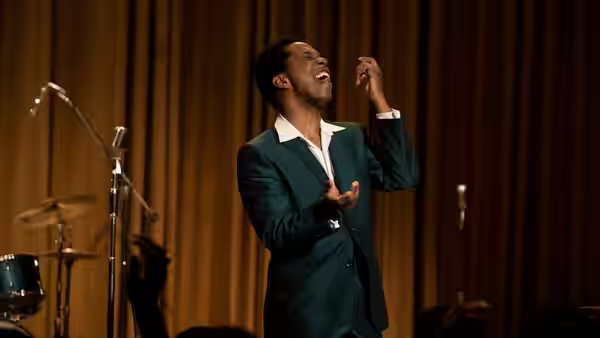
Tariq Anwar’s editing gives the listeners time to register their doubts, though it cannot make every carefully developed point feel like spontaneous conversation. There are stretches when the rhythm grows dutiful, and a little less explanation would have sharpened the friction. Terence Blanchard’s score leaves the dialogue enough room, but it is Leslie Odom Jr.’s singing that makes the stronger impression. His voice gives Sam Cooke a persuasive presence that the spoken exchanges sometimes work too hard to establish.
Historical dramas can be so respectful of famous people that they leave them nothing interesting to do. Regina King lets these men be irritating without making them unworthy of affection. At 114 minutes, the film asks for patience with talk and mostly repays it. Choose it for the actors, and allow for the occasional speech that should have been interrupted.