Jon Gunn’s true-story drama has two good performances, from Hilary Swank and Alan Ritchson, and a script that smooths everything they do. Sincere and decent, it never once asks why a roofer needs charity to keep his daughter alive.
Ordinary Angels tells a true story from Louisville, Kentucky, and it tells it the way such stories are usually told: a stranger with a flaw, a family in trouble, a town that comes good. Jon Gunn directs from a script by Kelly Fremon Craig and Meg Tilly, and for 118 minutes it is sincere, competent and safe. Two performances lift it above the run of the genre. The writing keeps them on a short lead.
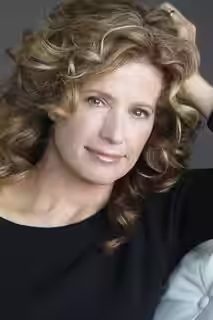
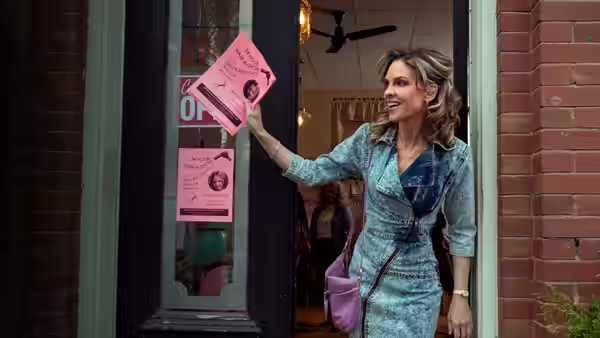
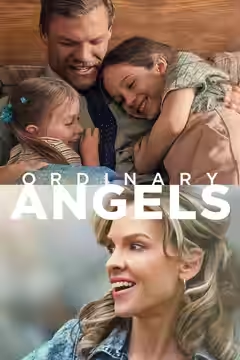
Hilary Swank plays Sharon Stevens as a woman who has never once lowered her voice. She is a hairdresser with a perm the size of a lampshade, a drink problem she is not treating and a son, Derek (Dempsey Bryk), who no longer takes her calls. Swank does not soften her. The pushiness that gets doors opened is the same pushiness that empties rooms, and the film’s best scenes are the ones where Ed’s mother Barbara (Nancy Travis) looks at this stranger in her kitchen and plainly wants her gone. Swank has not had a part this good for some time, and she works it hard.
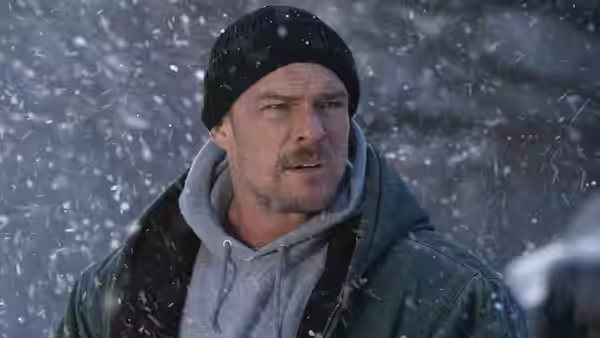
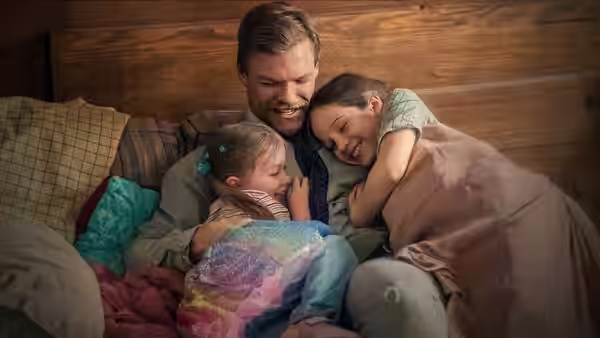
Alan Ritchson, known for playing the giant in Reacher, is the surprise. Ed Schmitt is a roofer who has just buried his wife, Theresa (Amy Acker), and cannot pay the hospital that treated her, let alone the one that will have to treat their younger daughter, Michelle (Emily Mitchell). Ritchson plays him small. He sits at a kitchen table with a stack of envelopes and does not open them, and there is a phone call about a bill in which he says almost nothing, and we were more moved than we had expected to be by a man that size failing to speak. It is the one stretch of the film that trusts silence.
Maya Bankovic shoots Louisville in two colours: the amber of the salon and the church hall, and the grey of the hospital car park and the roofs Ed works on in the cold. Nazgol Goshtasbpour’s Schmitt house is cramped and lived in, coats on every hook, and Heather Neale puts Sharon in leopard print and shoulder pads so that she never matches a room she walks into, which is the point. Pancho Burgos-Goizueta’s score is the problem. It arrives early in every scene, piano then strings, to tell us how the scene will end, and it is right every time. Parker Adams cuts the fundraising as montage, haircuts and cheques and church notices, so the money comes in fast, and the middle hour is mostly people being kind at speed.
What the script will not do is ask the obvious question. A roofer’s child needs a new liver and the family’s route to it is a hairdresser going door to door. The film treats this as uplifting. Sharon marches into a hospital billing office and talks a debt down, and it is played as a victory, and we sat there wondering why the debt existed. Every time Ed’s situation might become an argument about anything larger than Ed, a casserole arrives.
There is also Sharon’s own story, which the script sets up carefully and then resolves in about four minutes. Her drinking, her son, the meetings she attends with Rose (Tamala Jones) beside her: these are the reasons she needs this family, and the film says so in a speech rather than letting us see it. The last half hour, set in a snowstorm, we will not describe, except that it is well staged, goes on longer than it needs to, and is scored as if we might not know a blizzard is serious.
Against the usual standard of the inspirational true-story drama, this is a cut above: the acting is better, the church is present without preaching, and nobody is a villain. Against the standard of a drama, it is thin. We believed the family and we admired the two leads; we did not believe the town, which comes round on cue and in the right order. Most critics have been a little warmer than we are. If the genre is yours, it will do the job it promises, and you will know how it ends about twenty minutes in.