Soderbergh’s true story of a filing clerk who took a utility company to court is shrewd about how such fights are actually won, and it is carried, scene by scene, by Julia Roberts. It is predictable to the minute. We did not much mind.
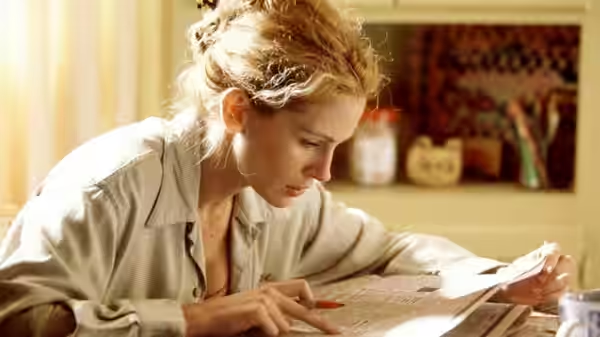
Erin Brockovich has no money, no husband and a neck brace from a car accident that was not her fault, and in the opening scene a jury declines to believe her. She responds by turning up at her lawyer’s office and refusing to leave until he gives her a job. Ed Masry (Albert Finney) does, mostly to make her stop talking. In a pro bono property file she finds blood tests and medical records, drives out to Hinkley, California, and starts asking why a power company is so keen to buy people’s houses. That is the first half hour, and Steven Soderbergh has made a good, plain film out of what follows. It is as predictable as a bus timetable. It is also funny, properly acted and honest about how a case like this gets built, which is by knocking on doors and reading everything.
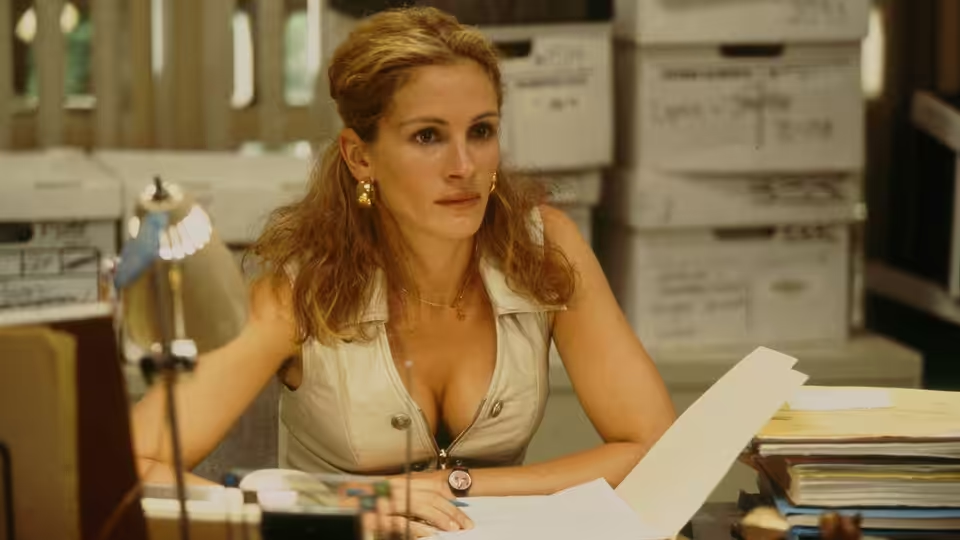
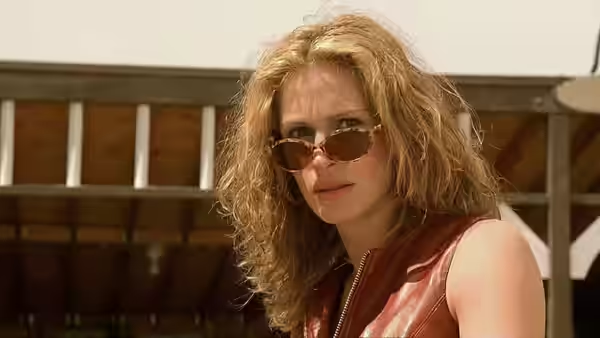
Roberts plays Erin fast and loud and never once asks us to like her, which is why we do. The mouth is the weapon; she swears at receptionists, lawyers, neighbours and her own boss, and the swearing is precise. Jeffrey Kurland puts her in the shortest skirts and lowest tops in any room she walks into, and the film is clear-eyed about what that costs her and what it buys. Some critics found the wardrobe a distraction from the case. We thought it was the case: Erin is underestimated on sight, by everyone, and she uses that to get into rooms nobody else can enter.
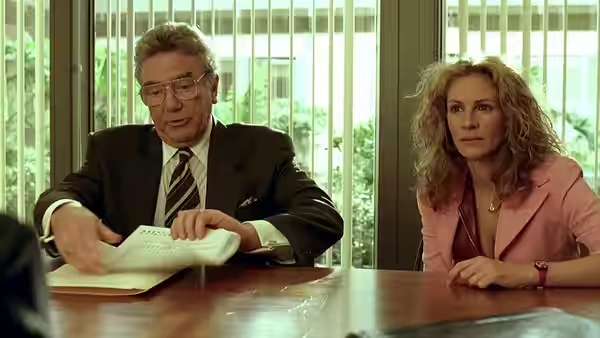
Finney is the other reason to watch. His Masry is rumpled, tired, pleased with a small practice and appalled to find himself in a large fight, and the exasperation slowly turns into something like pride. The two of them arguing across a desk is the best material in the film. Aaron Eckhart’s George, the biker who moves in next door and ends up raising Erin’s children while she drives around the desert, is written as a saint and Eckhart plays him as one, which is not his fault and is a fault.
Soderbergh shoots it rough. Edward Lachman’s camera is often handheld and the light looks like whatever was already there when the crew arrived; the desert is bleached brown and the houses are photographed in flat afternoon sun, with no swelling music to tell us these people are victims. Philip Messina gives the law office wood panelling and a drop ceiling, and Erin’s rented house looks rented. Anne V. Coates cuts scenes before they can take a bow, coming in late and leaving early, so that a film with a dozen speeches in it never feels like it is making one. Thomas Newman’s score is guitar and hand percussion, low in the mix, and it stays out of the way until the last stretch, when it does not.
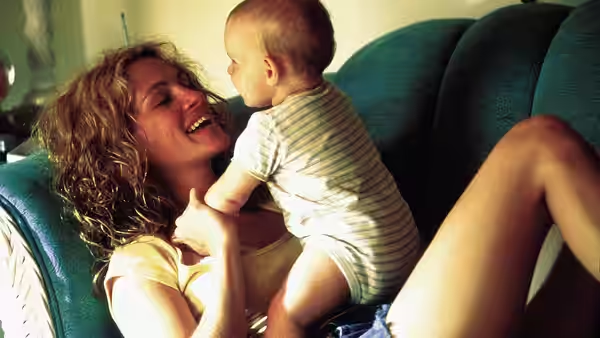
Here is what got us. Erin is in a motel in Hinkley, and George rings to tell her that their youngest has said her first word, and Erin was not there to hear it. Roberts does almost nothing with her face. We were moved more than we expected to be, because the film has spent an hour making the case matter and it now spends thirty seconds pointing out what it is costing. Marg Helgenberger, as the first Hinkley mother Erin sits down with, does similar work: a woman explaining her family’s tumours in the tone of someone giving directions.
The weaknesses are the ones the material invites. The company’s lawyers are cardboard, and Veanne Cox’s Theresa Dallavale, a lawyer from a bigger firm who is set up as a rival, is dispatched in a single exchange written to be applauded. Susannah Grant’s script is never in any doubt about who is right, and the second half repeats its own shape: Erin drives out, a family tells its story, Erin drives back and shouts at Ed. At 131 minutes we felt the length around the two-hour mark. There is also a late arrival, played by Tracey Walter, whose timing is a little too convenient, and we will say no more about him.
After Out of Sight (1998), this is Soderbergh’s simplest film, and that looks like a choice rather than a lapse. He has a star and a true story, and he trusts both enough not to decorate them. It carries a 15 certificate, mostly for the language, and the language is the point. Watch it with someone who still thinks Julia Roberts is only a smile; they will be quiet by the end of the first reel.