Sharon Stevens (Hilary Swank) in a knit hat and winter coat outdoors in falling snow
Film review

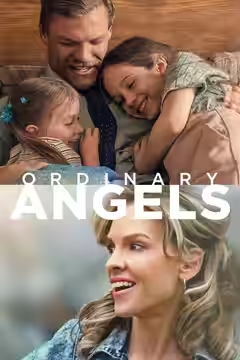
Ordinary Angels

2024 · Directed by Jon Gunn · 1h 58m

In a sentenceHilary Swank harangues Louisville into decency for two hours while a string section reminds us it counts

Louisville, Kentucky, in the early 1990s. Sharon Stevens (Hilary Swank) runs a hair salon with her friend Rose (Tamala Jones), drinks too much and is not speaking to her grown son. In the newspaper she reads about Ed Schmitt (Alan Ritchson), a roofer whose wife Theresa (Amy Acker) has just died and whose younger daughter Michelle (Emily Mitchell) needs a liver transplant the family cannot pay for. Sharon turns up at the funeral uninvited, then at the house, where Ed’s mother Barbara (Nancy Travis) and older daughter Ashley (Skywalker Hughes) do not know what to make of her. Ed does not want help. Sharon organises a fundraising day at the salon anyway, and starts on the hospital bills.

Plays from YouTube when you press play; nothing loads from them until then.

Fi1m review

Jon Gunn’s true-story drama has two good performances, from Hilary Swank and Alan Ritchson, and a script that smooths everything they do. Sincere and decent, it never once asks why a roofer needs charity to keep his daughter alive.

Ordinary Angels tells a true story from Louisville, Kentucky, and it tells it the way such stories are usually told: a stranger with a flaw, a family in trouble, a town that comes good. Jon Gunn directs from a script by Kelly Fremon Craig and Meg Tilly, and for 118 minutes it is sincere, competent and safe. Two performances lift it above the run of the genre. The writing keeps them on a short lead.

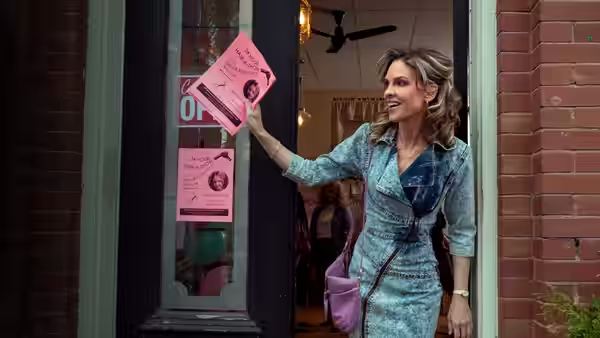
Hilary Swank plays Sharon Stevens as a woman who has never once lowered her voice. She is a hairdresser with a perm the size of a lampshade, a drink problem she is not treating and a son, Derek (Dempsey Bryk), who no longer takes her calls. Swank does not soften her. The pushiness that gets doors opened is the same pushiness that empties rooms, and the film’s best scenes are the ones where Ed’s mother Barbara (Nancy Travis) looks at this stranger in her kitchen and plainly wants her gone. Swank has not had a part this good for some time, and she works it hard.

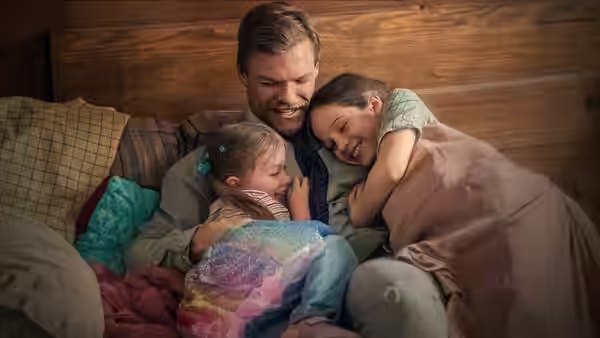
Alan Ritchson, known for playing the giant in Reacher, is the surprise. Ed Schmitt is a roofer who has just buried his wife, Theresa (Amy Acker), and cannot pay the hospital that treated her, let alone the one that will have to treat their younger daughter, Michelle (Emily Mitchell). Ritchson plays him small. He sits at a kitchen table with a stack of envelopes and does not open them, and there is a phone call about a bill in which he says almost nothing, and we were more moved than we had expected to be by a man that size failing to speak. It is the one stretch of the film that trusts silence.

Maya Bankovic shoots Louisville in two colours: the amber of the salon and the church hall, and the grey of the hospital car park and the roofs Ed works on in the cold. Nazgol Goshtasbpour’s Schmitt house is cramped and lived in, coats on every hook, and Heather Neale puts Sharon in leopard print and shoulder pads so that she never matches a room she walks into, which is the point. Pancho Burgos-Goizueta’s score is the problem. It arrives early in every scene, piano then strings, to tell us how the scene will end, and it is right every time. Parker Adams cuts the fundraising as montage, haircuts and cheques and church notices, so the money comes in fast, and the middle hour is mostly people being kind at speed.

What the script will not do is ask the obvious question. A roofer’s child needs a new liver and the family’s route to it is a hairdresser going door to door. The film treats this as uplifting. Sharon marches into a hospital billing office and talks a debt down, and it is played as a victory, and we sat there wondering why the debt existed. Every time Ed’s situation might become an argument about anything larger than Ed, a casserole arrives.

There is also Sharon’s own story, which the script sets up carefully and then resolves in about four minutes. Her drinking, her son, the meetings she attends with Rose (Tamala Jones) beside her: these are the reasons she needs this family, and the film says so in a speech rather than letting us see it. The last half hour, set in a snowstorm, we will not describe, except that it is well staged, goes on longer than it needs to, and is scored as if we might not know a blizzard is serious.

Against the usual standard of the inspirational true-story drama, this is a cut above: the acting is better, the church is present without preaching, and nobody is a villain. Against the standard of a drama, it is thin. We believed the family and we admired the two leads; we did not believe the town, which comes round on cue and in the right order. Most critics have been a little warmer than we are. If the genre is yours, it will do the job it promises, and you will know how it ends about twenty minutes in.


Critical consensus AI synthesised

62
Positive
4
Mixed
4
Negative
2

Most critics find Ordinary Angels a decent, old-fashioned true-story drama, and even those who resist it concede the real events are hard to argue with. The praise clusters almost entirely on Hilary Swank, whose performance is called nuanced, forceful and naturalistic by reviewers on both sides of the verdict. Alan Ritchson gets credit from several for carrying the dramatic weight opposite her.

The reservations are about everything around the performances. The film is called predictable, sentimental and too long, and more than one critic notes that it skirts the healthcare politics behind the family’s crisis; Empire says that leaves the viewer angrier than inspired. The spread is wide, running from outright enthusiasm to dismissal. The Los Angeles Times is the sharpest dissenter, arguing the film is less affecting than the story it is based on because Sharon’s motivations never convince.

The Hollywood Reporter
20 February 2024 · Frank Scheck
90*

Scheck finds the true-story drama irresistible and inspirational despite its predictable elements. He praises Hilary Swank’s forceful, nuanced performance and says the rousing finale will have audiences cheering.

Read the full review →
Variety
20 February 2024 · Courtney Howard
78*

Howard finds the film sentimental but ultimately moving, with its community-minded story winning over even cynics. She especially praises Hilary Swank’s nuanced, naturalistic performance, while noting that the score and some heavy-handed explanations weaken the film.

Read the full review →
The Guardian
23 April 2024 · Catherine Bray
65*

Bray finds the film effective as an old-fashioned character drama, though it sidesteps the politics behind the family’s crisis. She particularly praises Alan Ritchson’s dramatic performance.

Read the full review →
The New York Times
22 February 2024
64*

The page is identified as a review of the film, but its text is inaccessible. The critic’s verdict and specific praise or complaint cannot be determined.

Read the full review →
IndieWire
22 February 2024 · C · David Ehrlich
57

Ehrlich finds the faith-based drama an interesting change of pace, though not a good film. He praises Hilary Swank’s credible desperation while criticizing the story’s omissions and implausibilities.

Read the full review →
Empire
25 April 2024 · Helen O'Hara
45*

The review finds the story touching but too flat to make a fully compelling drama, and says its healthcare critique leaves the viewer more furious than inspired. It praises the solid performances and heartbreaking setup, while noting that the film’s sermonising is mostly restrained.

Read the full review →

Straight answers AI written, from our review

Is Ordinary Angels worth watching?
Ordinary Angels is a sincere, competent true-story drama that we scored 56: worth an evening only if the inspirational genre is already yours. Hilary Swank and Alan Ritchson are both better than the script around them, which smooths every difficulty and tells you how each scene ends about twenty minutes before it does.
How long is Ordinary Angels, and what is it rated?
Ordinary Angels runs 1h 58m. It is a drama film.
Where can I watch Ordinary Angels in South Africa?
Ordinary Angels is available to rent from Apple TV from R34.99. Availability is checked daily; the links above go straight to each service.
How violent or frightening is Ordinary Angels, and is it suitable for children?
Ordinary Angels carries a UK 12A certificate and contains no violence to speak of; it is a drama about a bereaved family, a sick child and a hairdresser with a drink problem. Older children who can sit through two hours of hospital bills, grief and a long snowstorm should be fine, though there is little here for the young.
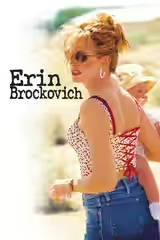
How does Ordinary Angels compare to Erin Brockovich?
Ordinary Angels and Erin Brockovich both follow a loud woman nobody wants to listen to, but Soderbergh's film knows why she is angry and what she is fighting, while Gunn's treats a hairdresser talking down a hospital debt as pure uplift and never asks why the debt exists. Both are predictable; the earlier film is the shrewder and the better of the two.
What should I watch after Ordinary Angels?
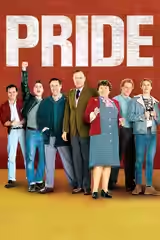
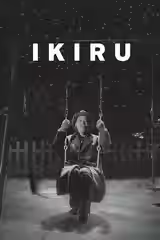
After Ordinary Angels, try Erin Brockovich (2000, Fi1m 78): A loud woman nobody wanted to listen to, and a script that knows why she is angry. Then Pride (2014, Fi1m 82): Strangers raising money for people who did not ask, and the politics left in; and Ikiru (1952, Fi1m 92): One ordinary person decides to do one useful thing before the end; quiet and unforgettable.

Cast

If you liked this, try…

  1. Erin Brockovich (2000, Fi1m 78)A loud woman nobody wanted to listen to, and a script that knows why she is angry.

  2. Lorenzo's Oil (1992) · not on Fi1m yetParents fighting a hospital system for a sick child, with the medicine taken seriously.

  3. Pride (2014, Fi1m 82)Strangers raising money for people who did not ask, and the politics left in.

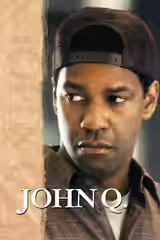
  4. John Q (2002) · not on Fi1m yetThe same father, the same bill, and a film willing to be furious about it.

  5. Ikiru (1952, Fi1m 92)One ordinary person decides to do one useful thing before the end; quiet and unforgettable.