Dense green tree canopy surrounds a narrow path visible through the branches
Film review

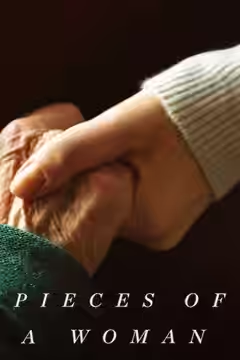
Pieces of a Woman

2020 · Directed by Kornél Mundruczó · 2h 07m

In a sentenceVanessa Kirby makes grief painfully clear; the music keeps asking if we have understood

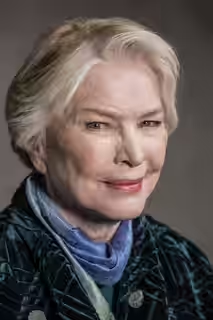
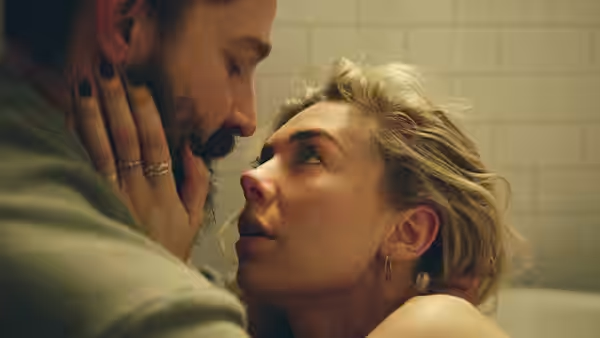
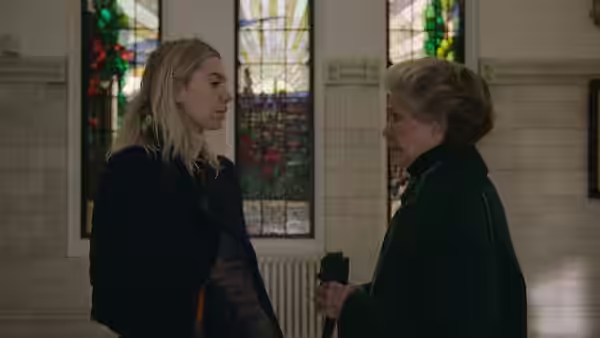
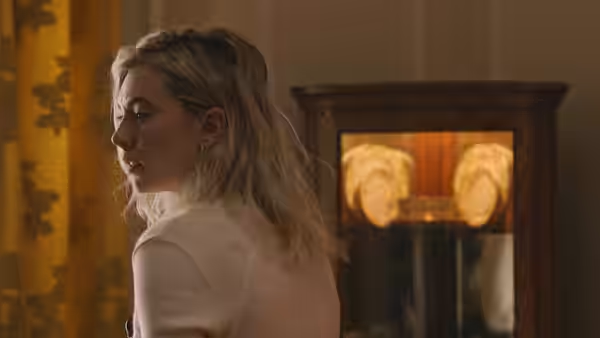
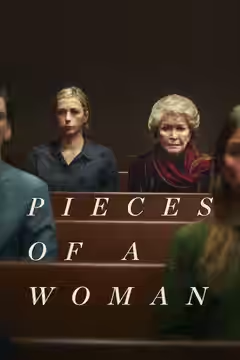
Martha Weiss (Vanessa Kirby) gives birth and loses her infant. Afterwards, she tries to continue her life while living with the loss. Sean Carson (Shia LaBeouf) and Elizabeth Weiss (Ellen Burstyn) are among those caught in the aftermath, as bereavement puts pressure on her marriage and family. Her grief is not always visible, and it does not arrive in a form she can readily explain or share. The physical demands of childbirth give way to the daily difficulty of carrying on among people who are also affected by what has happened.

Plays from YouTube when you press play; nothing loads from them until then.

Fi1m review

A harrowing opening and Vanessa Kirby’s precise performance make this uneven grief drama worth considering, though its later melodrama repeatedly tells us what to feel.

Pieces of a Woman is worth considering for Vanessa Kirby, provided there is an appetite for a difficult drama that becomes frustratingly emphatic. Director Kornél Mundruczó and writer Kata Wéber follow a woman through childbirth, infant loss and the grief that unsettles her marriage. They begin by asking us to stay with a physical ordeal, then struggle to make the aftermath equally persuasive. The acting remains compelling when the writing becomes overbearing.

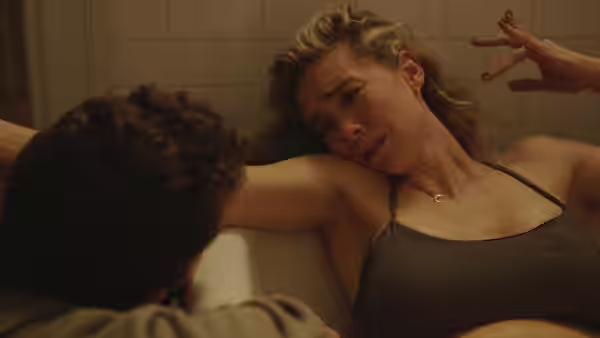
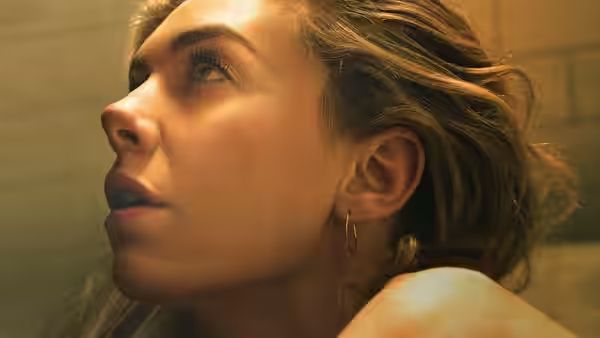
The opening childbirth sequence gives cinematographer Benjamin Loeb a demanding job: sustain our attention without the relief of a visible cut. The uninterrupted shot works because we keep looking at the woman giving birth, rather than congratulating the camera for staying with her. We were frightened by the bodily effort of it, and by the sense that there was no opportunity to step away. The performance supplies the urgency, and the length of the shot allows it to build.

Once Martha Weiss is grieving, her restraint becomes the film’s chief strength. She does not make every feeling immediately available, and we never took that difficulty as a failure to communicate. The performance makes the exhaustion of carrying on understandable without turning every moment into a lesson about bereavement. This asks for patience from an audience, and for long stretches the film is willing to wait alongside her.

Shia LaBeouf and Ellen Burstyn bring force to the surrounding domestic drama, but the confrontations are less convincing than the actors within them. Kata Wéber’s screenplay increasingly gives the distress a familiar melodramatic shape. We can believe the pain and still find the way it is presented too deliberate. The quieter acting has already made the suffering intelligible, so the more emphatic passages feel unnecessary.

Dávid Jancsó’s editing cannot quite make the later passages feel as concentrated as the opening. After that sustained stretch of childbirth, the movement through the grief becomes scattered, and the domestic drama loses momentum. This is more than the inevitable lowering of intensity after such an ordeal: individual scenes ask for emotion without always earning it from what precedes them. There is room for a slower pace here, but too often we become conscious of the scenes being arranged to produce a response.

Howard Shore’s score adds pressure where the actors need space, insisting on sadness that is already clear. Sylvain Lemaitre’s production design is less distracting, although the domestic scenes can feel arranged for confrontation rather than lived in. The settings never pull our attention away from the performances, which is welcome when so much else is competing for it. Too often, though, the staging and music make us conscious of the effort to move us.

As a grief drama, it is strongest when it allows sorrow to be awkward and difficult to read. Its attempts to make that sorrow more legible are the chief reason we hesitate to recommend it without qualification. The performance at its centre deserves attention, but the uneven writing makes 127 minutes feel longer than they need to. Choose it for the acting, and only if infant loss is something you are willing to sit with tonight.

Critical consensus AI synthesised

64
Positive
12
Mixed
11
Negative
3

The consensus is cautiously favourable, with positive and mixed reviews nearly level. Vanessa Kirby draws the most consistent praise for a performance that makes grief felt through restraint as well as raw distress, including from critics unconvinced by the film around her. The opening childbirth sequence is another recurring strength: many reviews find its uninterrupted take harrowing and technically assured. More sympathetic critics see an emotionally complex drama whose performances carry it through the heavier passages.

Reservations cluster around heavy-handed symbolism, contrived melodrama and a failure to sustain the opening’s force. Several reviews find the later scenes too conventional or the resolution too neat for the grief portrayed earlier. The spread is wide, reaching from deeply moved approval to doubts about whether the film earns its emotion. The New Yorker offers the sharpest dissent, finding the drama hollow and overblown and the much-praised opening take ultimately pointless.

Evening Standard
8 January 2021 · Charlotte O'Sullivan
85*

O’Sullivan gives the film a strongly positive review, despite some melodramatic moments and metaphors that feel overdone. She especially praises Vanessa Kirby’s raw, compelling performance as a grieving mother.

Read the full review →
Radio Times
★★★★ · Hanna Flint
80

Flint describes the drama as heartbreaking and powerfully performed. She singles out Vanessa Kirby’s robust, unflinching performance as its strength.

Read the full review →
Little White Lies
festival review · Hannah Strong
78*

Strong finds the film delicate and devastating, while noting a few heavy-handed moments. She especially praises Vanessa Kirby’s emotionally restrained performance and the film’s empathetic portrayal of grief after infant loss.

Read the full review →
The i Paper
8 September 2020 · festival review · James Mottram
78*

The critic finds the film harrowing and devastating, despite an excessively twee postscript. Vanessa Kirby’s powerhouse performance is singled out as career-best, with Shia LaBeouf and Ellen Burstyn also praised.

Read the full review →
Empire
4 January 2021 · Terri White
75*

White finds the film powerful but says its courtroom scene and symbolism weaken its otherwise stark approach. She singles out Vanessa Kirby’s breathtaking performance, especially in the intense childbirth sequence.

Read the full review →
Variety
5 September 2020 · Peter Debruge
75*

Debruge finds the film a mature, masterfully acted drama, though its melodrama and symbolism sometimes feel overdone. He especially praises Vanessa Kirby’s nuanced performance and the remarkable childbirth sequence.

Read the full review →

Straight answers AI written, from our review

Is Pieces of a Woman worth watching?
Pieces of a Woman is worth considering for Vanessa Kirby’s precise performance and its harrowing opening; we score it 66 out of 100. It suits viewers willing to sit with a difficult drama about infant loss, though the later melodrama and insistent music too often tell us what the acting has already made clear.
How long is Pieces of a Woman, and what is it rated?
Pieces of a Woman runs 2h 07m. It is a drama film.
Where can I watch Pieces of a Woman in Ukraine?
Pieces of a Woman is streaming on Netflix in Ukraine. Availability is checked daily; the links above go straight to each service.
How violent or frightening is Pieces of a Woman, and is it suitable for children?
Pieces of a Woman has a UK 15 certificate and is not suitable for children, with a sustained childbirth sequence and infant loss making it emotionally demanding. We found the opening frightening because of its bodily effort and uninterrupted attention; these subjects warrant particular caution for teenagers and anyone sensitive to childbirth or bereavement.
How does Pieces of a Woman compare to Rabbit Hole?
Pieces of a Woman is more emphatic than Rabbit Hole, which we recommend more readily for its restraint and room for awkwardness, anger and everyday interruptions. Kirby’s performance and the frightening childbirth sequence give Pieces of a Woman force, but its later melodrama presses too hard; Rabbit Hole offers sharp humour and convincing compassion, despite occasionally feeling too carefully presented.
What should I watch after Pieces of a Woman?
After Pieces of a Woman, try Rabbit Hole (2010, Fi1m 76): Another bereaved couple, with more room for awkwardness, anger and everyday interruptions. Then The Son's Room (2001, Fi1m 82): An Italian family drama that gives mourning time without prescribing its proper shape; and Ordinary People (1980, Fi1m 81): Family grief becomes difficult conversation, with the performances making every evasion count.

Cast

If you liked this, try…

  1. Rabbit Hole (2010, Fi1m 76)Another bereaved couple, with more room for awkwardness, anger and everyday interruptions.

  2. The Son's Room (2001, Fi1m 82)An Italian family drama that gives mourning time without prescribing its proper shape.

  3. Maborosi (1995) · not reviewed yetFor a quieter account of bereavement, built around distance and patient observation.

  4. Ordinary People (1980, Fi1m 81)Family grief becomes difficult conversation, with the performances making every evasion count.

  5. A Woman Under the Influence (1974, Fi1m 86)A demanding domestic drama with a central performance worth enduring the discomfort.