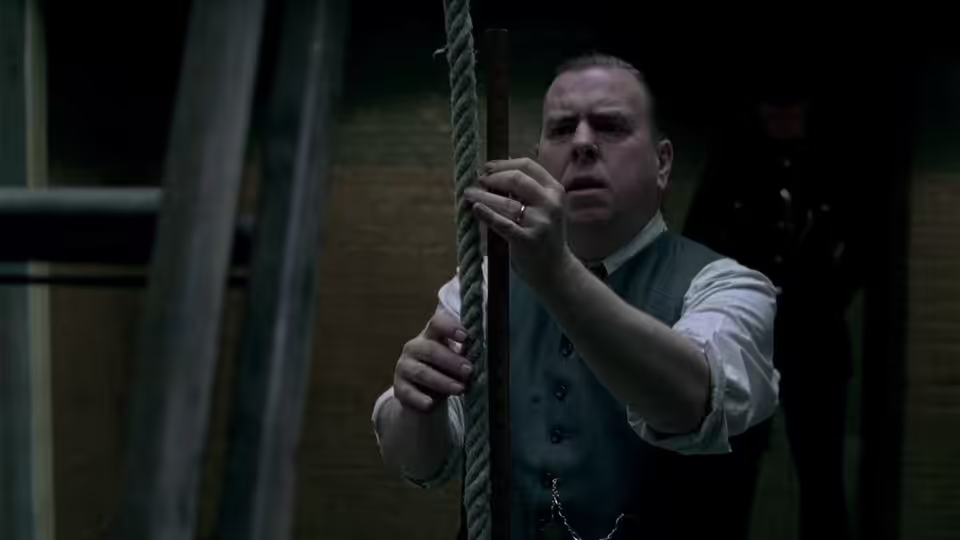
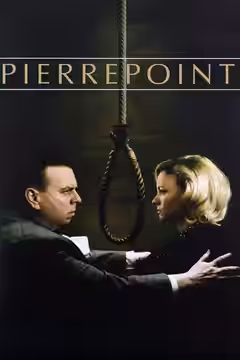
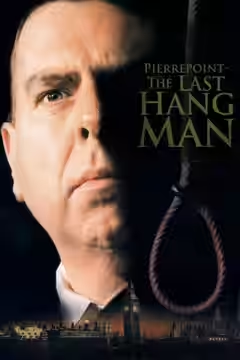
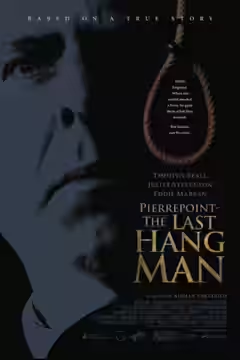
Timothy Spall is the reason to watch: a methodical, courteous man who hangs people for the state and takes pride in doing it well. The film around him is sober and grey and, towards the end, too keen to tell us what to think.
Adrian Shergold’s film, written by Bob Mills and Jeff Pope, is about a man who hanged people for the British state for most of his adult life and thought of it as a trade. Albert Pierrepoint did it quickly, did it cleanly, and went home. The film’s question is whether a man can do that and keep the rest of himself untouched, and for about an hour it asks the question properly. Then it starts answering it for us, which is a lesser thing.
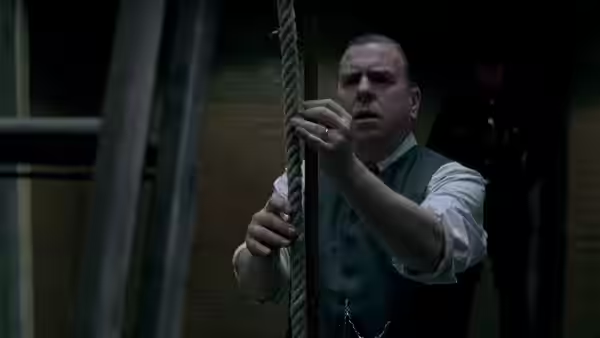
Timothy Spall is the reason it works at all. He plays Pierrepoint heavy and soft-voiced, a man in a bowler and a good overcoat (Mary-Jane Reyner keeps him respectable and slightly out of date) who looks at a prisoner through the spyhole the way a tailor looks at a customer: height, weight, neck. He does the arithmetic on a slip of paper. Afterwards he washes the body himself and will not have it mocked; the man has paid, he says, and is innocent now. Spall plays the pride without winking at it. It is a quiet performance and a stubborn one, and the film is at its best when it lets him get on with the work.
Juliet Stevenson’s Annie gets less to do and does it well. She works out what her husband does long before he tells her, and the scene in which she lets him know she knows, over a meal, with the kettle on, is played by both of them almost entirely in pauses. She does not forgive him. She stays, and keeps the house.
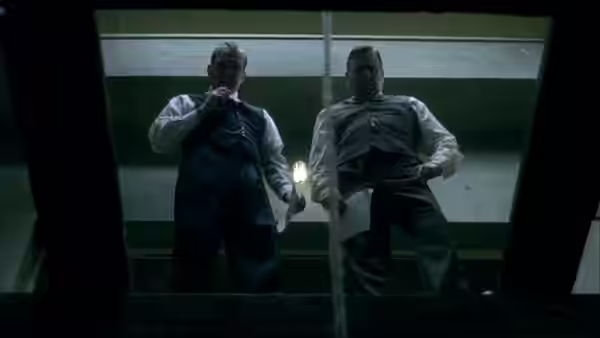
The executions are where the film gets at us. Candida Otton’s condemned cell has a wardrobe along one wall, and when the morning comes the wardrobe swings aside and the gallows is in the next room, a few steps away. Tania Reddin cuts each hanging to its parts, the door, the strap, the white cap, the lever, the drop, and it is finished in less time than it takes to read this sentence. We were horrified, and nothing bloody is shown. It was the speed that did it, a man removed from the world with the efficiency of a parcel being posted, and the film is honest enough to make us see that this is Pierrepoint’s achievement and his boast. Danny Cohen shoots it in gaslight browns and prison greys, and Martin Phipps keeps the score to a few low notes and mostly out of the way.
The middle stretch, when the army flies Pierrepoint to Germany after the war to deal with the Belsen guards under Lieutenant Llewelyn (Tobias Menzies), is the film’s clearest idea. Irma Grese (Sheyla Shehovich) and Elizabeth Volkenrath (Joyia Fitch) are led in one after another, in batches, and the hangman becomes a public man, named in the papers and cheered in pubs. The country wanted somebody to do this and then wanted to admire him for it. Shergold does not labour the point, and Ann Bell’s Violet Van Der Elst, shouting abolition through a loudhailer outside the prison gates, is allowed to be a nuisance rather than a prophet.
Then the film stops trusting us. The pub strand, in which Pierrepoint sings duets with a drinking friend called Tish (Eddie Marsan, kindly and sad), is set up so plainly that you can feel where it is going from the first chorus, and when it gets there Mills and Pope stop relying on Spall’s face and start writing speeches. A late scene with a Minister (Simon Armstrong) says in words what the hangings had already shown. The last half hour has the air of a case being summed up to a jury. It also looks, throughout, like well-made television: tight interiors, a lot of two-shots, nothing a big screen adds much to.
As a British true-crime drama it sits beside 10 Rillington Place (1971), which follows a case Pierrepoint ended in real life, and it is a smaller, tidier film than that one. The reviews so far are split between those who find it preachy and those who find it brave, and we would say it is both: brave for an hour, preachy for the last thirty minutes, and carried past the join by Spall.
Watch it for him, at home, in one sitting. At 98 minutes it does not need pausing, and the 15 certificate is for what you will imagine rather than what you will see.