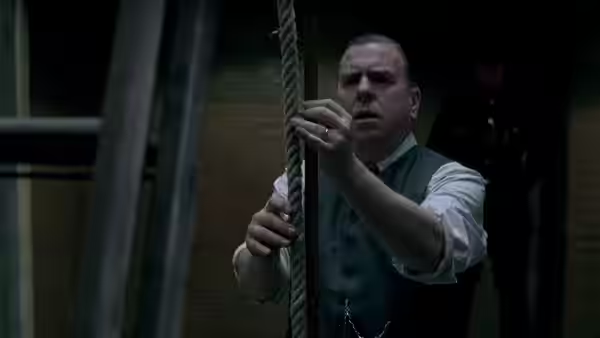
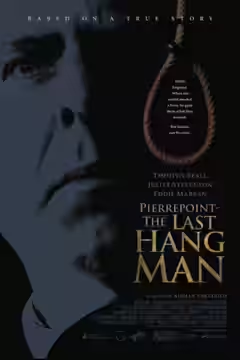
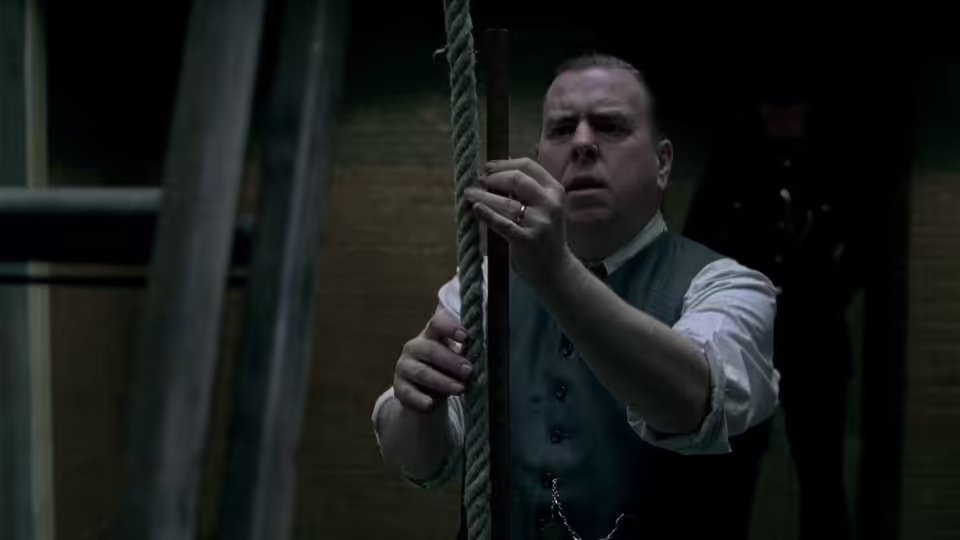
Albert Pierrepoint (Timothy Spall) adjusts a hanging rope in the execution chamber
Film review

Pierrepoint: The Last Hangman

2005 · Directed by Adrian Shergold · 1h 38m

In a sentenceSpall measures men for the drop like a tailor fitting a suit, and never once looks away

Northern England in the 1930s. Albert Pierrepoint (Timothy Spall) delivers groceries by day and writes to the Prison Commissioners asking to be trained as an executioner, the trade his father and his uncle followed before him. He tells nobody, least of all his wife Annie (Juliet Stevenson), who notices the money and the absences and asks no questions. At Strangeways he learns the arithmetic: the condemned man’s weight and height, the length of the drop, the strap, the cap, the lever, all of it to be done in seconds. He is quick, exact and courteous to the dead, and he is soon in demand. At the pub he drinks with Tish (Eddie Marsan), who sings with him and knows nothing. Then the war ends and the army sends for him.

Plays from YouTube when you press play; nothing loads from them until then.

Fi1m review

Timothy Spall is the reason to watch: a methodical, courteous man who hangs people for the state and takes pride in doing it well. The film around him is sober and grey and, towards the end, too keen to tell us what to think.

Adrian Shergold’s film, written by Bob Mills and Jeff Pope, is about a man who hanged people for the British state for most of his adult life and thought of it as a trade. Albert Pierrepoint did it quickly, did it cleanly, and went home. The film’s question is whether a man can do that and keep the rest of himself untouched, and for about an hour it asks the question properly. Then it starts answering it for us, which is a lesser thing.

Timothy Spall is the reason it works at all. He plays Pierrepoint heavy and soft-voiced, a man in a bowler and a good overcoat (Mary-Jane Reyner keeps him respectable and slightly out of date) who looks at a prisoner through the spyhole the way a tailor looks at a customer: height, weight, neck. He does the arithmetic on a slip of paper. Afterwards he washes the body himself and will not have it mocked; the man has paid, he says, and is innocent now. Spall plays the pride without winking at it. It is a quiet performance and a stubborn one, and the film is at its best when it lets him get on with the work.

Juliet Stevenson’s Annie gets less to do and does it well. She works out what her husband does long before he tells her, and the scene in which she lets him know she knows, over a meal, with the kettle on, is played by both of them almost entirely in pauses. She does not forgive him. She stays, and keeps the house.

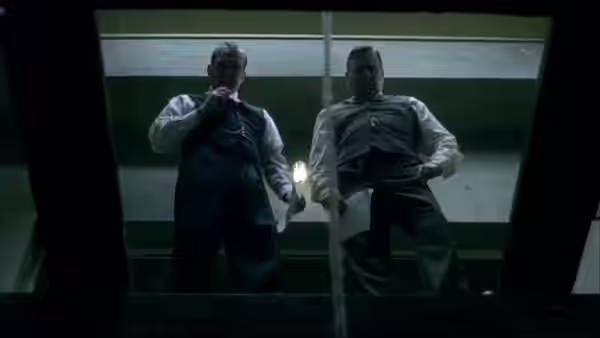
The executions are where the film gets at us. Candida Otton’s condemned cell has a wardrobe along one wall, and when the morning comes the wardrobe swings aside and the gallows is in the next room, a few steps away. Tania Reddin cuts each hanging to its parts, the door, the strap, the white cap, the lever, the drop, and it is finished in less time than it takes to read this sentence. We were horrified, and nothing bloody is shown. It was the speed that did it, a man removed from the world with the efficiency of a parcel being posted, and the film is honest enough to make us see that this is Pierrepoint’s achievement and his boast. Danny Cohen shoots it in gaslight browns and prison greys, and Martin Phipps keeps the score to a few low notes and mostly out of the way.

The middle stretch, when the army flies Pierrepoint to Germany after the war to deal with the Belsen guards under Lieutenant Llewelyn (Tobias Menzies), is the film’s clearest idea. Irma Grese (Sheyla Shehovich) and Elizabeth Volkenrath (Joyia Fitch) are led in one after another, in batches, and the hangman becomes a public man, named in the papers and cheered in pubs. The country wanted somebody to do this and then wanted to admire him for it. Shergold does not labour the point, and Ann Bell’s Violet Van Der Elst, shouting abolition through a loudhailer outside the prison gates, is allowed to be a nuisance rather than a prophet.

Then the film stops trusting us. The pub strand, in which Pierrepoint sings duets with a drinking friend called Tish (Eddie Marsan, kindly and sad), is set up so plainly that you can feel where it is going from the first chorus, and when it gets there Mills and Pope stop relying on Spall’s face and start writing speeches. A late scene with a Minister (Simon Armstrong) says in words what the hangings had already shown. The last half hour has the air of a case being summed up to a jury. It also looks, throughout, like well-made television: tight interiors, a lot of two-shots, nothing a big screen adds much to.

As a British true-crime drama it sits beside 10 Rillington Place (1971), which follows a case Pierrepoint ended in real life, and it is a smaller, tidier film than that one. The reviews so far are split between those who find it preachy and those who find it brave, and we would say it is both: brave for an hour, preachy for the last thirty minutes, and carried past the join by Spall.

Watch it for him, at home, in one sitting. At 98 minutes it does not need pausing, and the 15 certificate is for what you will imagine rather than what you will see.

Critical consensus AI synthesised

51
Positive
1
Mixed
1
Negative
2
Slant Magazine
29 May 2007 · ★★/4 · Nick Schager
50

Schager finds the film initially compelling but ultimately preachy, arid, and contrived. He praises Timothy Spall’s nuanced performance, especially its quiet portrayal of Pierrepoint’s inner struggle.

Read the full review →
Time Out
2 July 2007 · ★★ · Margaret Lyons
40

The page identifies this as a review, but its review text is unavailable. The critic’s verdict and any specific praise or complaint cannot be determined from the provided page data.

Read the full review →
Empire
31 March 2006 · David Hughes
35*

Hughes finds the performances strong but concludes that the underwritten screenplay and made-for-TV production leave the film wanting. He singles out Timothy Spall and Juliet Stevenson for excellent, understated performances.

Read the full review →
Eye for Film
1 March 2006 · Jennie Kermode
90*

Kermode calls the film a brave, intelligent triumph that should not be missed. She especially praises Timothy Spall’s nuanced performance and the film’s unsettling exploration of moral responsibility around capital punishment.

Read the full review →

Straight answers AI written, from our review

Is Pierrepoint: The Last Hangman worth watching?
Pierrepoint: The Last Hangman is worth watching for Timothy Spall, and we scored it 66. He plays Britain's hangman as a courteous tradesman who takes pride in doing the job quickly, and the film is at its best when it lets him work. The last half hour starts telling us what to think, so it suits the patient viewer more than the casual one.
How long is Pierrepoint: The Last Hangman, and what is it rated?
Pierrepoint: The Last Hangman runs 1h 38m. It is a drama and history film.
Where can I watch Pierrepoint: The Last Hangman in Türkiye?
Pierrepoint: The Last Hangman is not on any streaming or rental service in Türkiye at the moment. It is available in 2 other countries; change your country at the top of the page to see where. Availability is checked daily.
How violent or frightening is Pierrepoint: The Last Hangman, and is it suitable for children?
Pierrepoint: The Last Hangman carries a UK 15 certificate and is not for children. Nothing bloody is shown, but each hanging is cut to its parts, the strap, the cap, the lever, the drop, and the speed of it horrified us. The certificate is for what you will imagine rather than what you will see; the squeamish should still expect to be shaken.
How does Pierrepoint: The Last Hangman compare to Dead Man Walking?
Pierrepoint: The Last Hangman is the smaller, cooler film of the two, built around one man's trade rather than an argument between a nun and a killer. Dead Man Walking earns more emotion through Susan Sarandon and Sean Penn, though its debate is sometimes too carefully arranged. We recommend the American film more warmly; the British one is for those who want Spall and a sober, grey study of a job.

Cast

If you liked this, try…

  1. 10 Rillington Place (1971) · not on Fi1m yetThe same gallows seen from the condemned cell, with Richard Attenborough quietly dreadful.

  2. Dance with a Stranger (1985) · not on Fi1m yetRuth Ellis before the courtroom, with Miranda Richardson in a fury of lipstick.

  3. A Short Film About Killing (1988) · not on Fi1m yetKieślowski’s Polish execution drama, filtered green and sick, makes the state’s violence look like murder.

  4. Dead Man Walking (1995, Fi1m 84)The American argument, made through a nun and a killer, without letting either off.

  5. Mr. Turner (2014) · not on Fi1m yetSpall again, grunting through another trade he is better at than anyone.