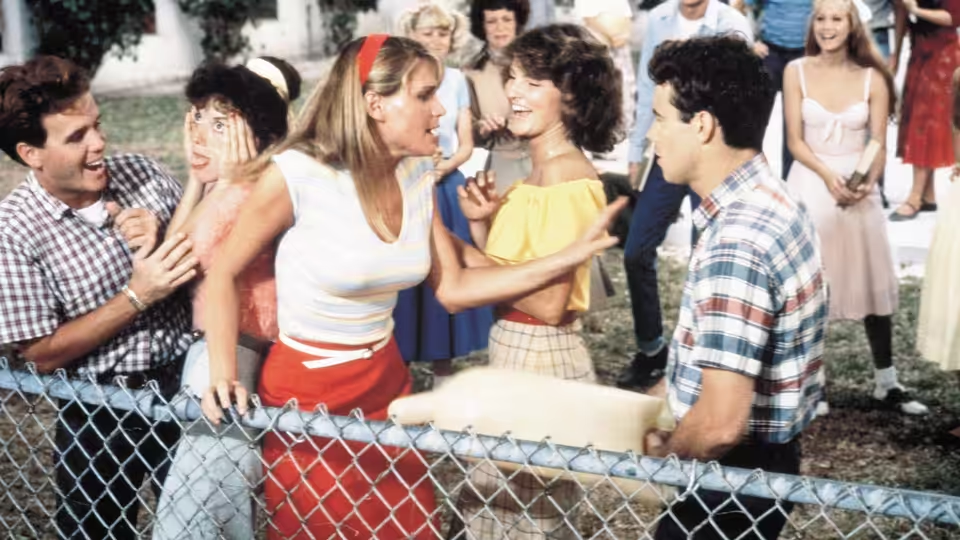
Bob Clark’s high-school farce has two or three set pieces that are properly funny and a great deal around them that is not, and its idea of a good time has aged badly. Nancy Parsons is the reason to stay.
Bob Clark made Black Christmas in 1974 and A Christmas Story in 1983, and in between he made this: 94 minutes of boys in Angel Beach, Florida, in 1954, trying to lose their virginity and being punished for it by every adult in the county. Porky’s is crude, it is sometimes funny, and it has dated in ways that are hard to laugh past. We can see why it was a phenomenon. We are less sure it deserves to still be one.
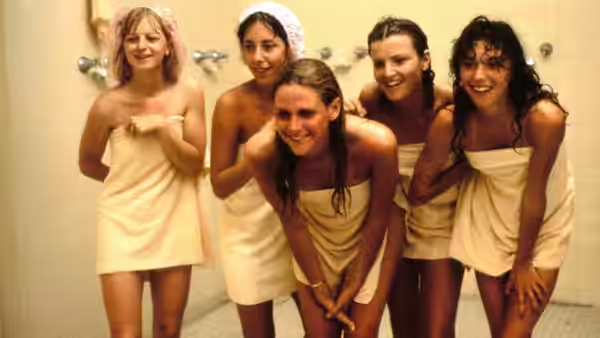
The set pieces are the point and the best of them are built with real care. The Cherry Forever evening, in which the older boys set the younger ones up with a woman in a shack and then stage an interruption, is a proper farce, timed to the second and shot from the floor where the frightened are. Susan Clark plays Cherry with a bored professionalism that is funnier than anything the boys say. And then there is the principal’s office. Nancy Parsons’s Balbricker marches in, states what happened to her in the changing room, states what she grabbed and how she would know it again, and demands a line-up. We laughed out loud and were still laughing a minute later, which almost never happens to us. It is Parsons who does it, playing outrage as if it were grief, while Doug McGrath’s Coach Warren and most critics try to keep their faces straight and fail.
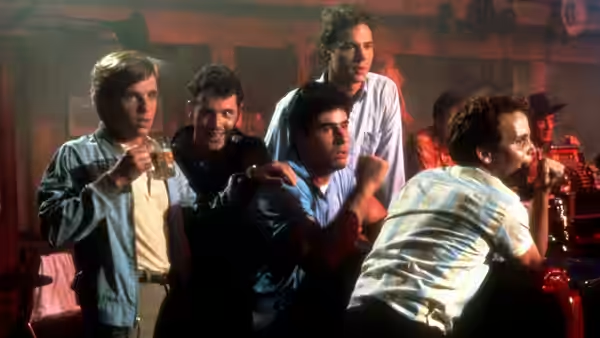
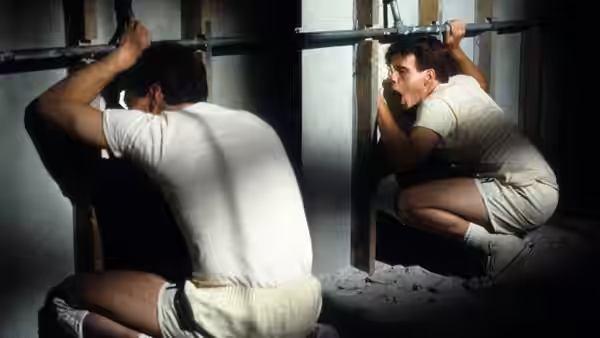
Reginald H. Morris shoots the daytime in flat, bright Florida sun, so that the school and the beach look like a holiday brochure, and saves his shadows for Porky’s itself. Reuben Freed builds the roadhouse as a long wooden barn over black water, lit red inside, with a floor you learn not to trust. Mary E. McLeod and Larry S. Wells put the boys in letterman jackets and rolled jeans, which does most of the work of telling us the year. Stan Cole cuts the big sequences from the wrong side of the wall, so we watch the boys watching rather than what they are watching, and that is the only reason the shower scene is bearable at all. Carl Zittrer and Paul Zaza’s music stays out of the way and lets the jukebox songs carry the period.
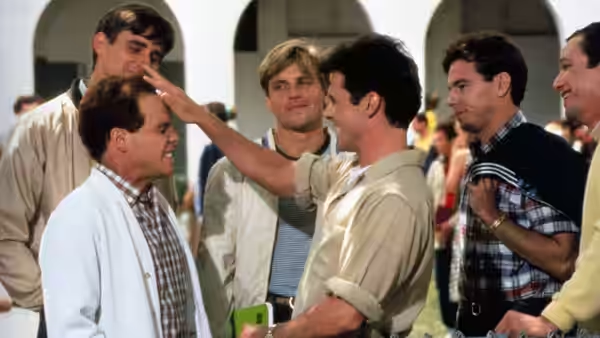
The trouble is everything between the set pieces. There are six boys and after an hour we could reliably tell apart three of them: Pee Wee because he is small and shouts, Meat because he is large, Tommy because he is the one who keeps going back to Porky’s. Mark Herrier’s Billy and Roger Wilson’s Micky are interchangeable, and the script gives them nothing to want except what everyone else wants. The girls are a wall with a hole in it. Kim Cattrall’s Honeywell has one scene in the gym and plays it with total commitment, and we admired her for it while noticing that the film had given her a nickname instead of a character. Kaki Hunter’s Wendy is the exception, dry and game and clearly brighter than any boy on screen, and the film keeps forgetting her.
Then there is Tim. Cyril O’Reilly plays him as a boy with a bigot for a father, and the film decides, around the middle, that this is where its heart is. A Jewish boy transfers in, Tim says the ugly things, and the matter is resolved in about four minutes with a fight and a handshake. Clark means it kindly. Meaning to say something is not the same as saying it, and dropping a serious subject into a film about peepholes and then picking it up again with so little weight leaves a worse taste than any of the jokes.
Against American Graffiti (1973) this is a step down in every department except nerve, and against Animal House (1978) it is less witty and less sure of who its idiots are. Against Clark’s own work it is the odd one: he had already shown he could frighten an audience and would soon show he could make them tender about a boy and a BB gun. Here he settles for making them snigger.
It carries an 18 and it is worth remembering that when the school holidays start. Watch it, if you watch it, for Clark, for Parsons, for the shack and the office, and skip forward through the rest. The gags that land are still landing; the film around them has not aged so much as gone off.