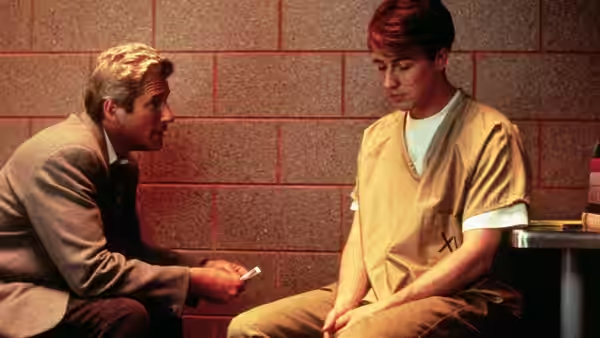
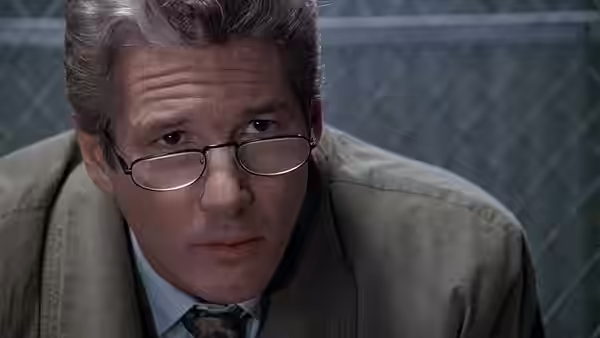
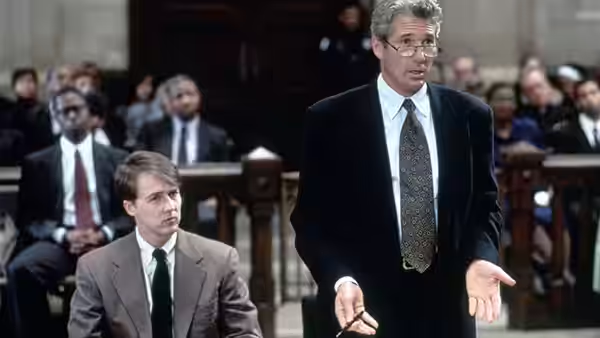
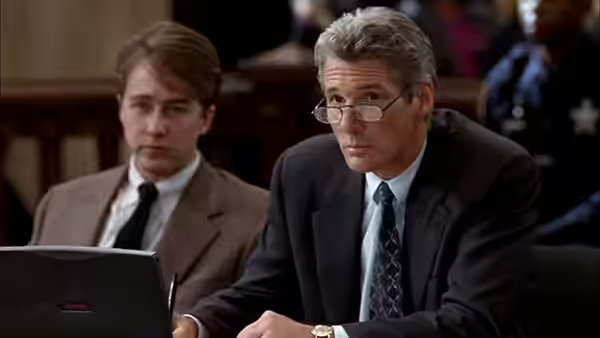
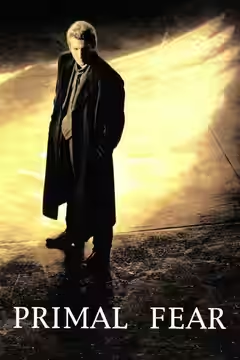
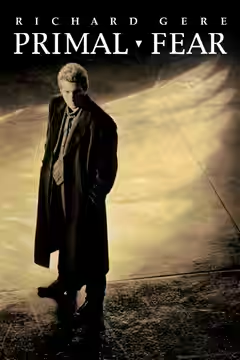
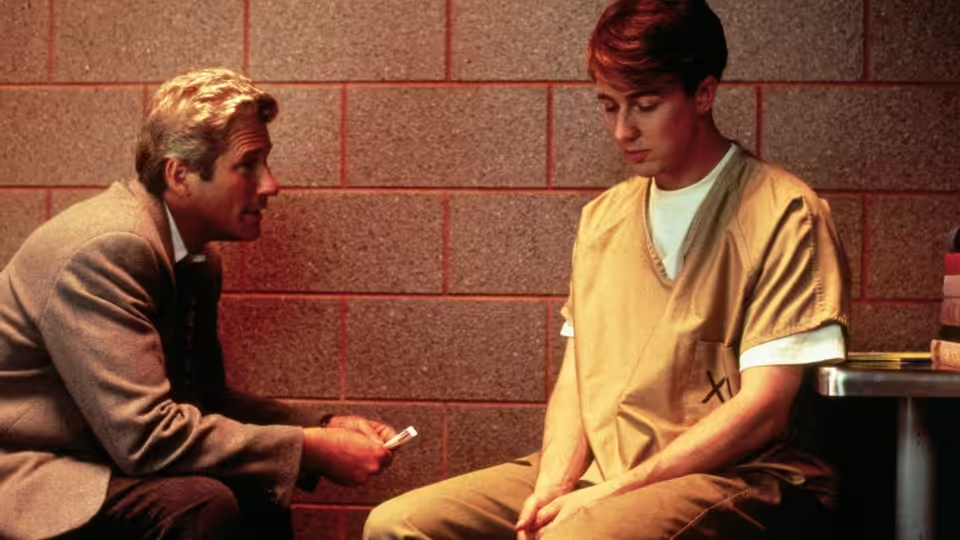
Martin Vail (Richard Gere) speaking with Aaron Stampler (Edward Norton) across a table
Film review

Primal Fear

1996 · Directed by Gregory Hoblit · 2h 10m

In a sentenceRichard Gere defends an altar boy for the publicity and a first-timer walks off with the film

Chicago. Archbishop Rushman (Stanley Anderson) is found butchered in his bedroom, and Aaron Stampler (Edward Norton), a stammering altar boy from Kentucky, is caught fleeing the cathedral with the archbishop’s blood on him. Martin Vail (Richard Gere), a celebrity defence attorney who has just posed for a magazine cover, takes the case for nothing because it is the biggest in town. Prosecuting is Janet Venable (Laura Linney), his former colleague and former lover, under State’s Attorney Shaughnessy (John Mahoney), who was once Vail’s boss and is now his enemy. Vail brings in psychiatrist Molly (Frances McDormand) to assess the boy, and sends his investigator Goodman (Andre Braugher) into the archbishop’s business dealings, which lead to a gangster client, Pinero (Steven Bauer), and towards City Hall.

Plays from YouTube when you press play; nothing loads from them until then.

Fi1m review

Gregory Hoblit’s first film is a smooth, handsome courtroom thriller that runs on rails, and the rails are visible. What lifts it is Edward Norton, in his first screen part, doing something in a holding cell that we have not forgotten.

Primal Fear is Gregory Hoblit’s first feature, and it knows exactly how long a scene should be. Working from William Diehl’s novel, with a screenplay by Steve Shagan and Ann Biderman, he puts a murdered archbishop, a bloodied altar boy and a lawyer who wants his face on magazine covers into a Chicago of wood-panelled courtrooms and wet streets. It is a glossy, professionally assembled courtroom thriller, and for most of its 130 minutes you can see the assembly. What makes it worth the evening is a first-time actor called Edward Norton.

Richard Gere plays Martin Vail with his chin up and his tie expensive. He opens the film telling a journalist that a defence lawyer’s job is not to ask whether the client did it, and he grins as if he enjoys being disliked for it. It is a good part for him: he is more convincing performing sincerity than being sincere, and Vail is always performing. Laura Linney, as the prosecutor Janet Venable, is handed a former colleague and former lover to play and not much else, and finds a tiredness in the woman the script did not write. John Mahoney’s Shaughnessy smiles like a man who owns the building, and Alfre Woodard’s Judge Shoat has a patience with limits.

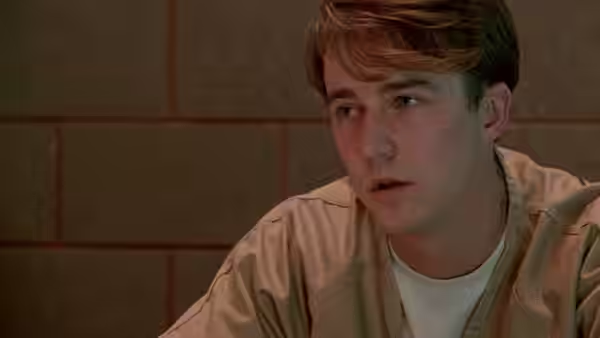
Then there is Norton. Aaron Stampler arrives with a Kentucky stammer, wrists too thin for his cuffs and eyes that go to the floor whenever a question is put to him, and for a while we took the performance for good casting: a boy who looks like a victim. Somewhere in the middle there is a scene in a holding cell that we will not describe. What we can say is that Norton does something with his voice and his shoulders and the set of his jaw, and we sat upright, and we have not forgotten it. The tagline promises a man with two faces; Norton is why that is not a gimmick.

Michael Chapman lights it like an expensive television drama, and we do not mean that as a complaint: amber lamplight in Vail’s rooms, cold blue in the cells, the cathedral in candle and shadow, a courtroom where every face is readable. Jeannine Oppewall gives Vail a flat of brick, glass and good furniture, the home of a man who buys things to be seen with, and Betsy Cox puts him in suits to match and Norton in clothes that look borrowed for court. James Newton Howard’s score is low strings and a slow pulse, and it knows when to stop. David Rosenbloom cuts the trial briskly, crossing between the courtroom and Goodman’s digging so the case seems to build even when it is only being explained.

And it is explained, at length. The archbishop had property dealings; a gangster client of Vail’s, Pinero (Steven Bauer), knows about them; City Hall is involved. Each is a piece the script moves so that a later piece can move, and none has any weight of its own. The psychiatry, delivered by Frances McDormand’s Molly, comes out as briefings, the words that matter said twice in case we missed them. For a stretch of the second hour we were waiting: not bored, but aware the film was telling us what it would later need us to know. It carries an 18, which the archbishop’s bedroom earns in the first ten minutes.

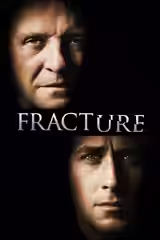
Against the courtroom film’s own standards this is the polished middle of the range. Anatomy of a Murder (1959) let its trial breathe and its lawyer be tired. Jagged Edge (1985) built a similar machine and hid the joins better. Hoblit went back to court with Fracture (2007) and by then let the actors run the plot rather than the other way round. Here, until Norton’s scene, the actors mostly serve the plot.

The final scene is the one the film is remembered for, and rightly. We will say only that it is a two-hander, that Hoblit and Norton arrived at it partly through improvisation, and that it sends you out talking. Watch it with someone who has not seen it and has somehow avoided being told. It is a rare pleasure to watch a film land a punch on a person who does not see it coming, even if you can see the arm being drawn back.
Critical consensus AI synthesised

69
Positive
8
Mixed
1
Negative
1

Most critics like Primal Fear, and the praise lands in one place: the acting. Edward Norton’s debut as the accused is singled out in nearly every review, described as electric, outstanding, the thing that lifts the film above its plot. Richard Gere’s ambitious defence lawyer draws steady approval too, and Gregory Hoblit’s direction, a first feature, is called crisp and confident, with the trial scenes handled ably.

The reservations cluster around the script. Several critics find the film glossy in a television way, densely plotted but mechanical, its twists well placed rather than surprising. The spread is wide. Empire finds the plot more contrived than believable, and The Independent goes further, calling it flat and ludicrous and complaining that Gere sleepwalks through it. The two dissenters agree with the majority only on the cast; even they think the actors deserve a better screenplay.

Los Angeles Times
3 April 1996 · Kenneth Turan
87*

The critic says the tight courtroom melodrama handles its suspenseful twists with skill and style, building a terrific want-to-know. Richard Gere is at his peak as the ruthless attorney, supported by strong performances and crisp direction from the first-time feature director.

Read the full review →
Radio Times
★★★★ · Alan Jones
80

The critic calls it an enjoyably involving courtroom drama where Gere chases fame as much as justice. They single out the strong, energetic performances, especially Norton's electric and Oscar-nominated turn.

Read the full review →
RogerEbert.com
5 April 1996 · Roger Ebert
79*

The critic praises the film as better than its plot thanks to strong, three-dimensional characters, especially Richard Gere's nuanced performance as the ambitious lawyer and Edward Norton's standout debut. The director creates an atmosphere of menace and the story explores identity and the legal system effectively.

Read the full review →
Time Out
10 September 2012 · WH
73*

The critic finds the film a smooth but mechanical courtroom drama with twists but few surprises. They praise the ably executed trial scenes and note that Norton shows notable range while Gere fits his role well.

Read the full review →
The New York Times
3 April 1996 · Janet Maslin
70*

The critic finds the film glossy and charming in a television style, with a solid performance from Richard Gere as the slick lawyer and a polished look from the cinematography. The director's debut sticks to surface appeal while turning the closing revelation into a strong selling point.

Read the full review →
Variety
28 March 1996 · Todd McCarthy
70*

The critic notes the densely plotted, talky drama has well-placed twists but resembles a high-end telefilm and makes its points insistently. It is sparked by Edward Norton's outstanding debut performance, while the legal issues provide immediate force but lack lasting resonance.

Read the full review →

Straight answers AI written, from our review

Is Primal Fear worth watching?
Primal Fear is worth an evening for anyone who likes a courtroom thriller, and we scored it 71. It is smooth, handsome and built on rails you can see, with a second hour that spends too long explaining property deals and City Hall. Edward Norton, in his first screen part, is the reason to watch, and the final scene is the reason to watch it with someone who has not been told.
How long is Primal Fear, and what is it rated?
Primal Fear runs 2h 10m. It is a crime and drama film.
Where can I watch Primal Fear in Azerbaijan?
Primal Fear is streaming on Netflix in Azerbaijan. Availability is checked daily; the links above go straight to each service.
How violent or frightening is Primal Fear, and is it suitable for children?
Primal Fear carries an 18 in the UK and an R in the US, and it earns the certificate in the first ten minutes with the sight of the archbishop's bedroom after his murder. It is not a horror film and the fear is of the courtroom kind, but the violence is bloody and the subject adult. Not for children; older teenagers who can take a butchered body will be fine.
How does Primal Fear compare to Anatomy of a Murder?
Primal Fear is the glossier and more mechanical of the two, while Anatomy of a Murder is the better film, letting its trial breathe and its lawyer be tired where Hoblit's moves pieces into place for a later payoff. Preminger's is long and unkind to its one woman; Hoblit's is briskly cut and has Norton. If you want a trial to live inside, choose the earlier film; if you want to be caught out at the end, choose this one.
Is Primal Fear based on a true story or a book?
Primal Fear is based on William Diehl's novel of the same name, adapted by Steve Shagan and Ann Biderman; it is not a true story. Our review does not measure it against the book, so we cannot say how faithful it is, but you do not need to have read it. Going in knowing nothing is the whole point, and readers of the novel will already know the ending.
What should I watch after Primal Fear?
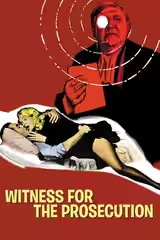
After Primal Fear, try Anatomy of a Murder (1959, Fi1m 87): The courtroom film that lets its trial breathe and its lawyer be tired. Then The Usual Suspects (1995, Fi1m 82): Another interrogation-room performance built entirely to be reconsidered on the way home; and Witness for the Prosecution (1957, Fi1m 87): Billy Wilder’s London trial, played for laughs until it suddenly is not.

Cast

Awards

Academy Awards, 1997

Nominated
Best Supporting Actor

If you liked this, try…

  1. Anatomy of a Murder (1959, Fi1m 87)The courtroom film that lets its trial breathe and its lawyer be tired.

  2. Jagged Edge (1985) · not on Fi1m yetGlenn Close defends a man she is sleeping with; the same machine, better hidden.

  3. The Usual Suspects (1995, Fi1m 82)Another interrogation-room performance built entirely to be reconsidered on the way home.

  4. Witness for the Prosecution (1957, Fi1m 87)Billy Wilder’s London trial, played for laughs until it suddenly is not.

  5. Fracture (2007) · not on Fi1m yetHoblit back in court, with Anthony Hopkins enjoying himself at Ryan Gosling’s expense.

Primal Fear (1996) review: slick trial thriller stolen by Norton (Azerbaijan) | Fi1m