Goldie Hawn is funny and watchable for every one of the 110 minutes, and for about half of them the film around her is too. The barracks half is sharp and well drilled; what follows is a softer picture that forgets most of its jokes.
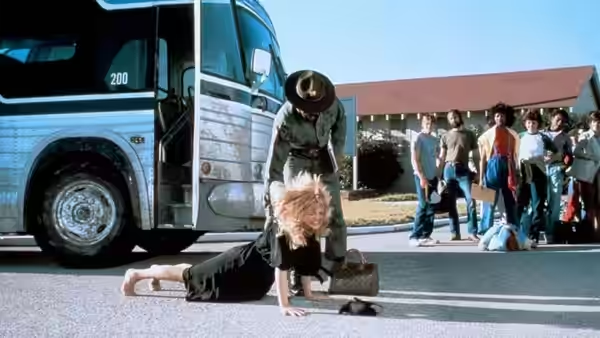
Judy Benjamin (Goldie Hawn) is widowed on her wedding night when Yale Goodman (Albert Brooks) dies in the act, and within a day a recruiting sergeant, Jim Ballard (Harry Dean Stanton), has her signing up for an Army of private rooms and yachts. Howard Zieff’s comedy is at its best from that point to the hour mark, in a training camp where a woman who has never carried her own luggage is made to carry everything. Then it posts her somewhere else, and a slacker, less funny film takes over. The first half is worth an evening. The second is worth staying on the sofa for her.
Hawn is the whole point, and she knows it. She plays Judy not as a fool but as a woman wholly convinced by nonsense, and the script by Nancy Meyers, Charles Shyer and Harvey Miller gives her the right nonsense to believe. In the rain on her first night, hair collapsing, she explains to nobody in particular that she has joined a different Army, the one with the condominiums. We laughed, more than once, because Hawn never plays the line for a laugh. Her face stays serious. The joke is on her certainty, not her stupidity.
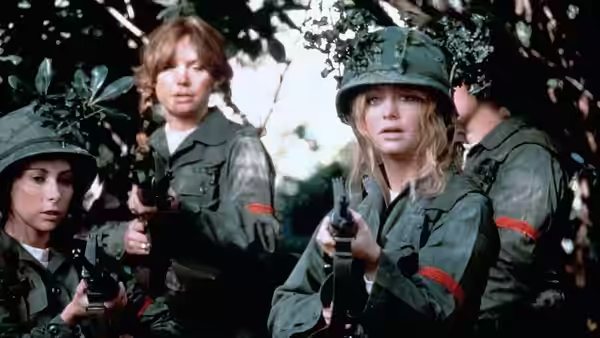
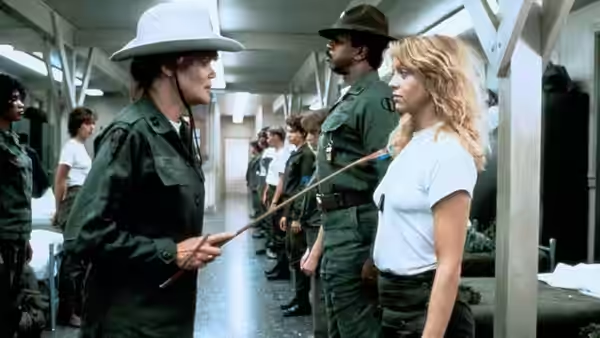
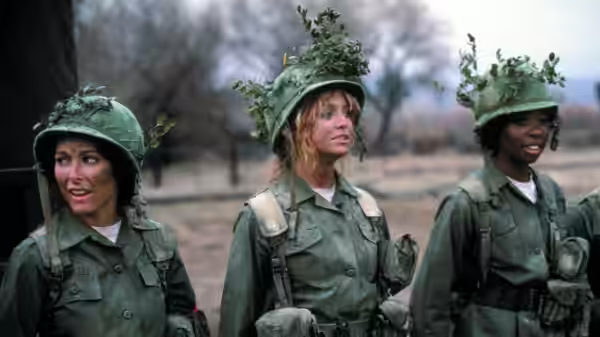
Eileen Brennan is the other reason the camp works. Her Captain Doreen Lewis is a small, tightly buttoned woman who has decided every day in advance and resents Judy for being a surprise. Brennan plays her without camp or cruelty; she looks tired rather than wicked, which is funnier. Mary Kay Place’s Mary Lou Glass gets some good lines in the bunk next door. The writers give the barracks a real routine, scrubbing and drilling and the obstacle course, so the scenes are about something being done badly and then slightly less badly.
The craft is modest and mostly sound. David M. Walsh shoots the camp under a flat grey sky so the mud and the fatigues come out the same colour and Hawn’s hair is the only bright thing in the frame. Betsy Cox cuts her uniform for someone much larger, so she spends an hour hitching it up. Bill Conti’s score is brass and snare and stays out of the actors’ way. Sheldon Kahn cuts the training in short dry beats and lets Hawn’s reactions end the scenes. Robert F. Boyle and Jeffrey Howard set the carpeted Benjamin world against bare boards and metal bunks.
Sam Wanamaker and Barbara Barrie turn up mid-film as Teddy and Harriet Benjamin to fetch their daughter home, in the best-written scene in the picture. For five minutes the film says plainly what it is about: a woman who has been looked after all her life deciding whether she wants to go on being looked after. Here it is said by two parents who love her and do not think much of her.
Then Judy leaves the base, and we will not describe where she goes, but Armand Assante’s Henrí Trémont and Robert Webber’s Colonel Clay Thornbush are waiting there. The second half means well; it wants to carry the parents’ question to an answer, an honest ambition for a comedy that could have stayed in the mud. But the jokes thin out, Assante is handed charm and nothing to do with it, and Webber gets one strong scene. We checked the time twice in the last half hour, having not thought to once in the first.
Against the line of service comedies, this one has a better lead than most and a weaker finish than many. It is not a one-joke film; it is a one-setting film, and when it leaves the setting it leaves the laughs behind. The 15 certificate is largely for the wedding night, which is franker than most 1980 comedies managed.
Watch it for the first hour and Hawn in the rain. She is still the best thing on screen in the last stretch; the film has simply stopped giving her anything to do with it.