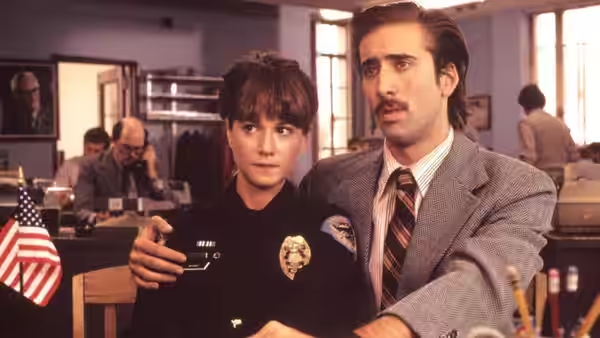
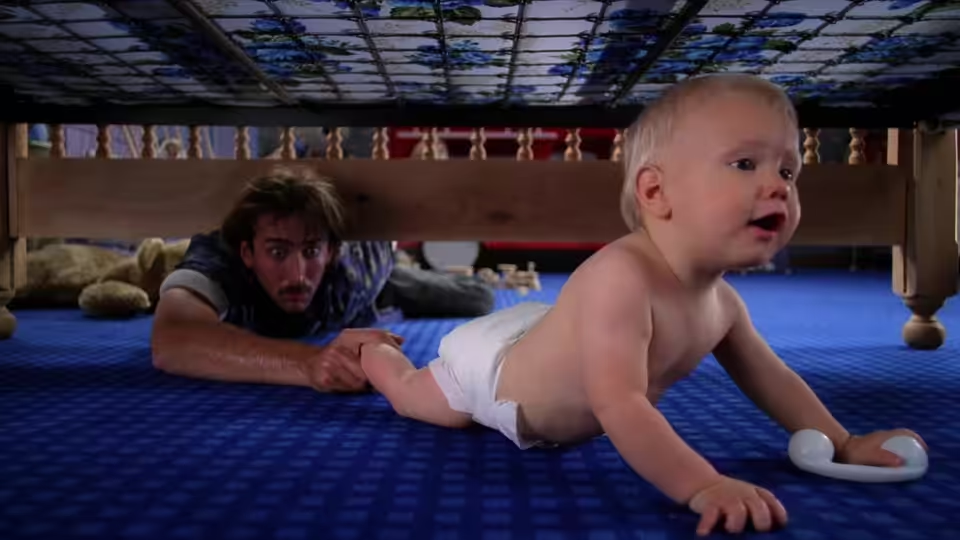
H.I. (Nicolas Cage) lies under the bed watching Nathan Junior crawl
Film review

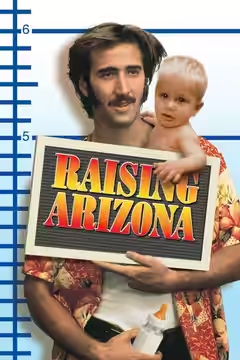
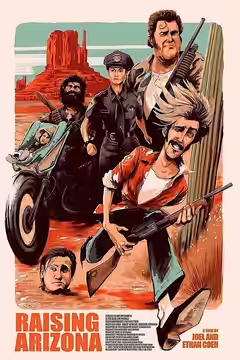
Raising Arizona

1987 · Directed by Joel Coen · 1h 34m

In a sentenceNicolas Cage approaches fatherhood as though stealing the baby were the difficult part

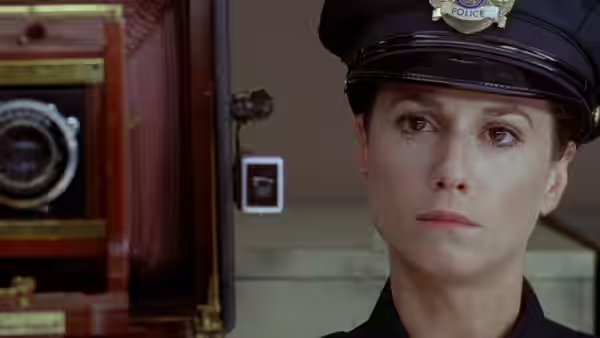
Nicolas Cage plays a repeat convenience-store robber who falls for police photographer Ed (Holly Hunter). They want to start a family, and decide that stealing one of a set of quintuplets is the way to do it. Parenthood begins for the trailer-dwelling couple with a crime rather than a birth, in an Arizona where their domestic ambitions sit alongside the habits of an outlaw life. Joel Coen directs a comedy co-written with Ethan Coen, with John Goodman, William Forsythe and Frances McDormand among the supporting cast.

Plays from YouTube when you press play; nothing loads from them until then.

Fi1m review

Joel Coen’s baby-stealing farce is funny, warm and more carefully made than its racket suggests. Nicolas Cage and Holly Hunter make the couple worth caring about, even when the plotting cannot keep pace with the chases.

Stealing a baby is an unpromising basis for a warm comedy, which is part of the pleasure of Raising Arizona. Joel Coen directs from a script written with Ethan Coen, and the brothers take the couple’s wish for a family seriously without pretending their solution makes sense. The result is a funny, affectionate farce that we recommend, with a warning about its appetite for noise. It asks us to care about two people while watching them do something indefensible, and mostly gets away with it.

Nicolas Cage plays a repeat convenience-store robber; Holly Hunter’s Ed is a police photographer. Their courtship and decision to steal a quintuplet give the film a domestic purpose beneath all the criminal activity. Cage’s slapstick is so good because he allows his character to look foolish without making him seem incapable of feeling, while Hunter brings a seriousness that makes the pair convincing together. We were surprised by how much we wanted them to have a family. The theft remains appalling, but the performances make the longing behind it difficult to dismiss.

Barry Sonnenfeld’s cinematography keeps the physical comedy in motion. His moving camera gives the chases a restless energy, making the pursuit itself funny rather than merely a way of getting to the next joke. Michael R. Miller’s editing gives the packed pre-credits sequence its momentum, establishing that the film will not wait politely for us to catch up. That speed suits the reckless decisions; it can also make a good joke feel hurried out of the way.

Jane Musky’s production design gives this Arizona a seediness that suits people trying to establish a respectable household by stealing somebody else’s child. The couple’s trailer matters: their ambitions are easy to recognise, even when their surroundings are being used for broad comedy. Carter Burwell’s score works with the film’s hectic movement, helping the farce stay playful rather than merely abrasive. With so much activity in the images and music, the quieter work of making us care falls heavily on Cage and Hunter.

The weakness is the story’s loose construction, and it becomes more noticeable once the initial premise has done its work. Joel and Ethan Coen are better here at inventing another complication than making each one feel necessary. Some of the supporting figures remain comic types, and the relentless pace gives us little time to become interested in them beyond the next gag. At 94 minutes the film is short, but some passages are busy without being especially funny.

The dialogue is another reason to stay with it through the commotion. Joel and Ethan Coen give the couple ways of explaining themselves that are funny without making the wish for a family seem foolish. For a crime farce, it pays unusual attention to the sort of home its criminals hope to make. Watch it for Cage and Hunter, provided nobody on the sofa needs a quiet evening.

Critical consensus AI synthesised

64
Positive
7
Mixed
1
Negative
3

Most critics come down in favour of the Coens’ second film, and the praise clusters on the writing. Reviewers admire the invention of the dialogue, the audacious opening stretch before the credits, and the seedy, mythical Arizona the brothers build and fill with no-hopers. Cage and Hunter are praised, and Carter Burwell’s score and Barry Sonnenfeld’s camerawork are singled out. Several count it among the Coens’ warmest work.

The spread is wide, and the reservations are about pace and structure rather than craft. Variety finds the loosely built story does not always hold together; RogerEbert.com finds the dialogue over-mannered and the film short of velocity. The Los Angeles Times goes further, calling it technically adept but boring and condescending towards its trailer-park characters, and Eye for Film sees no serviceable plot at all. The coolest notices date from 1987; those written since are almost uniformly warm.

Empire
1 January 2000 · Mark Dinning
90*

The critic calls it a wonderfully surreal, hilarious joy that mixes multiple genres including prison movie, screwball comedy and Spaghetti Western while delivering frantic fun and timeless chases. They single out the sublime dialogue, Carter Burwell's score and Barry Sonnenfeld's cinematography for praise.

Read the full review →
Time Out
10 September 2012 · GA
85*

The Coen brothers deliver a fervently inventive comedy that confounds expectations after Blood Simple. Its fresh and funny quality stems from the sheer fertility of the writing and the splendidly seedy depiction of a mythical Arizona populated by memorable no-hopers.

Read the full review →
Radio Times
★★★★ · John Ferguson
80

This delirious mix of slapstick, surrealism and sentimentality remains one of the Coens' warmest, most complete works. The dazzling invention of the brothers shines through from the audacious pre-credits sequence, with superb performances from Cage and Hunter.

Read the full review →
Vulture
20 October 2010 · Alden Ford
80*

The critic enjoyed the film as a quirky, loud and colorful early Coen comedy that holds up well due to strong characters, writing, cast and filmmaking. It succeeds on its own terms as an energetic piece showcasing the directors' potential.

Read the full review →
The New Yorker
13 April 1987 · Pauline Kael
70*

The film is a broad, cornpone-surreal burlesque about baby love and family aspirations, with a galumphing tempo and sight gags. It has rambunctious charm thanks to the Coens' mechanical camera work and Nicolas Cage's winning slapstick performance.

Read the full review →
The New York Times
11 March 1987 · Vincent Canby
70*

The Coen brothers' second feature is a comedy about a recidivist convenience-store robber who falls for a police photographer and steals a quintuplet to start a family. It is praised for its neo-Hitchcockian style and the leads' performances.

Read the full review →

Straight answers AI written, from our review

Is Raising Arizona worth watching?
Raising Arizona is worth watching for anyone who likes their comedy fast and loud, and we scored it 84. Nicolas Cage and Holly Hunter make a baby-stealing couple worth caring about, and the chases are staged with real skill. The story is loosely built, and the pace can hurry a good joke off before it lands.
How long is Raising Arizona, and what is it rated?
Raising Arizona runs 1h 34m. It is a comedy and crime film.
Where can I watch Raising Arizona in Chile?
Raising Arizona is streaming on Disney+ in Chile. Availability is checked daily; the links above go straight to each service.
How violent or frightening is Raising Arizona, and is it suitable for children?
Raising Arizona is a UK 12 comedy about stealing a baby, and it is far more noisy than frightening. The crime at its centre is treated as farce, with slapstick chases rather than anything gruesome, so most children over twelve should be fine. Younger viewers may struggle to keep up rather than be scared.
How does Raising Arizona compare to Delicatessen?
Raising Arizona and Delicatessen both make appalling behaviour companionable through elaborate visual comedy, but the Coens are warmer and Jeunet and Caro are stranger. The American film asks you to want its criminals to succeed; the French one asks you to laugh at cannibalism from a polite distance. Choose Raising Arizona for heart, Delicatessen for oddity.
What should I watch after Raising Arizona?
After Raising Arizona, try The Ladykillers (1955, Fi1m 86): The criminals are scarcely qualified, and the domestic arrangements prove still more troublesome. Then Paper Moon (1973, Fi1m 86): A child and a swindler make an awkward family, with less shouting; and Delicatessen (1991, Fi1m 83): Another grubby neighbourhood where elaborate visual jokes make appalling behaviour oddly companionable.

Cast

If you liked this, try…

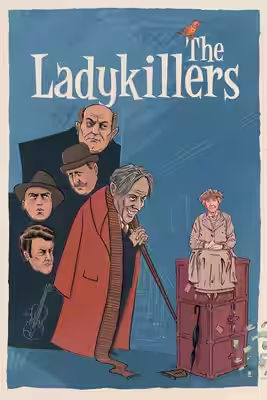
  1. The Ladykillers (1955, Fi1m 86)The criminals are scarcely qualified, and the domestic arrangements prove still more troublesome.

  2. Paper Moon (1973, Fi1m 86)A child and a swindler make an awkward family, with less shouting.

  3. Delicatessen (1991, Fi1m 83)Another grubby neighbourhood where elaborate visual jokes make appalling behaviour oddly companionable.

  4. The Man Without a Past (2002) · not reviewed yetFor more affection towards people whose domestic hopes exceed their available resources.

  5. Hunt for the Wilderpeople (2016, Fi1m 82)Another makeshift family pursued through a comedy that leaves room for loneliness.

Free account

Know what to watch tonight

Two lists that know where things are streaming, collections you can share, your own score beside ours, and Discover that remembers what you have seen.

  • Want to see, sorted by what is streaming now
  • Seen, with your score out of ten
  • No adverts, ever