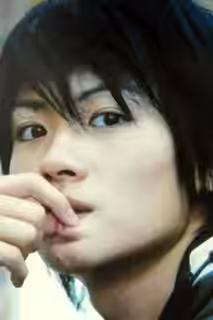
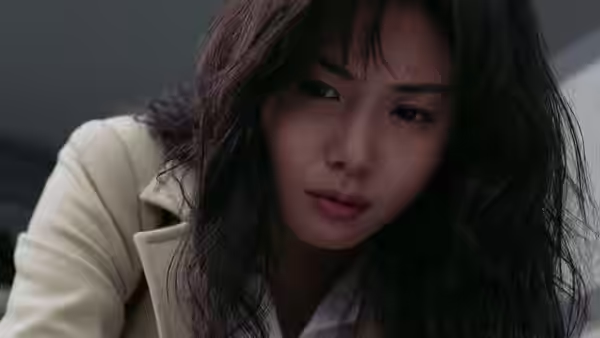
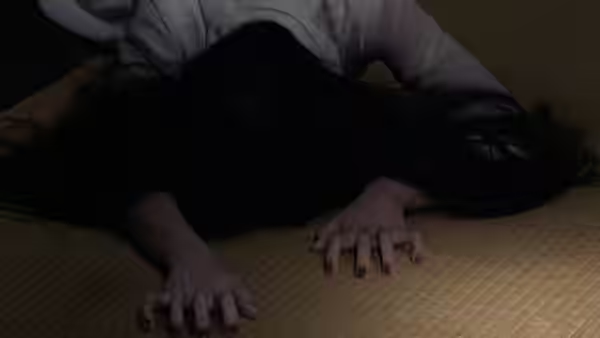
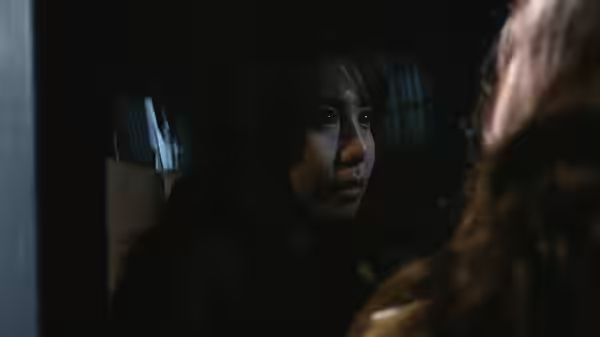
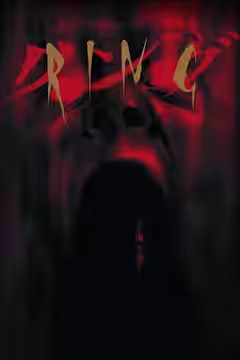
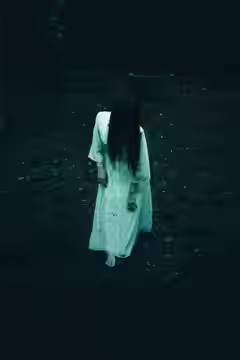
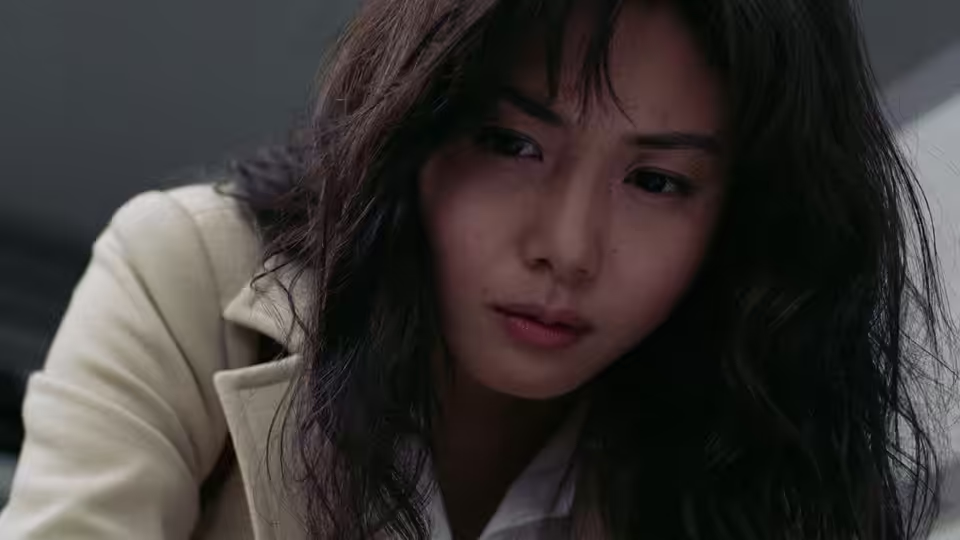
Reiko (Nanako Matsushima) leans forward in a pale coat, looking down
Film review

Ring

1998 · Directed by Hideo Nakata · 1h 36m

In a sentenceOne curse, one week, and a strong case for leaving the lights on

A curse has a cure, but there is only one week to find it. Ring centres on Reiko Asakawa (Nanako Matsushima), with Ryuji Takayama (Hiroyuki Sanada) and Yoichi Asakawa (Rikiya Ôtaka) among its principal characters. An investigation follows, as the threat imposes a deadline on the search for answers. Miki Nakatani plays Mai Takano, Yuko Takeuchi plays Tomoko Oishi and Hitomi Sato plays Masami Kurahashi. Hideo Nakata directs this horror-thriller, with Hiroshi Takahashi adapting a novel by Kōji Suzuki about a curse whose cure must be found against the clock.

Plays from YouTube when you press play; nothing loads from them until then.

Fi1m review

Hideo Nakata’s Ring is frightening because it gives us time to look and worry. Its investigation sometimes drags or confuses, but the restraint makes the scares worth waiting for.

Ring is a frightening horror film with an investigation that occasionally makes it harder work than it needs to be. Hideo Nakata gives the promise of a curse, a cure and a one-week deadline a patient treatment, trusting us to worry without constant encouragement. The premise supplies enough urgency without every scene having to insist upon it. We recommend it, with a warning that following its explanations can require more effort than it should.

Junichiro Hayashi’s cinematography is clean and restrained, giving us time to look rather than constantly redirecting our attention. The images encourage the uncomfortable habit of checking the frame for something we might have missed. Iwao Saitô’s production design works within that simplicity, keeping the surroundings from becoming a separate attraction. That is an effective choice for this sort of horror, which needs us to keep examining what is in front of us even when we would prefer to look elsewhere.

We were frightened by how much time those uncluttered images gave us to worry. There is little visual fuss to distract us, and waiting for something to happen becomes unpleasant in itself. Kenji Kawai’s music helps sustain that unease without becoming the main thing we attend to; our attention stays on the image, rather than simply awaiting the next musical warning. The restraint earns its keep because the fear continues between the obvious opportunities to be scared.

Nanako Matsushima gives Reiko Asakawa enough urgency to keep us involved when the investigation threatens to become an exercise. Hiroyuki Sanada, as Ryuji Takayama, is valuable for the same reason: the performances maintain our interest through stretches devoted to establishing the next piece of information. Neither needs to advertise the seriousness of the material. The acting suits a film that expects close attention, and it helps carry passages where the writing is less sure of itself.

Hiroshi Takahashi’s screenplay, adapted from a novel by Kōji Suzuki, is where our reservation begins. A mystery need not answer everything, but we should usually understand what its characters think they are trying to establish. Here the investigation can feel both overextended and insufficiently clear, and Nobuyuki Takahashi’s editing does not quite solve the problem. His patient cutting elsewhere gives apprehension time to settle, but that pace becomes a drawback when we are waiting for a useful connection between pieces of information. At 96 minutes, the film could still lose a little of the inquiry without damaging its scares.

There is something pleasingly unfussy about this approach to technological horror. Hideo Nakata trusts a curse and a deadline to trouble us, and gives us enough space to do some of the worrying ourselves. It asks for concentration, which is reasonable, and occasionally for more patience than the investigation deserves. Choose it for an evening when sitting quietly with a growing sense of unease sounds appealing, and allow a little tolerance for the detective work.

Critical consensus AI synthesised

86
Positive
3
Mixed
1
Negative
0
Time Out
28 October 2008 · ★★★★★ · David Jenkins
100

The review calls the film sublime and quietly terrifying. It singles out its enduring effectiveness as techno-horror.

Read the full review →
The Guardian
31 October 2008 · Peter Bradshaw
90*

Bradshaw calls the film a genuinely scary classic that retains its power to disturb. He praises its intensely frightening moments, while noting that the storytelling can be confusing.

Read the full review →
The AV Club
8 April 2003 · Scott Tobias
65*

Tobias finds the original less accomplished overall than the American remake, but still haunting and worthwhile. He praises its minimalist intensity and especially its chilling final turn, while noting that the investigative middle sags.

Read the full review →
Eye for Film
19 January 2001 · Angus Wolfe Murray
90*

The critic calls the film extraordinary and says its horror feels universal. They praise Nakata’s clean visual approach for letting fear arise in the viewer’s mind.

Read the full review →

Straight answers AI written, from our review

Is Ring worth watching?
Ring is worth watching for horror viewers who enjoy patient, sustained unease, and we score it 84 out of 100. We find its restrained images and quiet waiting frightening, though the investigation sometimes drags and its explanations require more effort to follow than they should.
How long is Ring, and what is it rated?
Ring runs 1h 36m. It is a horror and thriller film.
Where can I watch Ring in Switzerland?
Ring is not on any streaming or rental service in Switzerland at the moment. It is available in 5 other countries; change your country at the top of the page to see where. Availability is checked daily.
How violent or frightening is Ring, and is it suitable for children?
Ring has a UK 15 certificate and is frightening enough that we would not recommend it for children. The scares we describe come from prolonged waiting, uncluttered images and a growing sense of threat; teenagers within the certificate’s age range still need a tolerance for sustained unease.
Is Ring based on a true story or a book?
Ring is adapted from a novel by Kōji Suzuki, with a screenplay by Hiroshi Takahashi, rather than presented as a true story. The story follows an investigation into a curse with a one-week deadline; our reservation concerns the sometimes confusing detective work, not its faithfulness to the book.

Cast

Awards

Sitges Film Festival Best Feature-Length Film award, 1999

Won
Sitges Film Festival Best Feature-Length Film award

If you liked this, try…

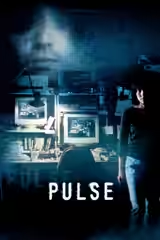
  1. Pulse (2001) · not on Fi1m yetAnother patient technological haunting, with loneliness making the empty spaces feel worse.

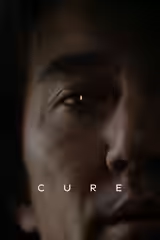
  2. Cure (1997) · not on Fi1m yetFor the uneasy investigation, and questions that become less comforting as answers accumulate.

  3. The Innocents (1961) · not on Fi1m yetCareful framing and uncertain perceptions make a quiet house difficult to endure.

  4. The Devil's Backbone (2001) · not on Fi1m yetA ghost story that gives its human troubles as much attention as its haunting.

  5. Lake Mungo (2008) · not on Fi1m yetRecorded images reward close attention, then make us regret having looked so carefully.