Robert Rodriguez and Frank Miller make a forceful, inventive crime film from Miller’s comics. Mickey Rourke and the hard black-and-white images are ample reasons to watch, but the repeated brutality becomes wearing.
Sin City is worth an evening for viewers with a taste for violent noir, though its repeated cruelties become wearing. Robert Rodriguez and Frank Miller make a crime film that holds unusually close to Miller’s comics, including their limitations. Three linked stories give guilt and revenge plenty of exercise. The appeal lies in watching how thoroughly the film commits to making its people and places resemble drawings. It rewards that attention, although 124 minutes is a long time to spend with characters this narrowly conceived.
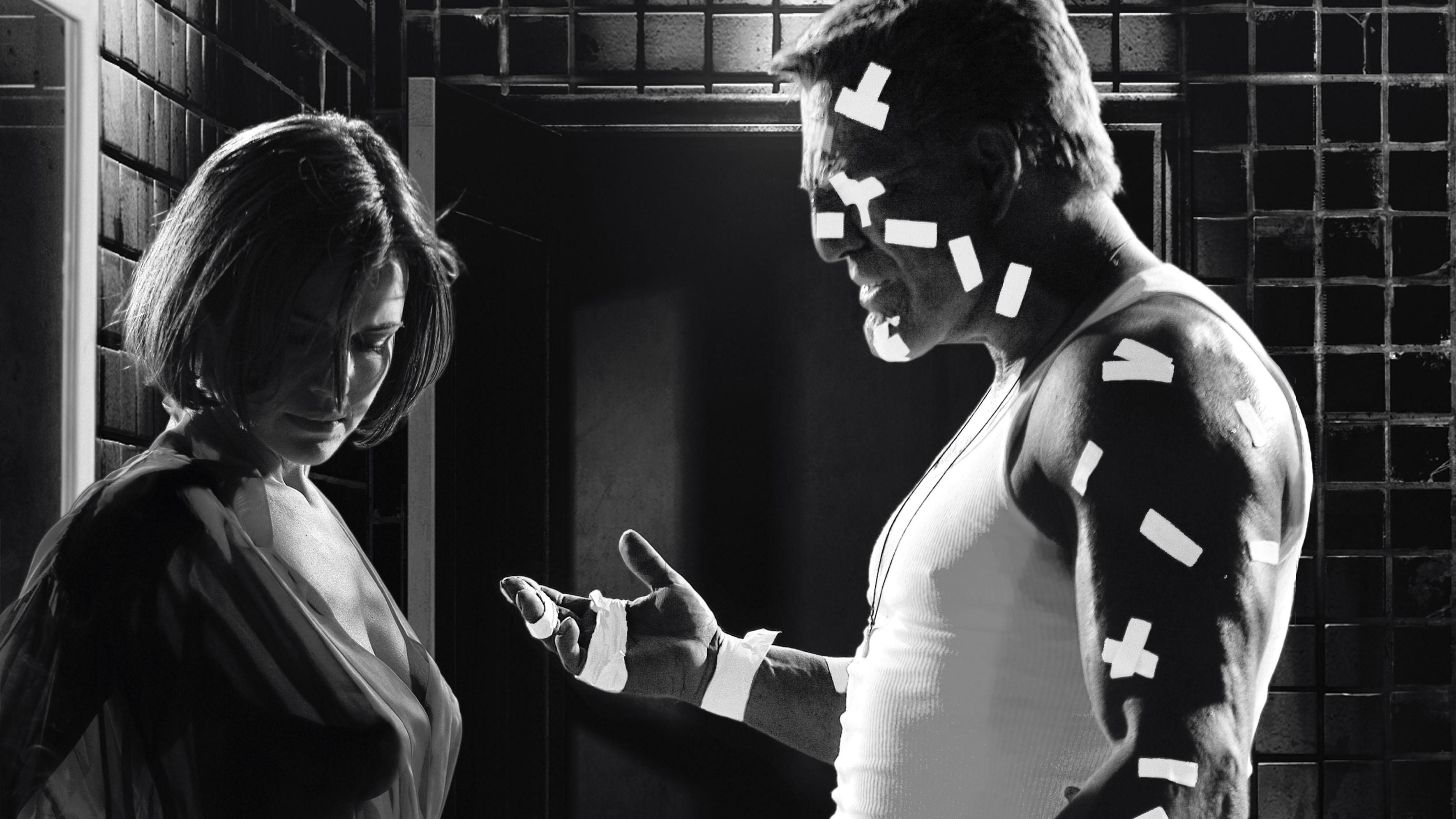
Rodriguez also handles the cinematography, and his black-and-white compositions give the comic-book approach a practical purpose. The strong contrast strips away distracting detail, while isolated patches of colour tell us where to look. We were thrilled by those sudden interruptions of the monochrome picture. They make looking an active pleasure, even when what is being shown is ugly. The digital environments work because the film never asks us to mistake this place for an ordinary city.
Mickey Rourke, playing Marv, supplies the human interest that this much graphic control might otherwise squeeze out. His forcefulness suits the oversized emotions, but there is enough feeling behind it to keep the performance from becoming another aggressive effect. We can care about Marv without requiring the film to make him respectable. Bruce Willis as Hartigan and Clive Owen as Dwight fit the hard-boiled company, too. Rourke is the one who makes the narrow range of permitted emotions feel least restrictive.
As editor, Rodriguez has to keep the separate stories from exhausting the same supply of shocks. Within each, the blunt rhythm suits the material: the film gives a violent act enough emphasis to register, then presses on. Across the whole running time, however, the repetition becomes harder to ignore. Another grievance and another round of punishment do not automatically renew our interest. The later stretches drag because the film has spent so long demanding much the same response.
The score by Robert Rodriguez, Graeme Revell and John Debney helps sustain the heightened mood. It takes these grubby dramas seriously enough to give them weight, without needing to persuade us that they could happen next door. The dialogue is less reliable. Miller and Rodriguez’s writing repeatedly pushes hard-boiled speech beyond toughness into self-conscious display. Some of the clumsiness is enjoyable as pulp excess, but the words too often underline a brutality the images have already made clear.
The film’s noir credentials rest heavily on its appetite for punishment. Its people tend to arrive with their moral positions fixed, so we spend little time reconsidering them. That simplicity suits the pulp approach, but it leaves the film short of doubt and surprise. Fidelity to Miller’s comics is understandable when the pictures offer this much, yet the writing could use more freedom. The genre can make revenge troubling in ways this film rarely attempts.
The 18 certificate is a useful warning about the cruelty, however stylised the images. There is enough invention here for a recommendation to noir enthusiasts, and Rourke gives that recommendation more substance than the visuals alone could supply. But the film’s relish for punishment is unlikely to win over anyone already doubtful about it. If prolonged brutality is likely to spoil the evening, choose something else.