Mahershala Ali gives this restrained science-fiction drama enough feeling to make its questions about mortality matter. We recommend it for his performance, with a reservation: the relationship at its centre needs more room, especially for Naomie Harris.
Swan Song is worth an evening for Mahershala Ali, whose performance makes a familiar science-fiction question feel painfully personal. What would it mean to confront another version of ourselves, particularly when our own mortality is involved? Writer-director Benjamin Cleary approaches that question with care, though sometimes with too much caution to follow its more troubling implications. The result is a good, uneven drama whose leading actor keeps finding complications that the writing could explore more fully.
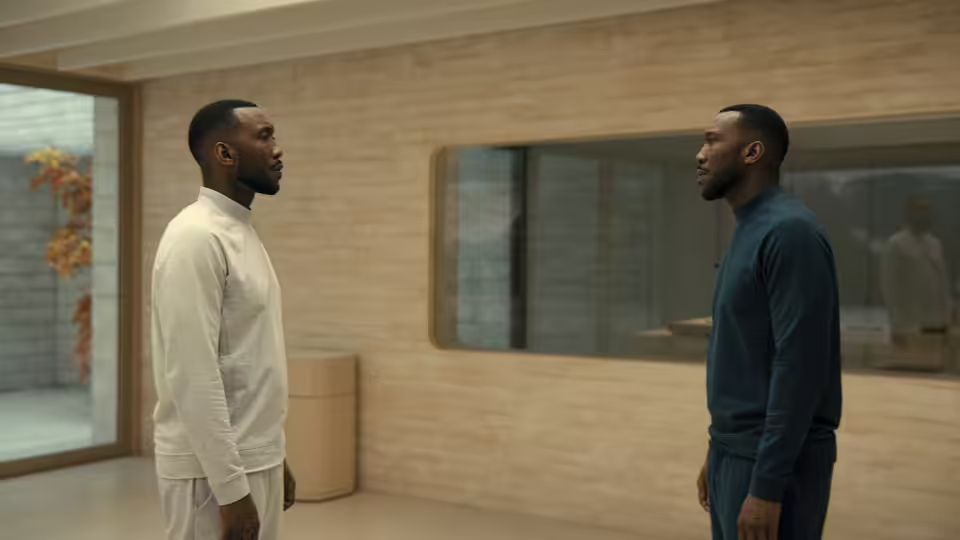
Ali plays Cameron Turner and his double without reducing either to a demonstration of how neatly an actor can distinguish two roles. His achievement is to make the conflicting emotions credible without settling them into a single, easily understood response. We were moved by Cameron confronting another version of himself, because Ali makes the encounter feel difficult before we have finished considering its possibilities. The thought experiment can wait while we attend to the man, which is precisely what this sort of science fiction needs.
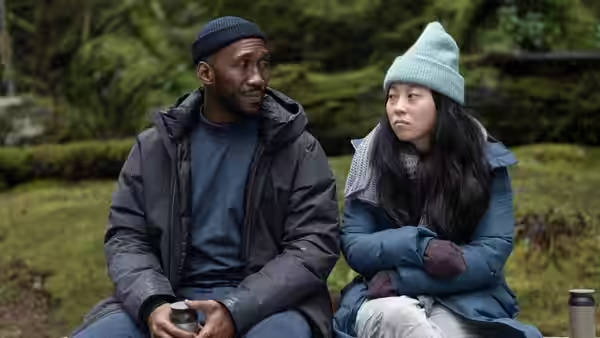
Naomie Harris gives Poppy Turner warmth and emotional credibility, and the chemistry between her and Ali makes their relationship worth caring about. That matters: without a convincing attachment, Cameron’s predicament would be an exercise with unusually good casting. But Cleary gives Poppy too little independent weight, leaving Harris to supply much of what we need to understand about her. We wanted more room for her responses and wishes, particularly in a film so concerned with what one person means to another.
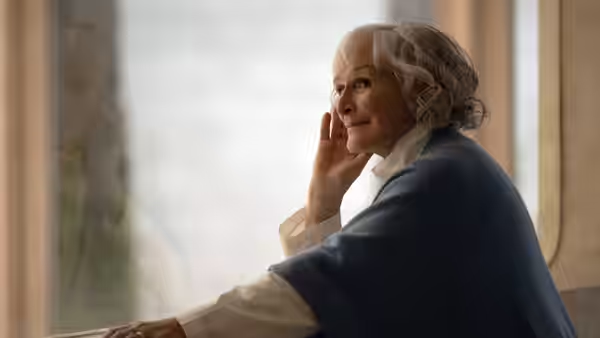
The near-future setting is one of the film’s quieter successes. Annie Beauchamp’s production design makes it feel sufficiently close to ordinary life that the speculative premise does not require a separate effort of belief. Masanobu Takayanagi’s cinematography finds a persuasive calm in the wooded landscapes, giving Cameron’s distress space without making every image announce it. That serenity is attractive, although it also contributes to a film that can seem reluctant to disturb its own careful composure.
We wanted more urgency from Nathan Nugent’s editing, particularly when the central dilemma has become clear and the drama still seems to be considering how to approach it. Patience suits Ali’s performance; elsewhere, it gives the thinly developed relationships nowhere to hide. Jay Wadley’s score is less persuasive to us as an emotional guide than the actors, who already make the sadness legible. The accumulated solemnity becomes restrictive, leaving too little variation in how the film asks us to respond.
Against the standards of speculative drama, Cleary deserves credit for taking an extraordinary proposition seriously without treating the people as dispensable illustrations. Yet the screenplay’s narrow attention to Cameron limits how thoroughly it can examine the ethical questions raised by his situation. Poppy’s underdevelopment is especially costly here, since a fuller sense of her might have made those questions harder and the drama less comfortable. The film is willing to explain its concerns, but less willing to let competing needs make a mess of them.
Ali makes that limitation bearable because his performance retains uncertainty even when the storytelling becomes too explicit. There is enough tenderness here to reward anyone drawn to science fiction about intimate relationships, rather than discovery or spectacle. Just do not expect Harris to receive the space her work deserves.