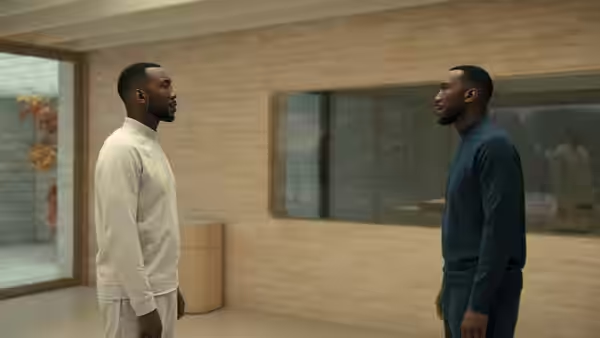
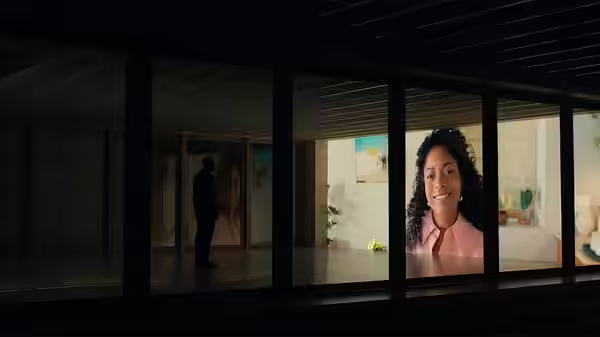
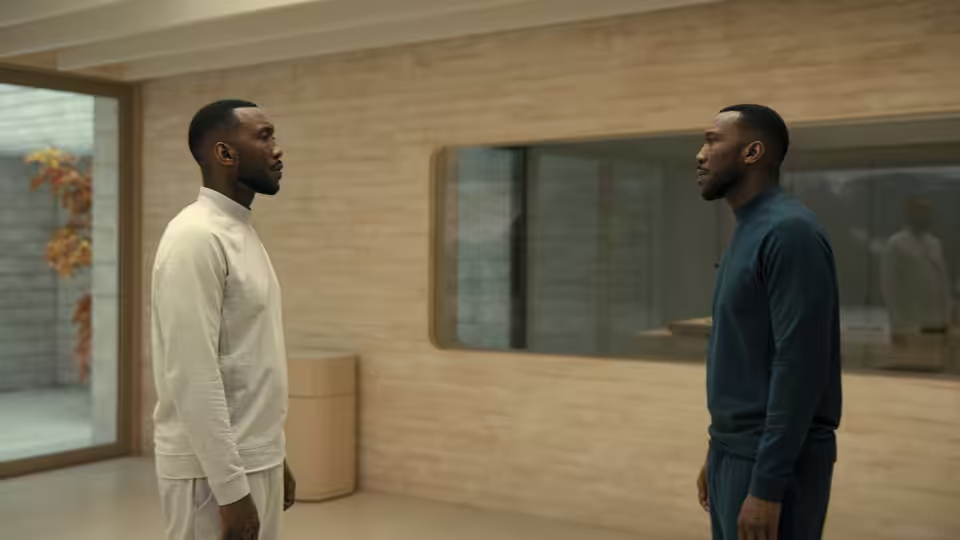
Cameron Turner (Mahershala Ali) faces his identical double in a bright clinical room
Film review

Swan Song

2021 · Directed by Benjamin Cleary · 1h 52m · CH 12

In a sentenceMahershala Ali makes meeting another Mahershala Ali look like a serious personal problem

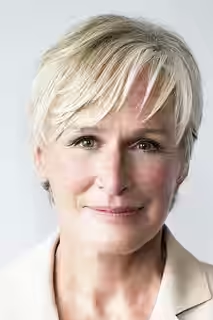
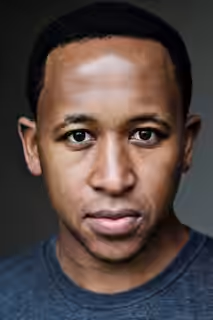
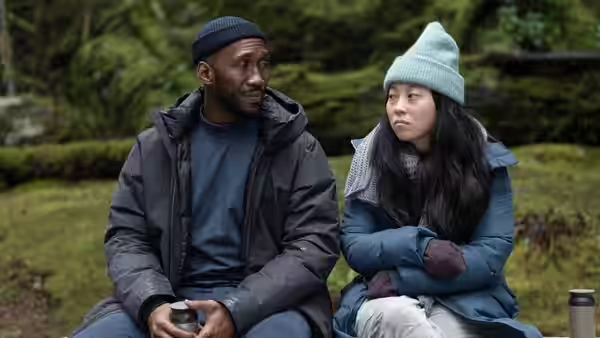
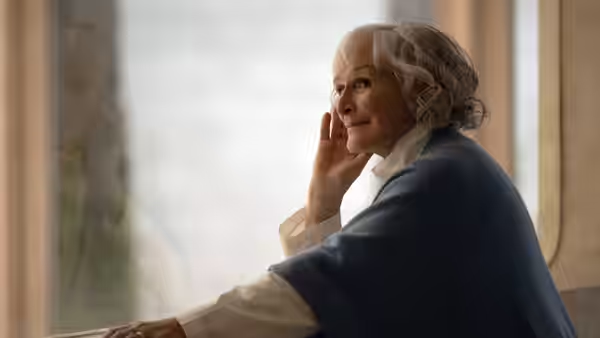
In a near future, Cameron Turner (Mahershala Ali) confronts another version of himself, bringing questions about mortality into his relationship with Poppy Turner (Naomie Harris). Faced with his double, Cameron has to consider what makes him the person Poppy loves, and what another version of that person could mean for their life together. Around them are Kate (Awkwafina) and Dr. Eve Scott (Glenn Close). The science-fiction premise keeps the attention on Cameron: his conflicting feelings about the man before him, his attachment to Poppy, and the difficulty of thinking about a future beyond himself.

Plays from YouTube when you press play; nothing loads from them until then.

Fi1m review

Mahershala Ali gives this restrained science-fiction drama enough feeling to make its questions about mortality matter. We recommend it for his performance, with a reservation: the relationship at its centre needs more room, especially for Naomie Harris.

Swan Song is worth an evening for Mahershala Ali, whose performance makes a familiar science-fiction question feel painfully personal. What would it mean to confront another version of ourselves, particularly when our own mortality is involved? Writer-director Benjamin Cleary approaches that question with care, though sometimes with too much caution to follow its more troubling implications. The result is a good, uneven drama whose leading actor keeps finding complications that the writing could explore more fully.

Ali plays Cameron Turner and his double without reducing either to a demonstration of how neatly an actor can distinguish two roles. His achievement is to make the conflicting emotions credible without settling them into a single, easily understood response. We were moved by Cameron confronting another version of himself, because Ali makes the encounter feel difficult before we have finished considering its possibilities. The thought experiment can wait while we attend to the man, which is precisely what this sort of science fiction needs.

Naomie Harris gives Poppy Turner warmth and emotional credibility, and the chemistry between her and Ali makes their relationship worth caring about. That matters: without a convincing attachment, Cameron’s predicament would be an exercise with unusually good casting. But Cleary gives Poppy too little independent weight, leaving Harris to supply much of what we need to understand about her. We wanted more room for her responses and wishes, particularly in a film so concerned with what one person means to another.

The near-future setting is one of the film’s quieter successes. Annie Beauchamp’s production design makes it feel sufficiently close to ordinary life that the speculative premise does not require a separate effort of belief. Masanobu Takayanagi’s cinematography finds a persuasive calm in the wooded landscapes, giving Cameron’s distress space without making every image announce it. That serenity is attractive, although it also contributes to a film that can seem reluctant to disturb its own careful composure.

We wanted more urgency from Nathan Nugent’s editing, particularly when the central dilemma has become clear and the drama still seems to be considering how to approach it. Patience suits Ali’s performance; elsewhere, it gives the thinly developed relationships nowhere to hide. Jay Wadley’s score is less persuasive to us as an emotional guide than the actors, who already make the sadness legible. The accumulated solemnity becomes restrictive, leaving too little variation in how the film asks us to respond.

Against the standards of speculative drama, Cleary deserves credit for taking an extraordinary proposition seriously without treating the people as dispensable illustrations. Yet the screenplay’s narrow attention to Cameron limits how thoroughly it can examine the ethical questions raised by his situation. Poppy’s underdevelopment is especially costly here, since a fuller sense of her might have made those questions harder and the drama less comfortable. The film is willing to explain its concerns, but less willing to let competing needs make a mess of them.

Ali makes that limitation bearable because his performance retains uncertainty even when the storytelling becomes too explicit. There is enough tenderness here to reward anyone drawn to science fiction about intimate relationships, rather than discovery or spectacle. Just do not expect Harris to receive the space her work deserves.

Critical consensus AI synthesised

65
Positive
9
Mixed
4
Negative
3

Most critics respond positively to Swan Song, with praise centred on Mahershala Ali’s restrained dual performance and the believable near-future setting. Even several detractors find emotional credibility in his portrayal of two versions of one man. The warmer reviews describe a thoughtful, moving drama about mortality, family and selfhood, with science fiction kept close to ordinary human concerns. Variety also praises the chemistry between Ali and Naomie Harris.

The spread is wide, however, and the main disagreement concerns how fully the film develops its premise. Admirers value its restraint; less persuaded critics find the relationships thin and the emotional payoff insufficient. IndieWire finds the film moving but regards Poppy as underwritten, a reservation echoed elsewhere in concerns about Harris’s limited role. The AV Club is more firmly dissatisfied, arguing that the ethical dilemma remains underexplored and that Ali’s performance cannot compensate for inert drama and overly explicit storytelling.

Los Angeles Times
15 December 2021 · Michael Ordoña
85*

The critic finds the drama compelling, led by Mahershala Ali’s richly grounded performance as two versions of one man. They especially praise how Ali conveys the character’s conflicting emotions with subtlety and depth.

Read the full review →
Radio Times
★★★★ · Kevin Harley
80

Harley calls it an intelligent, thoughtful sci-fi tear-jerker. He praises its practical near-future setting and its meditation on mortality and selfhood.

Read the full review →
Variety
13 November 2021 · festival review · Courtney Howard
80*

Howard finds the film a tender, thought-provoking weepie that handles its moral and emotional questions with restraint. She particularly praises Mahershala Ali and Naomie Harris for the chemistry and depth they bring to the love story.

Read the full review →
IndieWire
13 November 2021 · B · David Ehrlich
77

Ehrlich finds the film moving despite a concept that often constrains its human drama. He praises the instability and nuance of Mahershala Ali’s dual performance, while criticizing the thin characterization of Poppy.

Read the full review →
Empire
13 December 2021 · Nikki Baughan
75*

Baughan finds the film an engaging, thoughtful sci-fi drama with a strong central performance. She especially praises its grounded, richly textured production design, while noting that Naomie Harris is underused.

Read the full review →
The Guardian
14 December 2021 · Peter Bradshaw
75*

Bradshaw finds the film elegant, melancholy and unsettling, with an impressively serious approach to its sci-fi mystery. He singles out Mahershala Ali’s convincing performance as a man confronting his double.

Read the full review →

Straight answers AI written, from our review

Is Swan Song worth watching?
Swan Song is worth watching for Mahershala Ali’s moving performance, especially if we want science fiction about intimate relationships rather than spectacle; we score it 71 out of 100. Its questions about mortality carry emotional weight, though the drama lacks urgency and Naomie Harris’s character needs more room.
How long is Swan Song, and what is it rated?
Swan Song runs 1h 52m and is rated 12 by the CH in Switzerland. It is a drama and science fiction film.
Where can I watch Swan Song in Switzerland?
Swan Song is streaming on Apple TV in Switzerland. Availability is checked daily; the links above go straight to each service.
How violent or frightening is Swan Song, and is it suitable for children?
Swan Song carries a UK 15 certificate, making it unsuitable for children under 15. We describe it as a restrained, emotionally serious drama about mortality, but cannot give specific assurances about violence or frightening content: the certificate alone does not establish what those elements involve or how intense they are.
How does Swan Song compare to Never Let Me Go?
Swan Song and Never Let Me Go both approach mortality and attachment through restrained science fiction, and we recommend both with reservations about their careful handling of emotion. Swan Song is the better fit for an actor-led personal dilemma, with Ali making Cameron’s conflicting feelings credible; Never Let Me Go suits those more interested in romance and the awkward affection between its leads.
What should I watch after Swan Song?
After Swan Song, try Never Let Me Go (2010, Fi1m 73): Another restrained drama about mortality, attachment and the human cost of scientific possibility. Then Moon (2009, Fi1m 83): For another performance that makes questions of identity feel immediate and lonely; and Solaris (1972, Fi1m 87): For a more demanding encounter with love, memory and another person’s apparent return.

Cast

If you liked this, try…

  1. Never Let Me Go (2010, Fi1m 73)Another restrained drama about mortality, attachment and the human cost of scientific possibility.

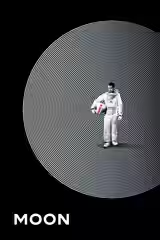
  2. Moon (2009, Fi1m 83)For another performance that makes questions of identity feel immediate and lonely.

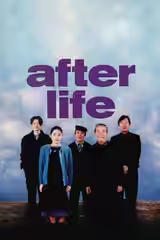
  3. After Life (1998) · not reviewed yetA patient Japanese film that gives memory and mortality concrete, everyday tasks.

  4. Solaris (1972, Fi1m 87)For a more demanding encounter with love, memory and another person’s apparent return.

  5. Marjorie Prime (2017) · not reviewed yetQuiet speculative drama asking how much of a person survives in recollection.