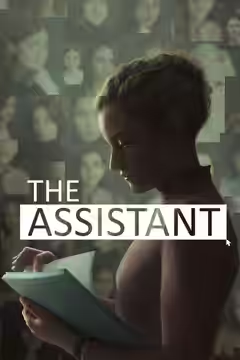
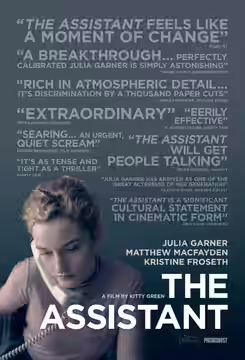
Kitty Green follows a junior assistant through one day at a film company whose boss is a voice on the phone. It is exact, quiet and hard to shake, and Julia Garner carries it almost without lines.
Kitty Green made documentaries before this, among them Casting JonBenet, and she has built The Assistant the way a documentary is built: one day, one office, one person, and a camera that does not go anywhere she cannot go. Jane (Julia Garner) is driven into the city before it is light and the film stays with her until she is driven home after dark. Nothing in between would count as an event anywhere else. She prints schedules, orders lunch, washes mugs, books a hotel, takes messages. We recommend it, and we should say plainly that the first half hour is meant to be a grind and that the grind is the point.
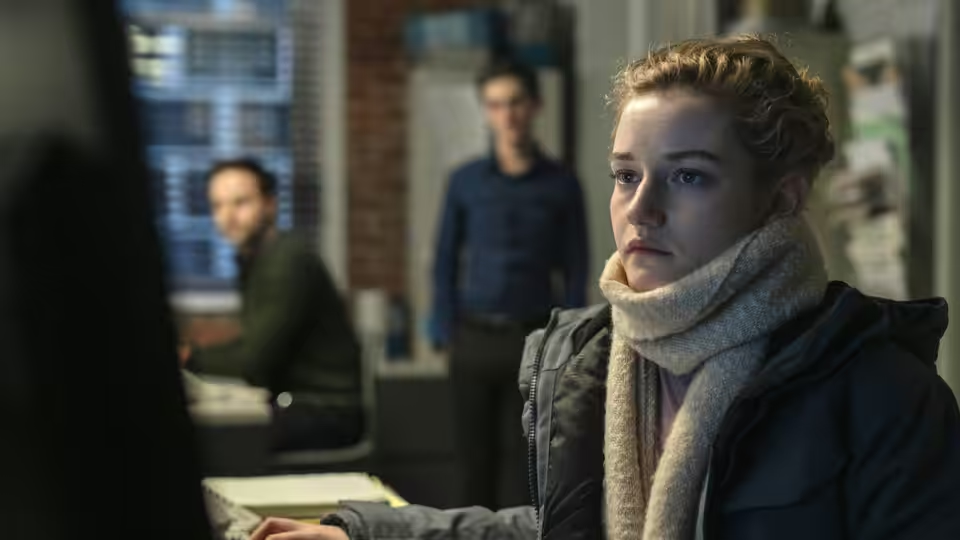
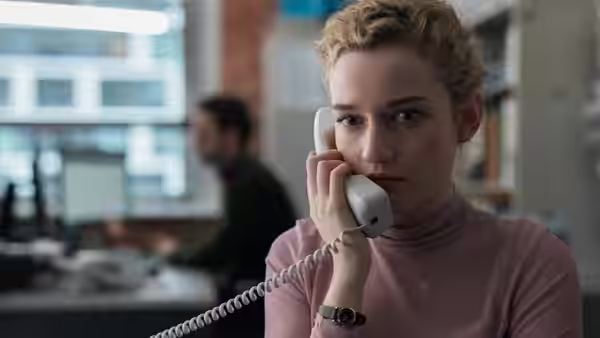
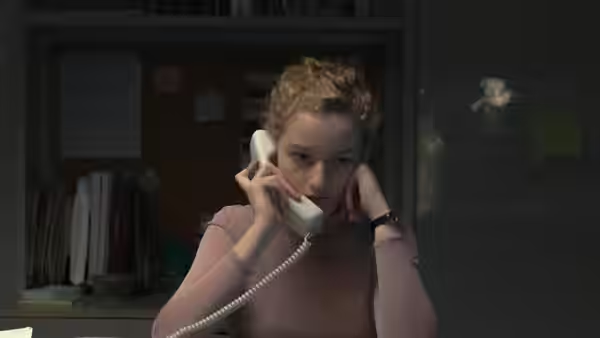
The morning is cleaning. Jane lifts a cushion on the boss’s sofa and scrubs at a stain underneath. She finds an earring on the carpet and puts it in a drawer. She picks a syringe out of a bin and says nothing. The boss’s wife, Ellen (Dagmara Dominczyk), rings twice to find out where her husband is, and Jane lies to her because that is the job. When the boss (Jay O. Sanders, a voice and a doorway and never a face) rings to shout at her, the two male assistants at the next desks (Jonny Orsini and Noah Robbins) stand behind her chair and tell her what to type. She is grateful for the opportunity. She will not let it happen again. Green has this happen twice, and the second time we understood that the email is not meant to fix anything. It is a form to be filled in.
Michael Latham shoots the office under its own ceiling lights with the blinds down, in greys and beiges, and he likes to put Jane at the far side of a wide frame so that the corridor behind her, and the door at the end of it, takes up more of the picture than she does. Fletcher Chancey’s production design gives us a row of desks, a glass partition, a kitchen with a bad coffee machine and a boss’s office we mostly see from outside. Tamar-kali’s score barely exists; what we hear for most of the 88 minutes is the photocopier, the phones, the lift and the hum of the lights. Green and Blair McClendon cut without hurry and refuse to shorten the chores, so when a print job takes a while, we wait for it.
Garner has perhaps two hundred words of dialogue and does the rest with her shoulders. She plays fear as good manners: a small nod, a tidy voice, eyes that go to the floor a fraction before anyone has said anything. When Sienna (Kristine Froseth) turns up from Idaho, a waitress with a new job she cannot describe and a hotel room she has not paid for, Jane takes her there in a taxi, and Garner’s face in the back seat is the film’s argument in one shot. We knew what she knew, and we knew she would go back to her desk.
She goes instead to Human Resources, to Wilcock (Matthew Macfadyen), and we will not tell you how that meeting ends. We will say it is the best scene in the film. Macfadyen plays a reasonable man who is on her side, who offers water and listens and asks sensible questions, and who by the end of a few minutes has made Jane feel that the problem in the room is her. We were angry when the scene finished, and we were still angry on the walk home, and it was not because anyone shouted. Nobody in this film ever shouts to her face.
It has limits, and Green chose them. Jane has no life outside the day: a call to her parents, a line about wanting to produce, and that is all. It keeps the film honest and it keeps her thin. The boss is a voice, a shadow behind frosted glass, and a rumble in the sound mix, and once or twice the mix turns him into something under the bed when the film is stronger treating him as a man who eats lunch. Some critics found the whole thing inert. We can see why. The method has one setting and it never changes gear.
It is 88 minutes and a 15 certificate. Watch it on a weeknight, after work, when you have already done a smaller version of Jane’s day. It will not feel much like a film then, which is what Green was after.