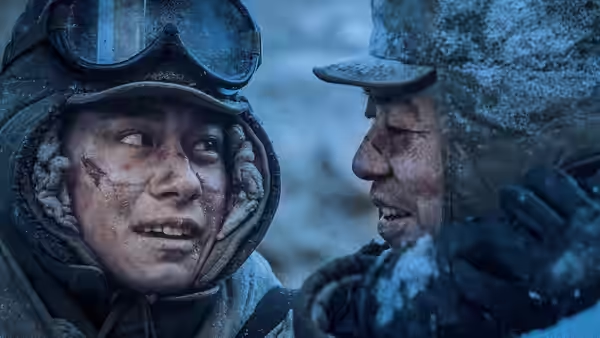
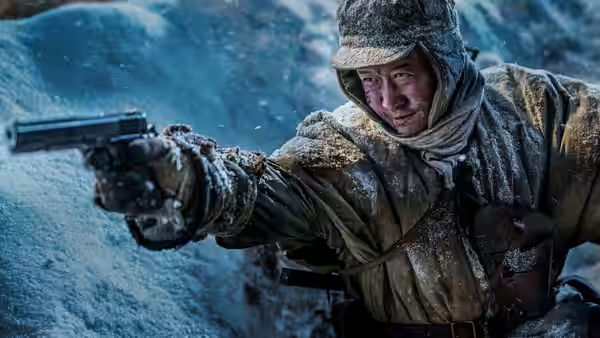
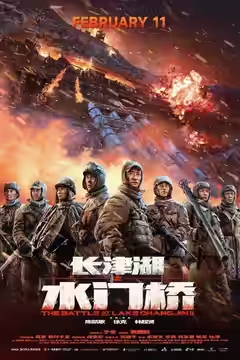
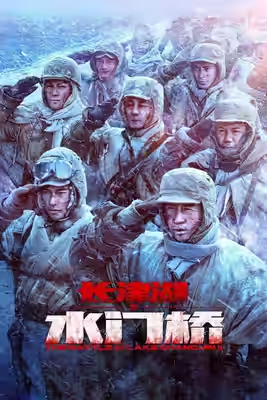
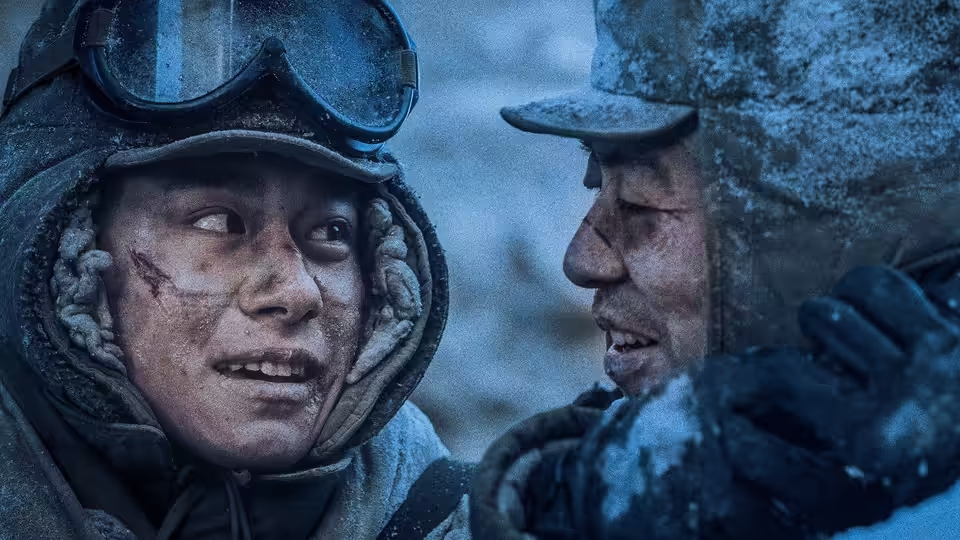
Two frost-covered soldiers in winter gear face each other on a snowy battlefield
Film review

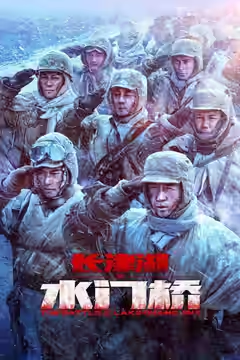
The Battle at Lake Changjin II: Water Gate Bridge

2022 · Directed by Tsui Hark, Chen Kaige, Dante Lam Chiu-yin · 2h 29m

In a sentenceMacArthur gets to be a cartoon while everyone else has to stand to attention

Wu Jing plays Wu Qianli, Jackson Yee plays Wu Wanli and Zhu Yawen plays Mei Sheng in this historical war film. The ensemble includes Yu Congrong (Jerry Lee), Ping He (Elvis Han Dongjun) and Song Shilun (Zhang Hanyu), with Geng Le as Battalion Commander Yang and Du Chun as Battalion Commander Zhang. Duan Yihong plays Tan Ziwei, Hu Jun plays Lei Jusheng and Wang Likun plays Mei Sheng’s Wife. Tsui Hark, Chen Kaige and Dante Lam Chiu-yin direct the 149-minute film.

Plays from YouTube when you press play; nothing loads from them until then.

Fi1m review

At 149 minutes, this war film wears down our patience with solemnity and stiff dialogue. Its ambition is evident, but the occasional burst of comic exaggeration cannot make it worth the slog.

The Battle at Lake Changjin II: Water Gate Bridge is a poor war film with enough ambition to make its failures frustrating. The directing credits name Tsui Hark, Chen Kaige and Dante Lam Chiu-yin, and the shared aim seems clear: to treat military endeavour with unbroken seriousness. There is nothing wrong with that starting point. The trouble is that the film makes reverence compulsory, leaving little room for people, and 149 minutes is a long time to spend being asked to pay our respects.

Wu Jing plays Wu Qianli, Jackson Yee plays Wu Wanli and Zhu Yawen plays Mei Sheng. The commitment of the performers is welcome, but the writing by Lan Xiaolong and Huang Jianxin allows earnestness to do too much of the work of character. Belief in a cause can make a soldier interesting; it cannot supply every detail of a personality. We wanted more awkwardness, more disagreement, or simply a conversation whose purpose was not to reinforce the film’s already settled position.

Elliot Leung’s music has to work within that narrow emotional range, and it does little to widen it. There is plenty of weight here, but too little variation in what we are being asked to feel. The same limitation affects the film’s scale: ambition is visible, yet the effort to make everything matter leaves too few moments that can be taken casually. A war film needs those smaller passages if we are to care about its soldiers between the fighting.

The MacArthur scenes are a welcome exception, allowing a cartoonish note to interrupt the solemnity. We laughed at that exaggeration, and felt relieved to be allowed a less dutiful response. The broadness is enjoyable because it changes the mood, even if it is hardly subtle characterisation. The English dialogue is much less successful: its stiffness keeps drawing attention to the lines themselves, and the humour cannot make every awkward exchange feel intentional.

The length makes these weaknesses harder to overlook. At 149 minutes, the film needs more than conviction to keep each stretch from feeling emotionally similar to the last. The cutting should have been tougher about how often we need to be told to take this seriously. War films can honour service while making room for fear, vanity, boredom or a bad joke; here the wish to remain respectful so often wins that the drama struggles to get started.

Viewers who want a reverent military spectacle may be willing to accept those limits, and it would be unfair to dismiss the seriousness of the effort. Our patience ran out with the stiff dialogue and the constant solemnity, not with the subject. The flashes of humour suggest how much a little freedom might have helped. We would choose something that gives its soldiers permission to be ordinary for a while.

Critical consensus AI synthesised

1 of 6
Positive
0
Mixed
0
Negative
1
The Guardian
20 December 2022 · Peter Bradshaw
30*

Bradshaw finds the war epic bloated and constrained by officially sanctioned earnestness, despite its ambition. He singles out the cartoony scenes involving MacArthur as enjoyable, while criticizing the wooden English dialogue.

Read the full review →

Straight answers AI written, from our review

Is The Battle at Lake Changjin II: Water Gate Bridge worth watching?
The Battle at Lake Changjin II: Water Gate Bridge is difficult to recommend; we score it 39/100 for its stiff dialogue, thin characterisation and relentless solemnity. Committed performances and occasional comic exaggeration offer some relief, but its 149 minutes chiefly suit viewers willing to accept those weaknesses for a reverent military spectacle.
How long is The Battle at Lake Changjin II: Water Gate Bridge, and what is it rated?
The Battle at Lake Changjin II: Water Gate Bridge runs 2h 29m. It is a war and history film.
Where can I watch The Battle at Lake Changjin II: Water Gate Bridge in France?
The Battle at Lake Changjin II: Water Gate Bridge is not on any streaming or rental service in France at the moment. It is available in 4 other countries; change your country at the top of the page to see where. Availability is checked daily.
How violent or frightening is The Battle at Lake Changjin II: Water Gate Bridge, and is it suitable for children?
The Battle at Lake Changjin II: Water Gate Bridge carries a UK 15 certificate, making it unsuitable for children under 15. The certificate indicates material intended for older teenagers and adults, but we cannot give a more precise account of violence or frightening imagery from the fighting noted in our review.
How does The Battle at Lake Changjin II: Water Gate Bridge compare to The Ascent?
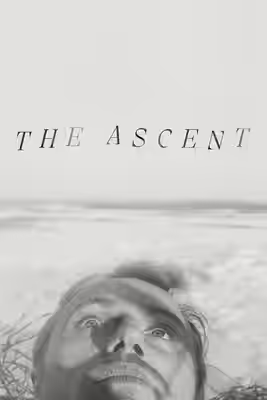
The Battle at Lake Changjin II: Water Gate Bridge is the weaker choice beside The Ascent, which we recommend for its exacting treatment of conscience under wartime pressure. Where Water Gate Bridge insists on reverence and patriotic certainty, The Ascent follows two partisans through snow, exhaustion and morally difficult choices; it is gruelling viewing, not a gentler alternative.
What should I watch after The Battle at Lake Changjin II: Water Gate Bridge?
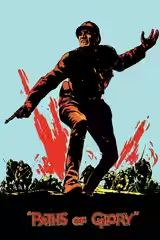
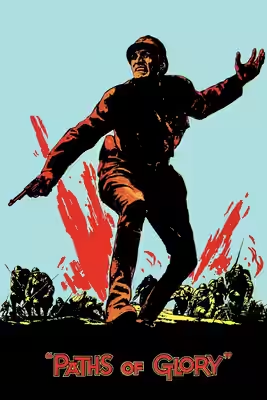
After The Battle at Lake Changjin II: Water Gate Bridge, try The Ascent (1977, Fi1m 88): Snow, exhaustion and choices that no amount of patriotic certainty can simplify. Then Paths of Glory (1957, Fi1m 93): Military authority receives the scrutiny that solemn speeches too often let it escape.

Cast

If you liked this, try…

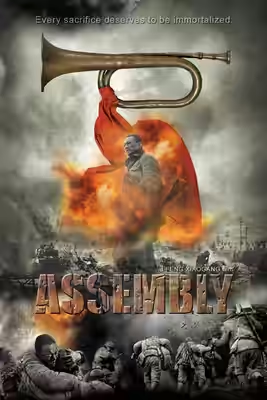
  1. Assembly (2007) · not reviewed yetA soldier’s duty becomes harder to separate from the cost of obedience.

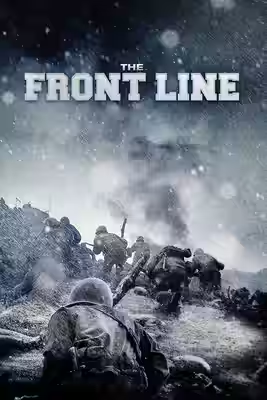
  2. The Front Line (2011) · not reviewed yetA contested hill gives military repetition a purpose beyond another explosion.

  3. The Ascent (1977, Fi1m 88)Snow, exhaustion and choices that no amount of patriotic certainty can simplify.

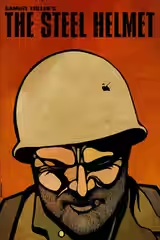
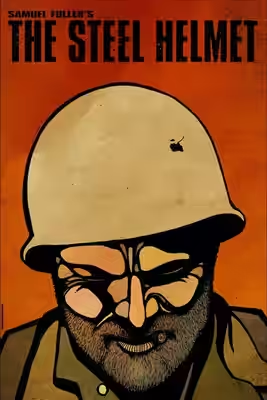
  4. The Steel Helmet (1951) · not reviewed yetA smaller Korean War film with more room for awkward human contradictions.

  5. Paths of Glory (1957, Fi1m 93)Military authority receives the scrutiny that solemn speeches too often let it escape.

Free account

Know what to watch tonight

Two lists that know where things are streaming, collections you can share, your own score beside ours, and Discover that remembers what you have seen.

  • Want to see, sorted by what is streaming now
  • Seen, with your score out of ten
  • No adverts, ever