Jim Carrey makes an unwanted friendship funny and uncomfortable, but Ben Stiller’s dark comedy gives its people too little substance. Worth considering for the performance, provided thin characters do not spoil the joke.
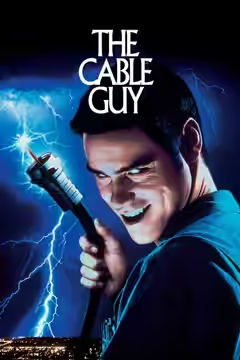
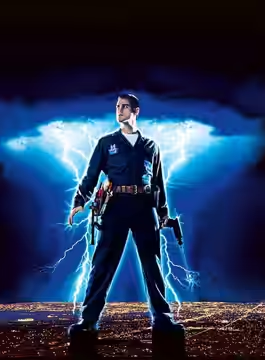
Ben Stiller’s The Cable Guy is an uneven black comedy worth considering for Jim Carrey, whose friendliness is almost as alarming as his aggression. A cable technician offers Steven extra channels for free, then becomes far too interested in his customer. The joke depends on how difficult it can be to reject somebody who insists he is helping. The discomfort is clear enough, but the screenplay by Lou Holtz Jr. gives the people involved too little substance to sustain it.
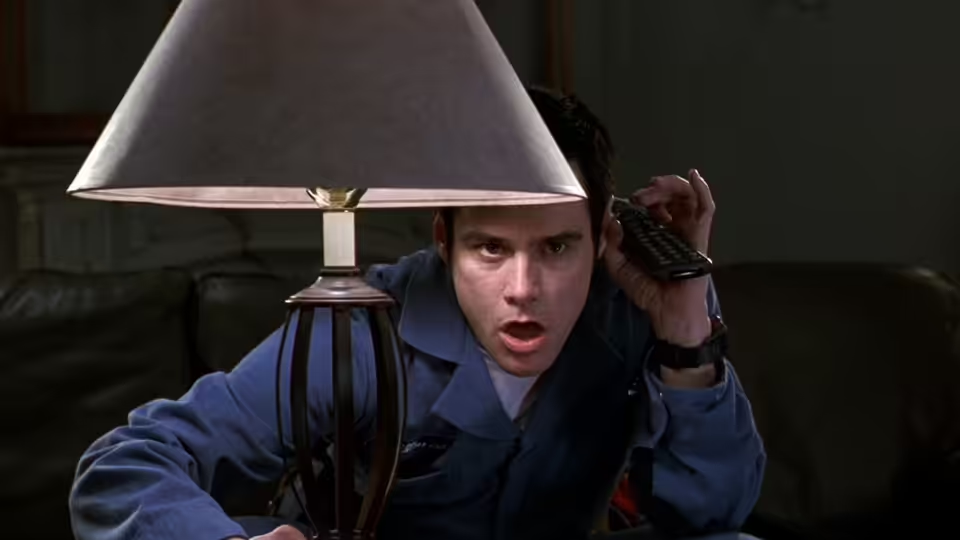
The Cable Guy’s eagerness makes ordinary courtesy feel risky. A little encouragement seems liable to be taken as a lasting commitment, and the physical comedy has the same pushy quality: he is funny without being easy company. We laughed at his eagerness, then wanted him to leave. The offer of free channels comes with so much unwanted attention that Steven’s discomfort becomes ours.
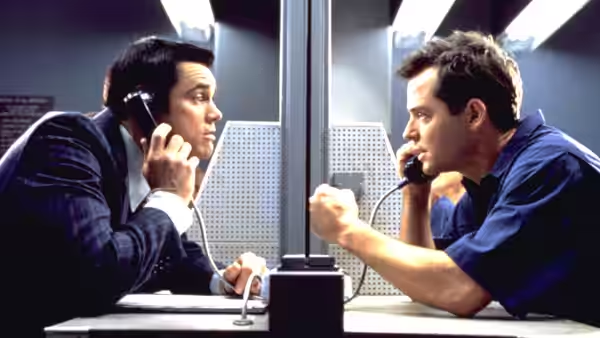
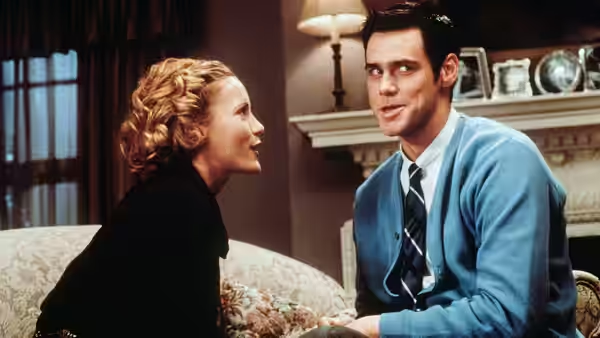
Matthew Broderick is useful as Steven because he does not try to match Jim Carrey’s energy. His restraint makes the technician seem more intrusive, although it also exposes how little Lou Holtz Jr. has written beyond the situation. Leslie Mann’s Robin and Jack Black’s Rick supply more people, but not enough reason to care about the disruption. For a comedy about somebody forcing his way into another person’s life, the film takes surprisingly little interest in that life.
Ben Stiller is more assured when directing the physical comedy. Robert Brinkmann’s camera gives Jim Carrey room to overdo things, and Steven Weisberg’s cuts keep the physical jokes moving. The trouble comes when another intrusion has to stand in for something new about either man. Individual passages are brisk and well handled, but at 96 minutes the film still has stretches where we are waiting for Steven to establish a boundary and for the script to move on.
Sharon Seymour’s production design is effective at giving the comedy an ordinary suburban setting for the technician to disturb. John Ottman’s music contributes to the unease, though the performance scarcely needs another nudge towards menace. The film has to let the inconvenience grow without losing the comedy of an unwanted visitor, and the strain becomes increasingly apparent. When the thriller becomes more emphatic, the nuisance becomes less funny, without Steven becoming much more interesting.
There is room here for a sharper comedy about television and the people who depend on it, but too much rests on Jim Carrey making the technician’s desperate need for company seem funny and alarming at the same time. The better black comedies make selfish or foolish people worth following without asking us to like them. Here, Jim Carrey provides most of that interest himself. Try it if an evening with an intrusive stranger sounds more promising than a comfortable comedy.