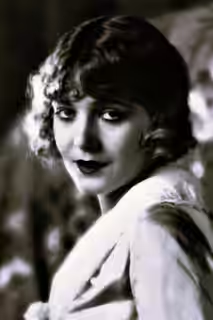
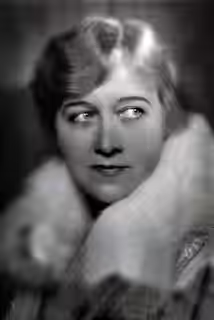
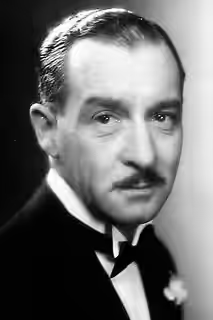
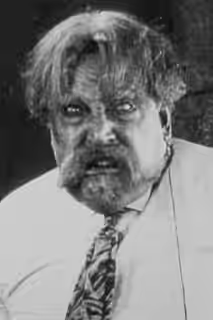
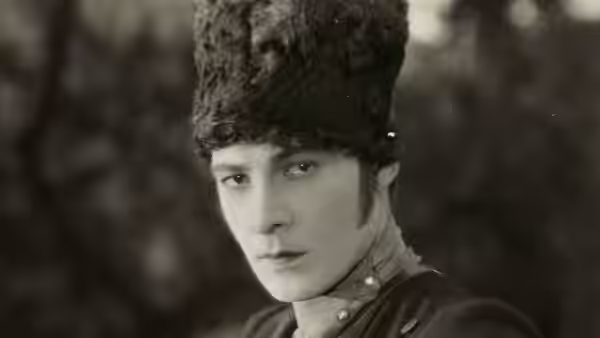
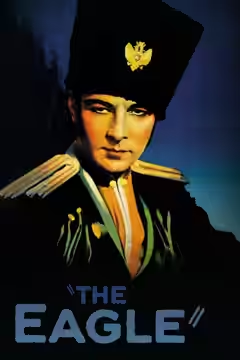
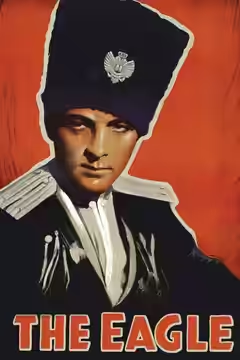
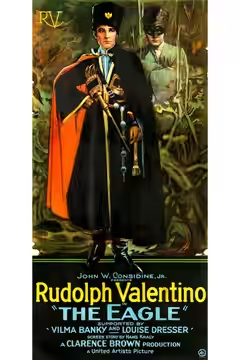
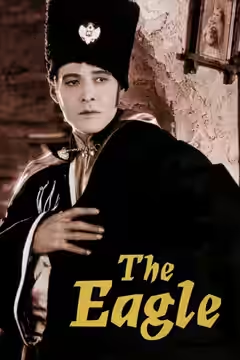
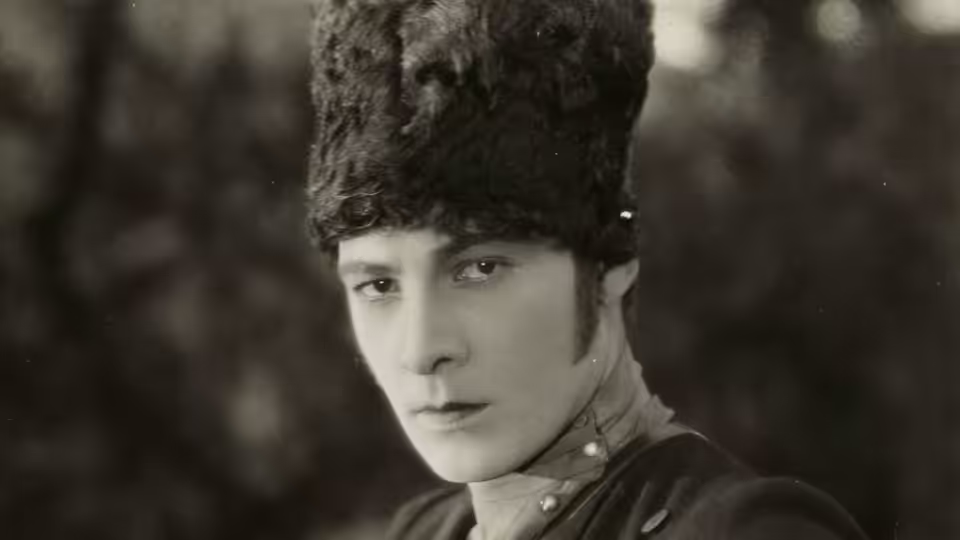
Lt. Vladimir Dubrovsky (Rudolph Valentino) wearing a tall fur hat and military uniform
Film review

The Eagle

1925 · Directed by Clarence Brown · 1h 13m

In a sentenceRudolph Valentino has the leading role; Louise Dresser seems quite prepared to requisition it

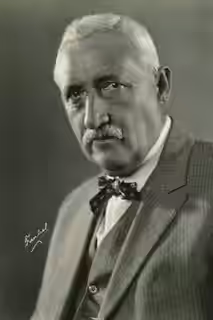
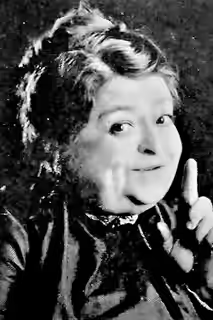
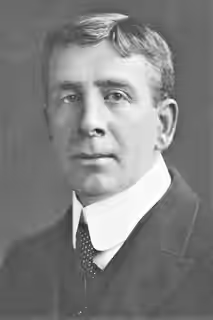
Lt. Vladimir Dubrovsky (Rudolph Valentino) is the central figure in an adventure combining romance and comedy. Around him are Mascha Troekouroff (Vilma Bánky), Catherine II (Louise Dresser), and Kyrilla Troekouroff (James A. Marcus). The officer’s story brings together military rank, imperial authority and the Troekouroff family, with Valentino taking the leading romantic role. Albert Conti plays Kuschka, while Carrie Clark Ward appears as Aunt Aurelia. Directed by Clarence Brown from Hanns Kräly’s screenplay, The Eagle draws on a novel by Alexander Pushkin and runs 73 minutes.

Fi1m review

Clarence Brown’s adventure gets considerable mileage from Rudolph Valentino’s charm and Louise Dresser’s amused authority. The romance is less persuasive than the comedy, but the brisk running time helps keep its limitations manageable.

The Eagle works best when it allows its leading man to be amusing. Clarence Brown’s adventure gives Rudolph Valentino room to suggest that being handsome need not be a solemn occupation, and that makes him agreeable company. We recommend it as a light entertainment, with reservations about a romance that does not always earn the attention it receives. Across 73 minutes, the balance of adventure, affection and comedy is sufficiently lively to carry the less engaging passages.

Valentino plays Lt. Vladimir Dubrovsky with an appeal that depends on more than the audience accepting him as desirable. There is pleasure in the difference between his formal bearing and the lighter impression he makes within it. Brown gives that quality sufficient attention; the leading performance does not become merely an excuse for the next piece of action. By the standards of romantic adventure, this is a useful strength: the company matters, particularly when the story asks us to take its hero’s attractions for granted.

Louise Dresser supplies the sharper pleasure as Catherine II. She makes authority funny without making it seem harmless, and her performance has a confidence that Valentino can profitably encounter rather than simply dominate. We laughed at Dresser’s enjoyment of imperial importance; she makes the character’s rank feel like a personal advantage she has every intention of enjoying. Her contribution also exposes a weakness elsewhere, because the comedy gives us a more immediate reason to watch closely than the love story does.

Vilma Bánky’s Mascha Troekouroff is an appealing presence, but the romantic emphasis can feel more dutiful than persuasive. Bánky and Valentino are easy to look at together; we were less consistently persuaded to care about them together. Hanns Kräly’s screenplay, drawn from a novel by Alexander Pushkin, is more satisfying when judged for its lightness than for emotional depth. That is not a demand for heavier treatment, merely for the romantic passages to hold our attention as readily as Dresser’s performance does.

George Barnes’s cinematography serves the performers well: faces remain the chief attraction, and the attention given to Valentino feels justified by what he contributes. Adrian’s costume design supports the distinction in bearing between the officer and the imperial figure, helping the performances establish their relative importance. Hal C. Kern’s editing keeps the entertainment moving, though briskness cannot make every romantic passage equally absorbing. These are useful, complementary contributions, and Brown’s direction benefits from their willingness to keep the people prominent within an adventure.

The mixture is more rewarding than any expectation of a sustained romantic spell would suggest. Brown understands that a leading man can remain attractive while allowing somebody else to be funnier, and Dresser makes full use of that freedom. The reservations matter, but they need not rule out an evening with a film this compact and this amiable about its pleasures. Choose it for Valentino with a lighter touch, and leave room for Dresser to become the main attraction.
Critical consensus AI synthesised

3 of 6
Positive
1
Mixed
2
Negative
0
Time Out
· TR
70*

The review appears favorable toward Brown’s direction. It singles out his ability to preserve human interest amid large-scale action.

Read the full review →
Variety
31 December 1924 · Variety Staff
65*

The review is favorable, presenting Valentino as a vigorous modern Russian Robin Hood. It especially praises Louise Dresser, saying she handles herself superbly and is nearly as central to the picture as Valentino.

Read the full review →
The New Yorker
14 November 1925 · Theodore Shane
64*

The page confirms a review of the film, but does not provide the critic’s verdict. Its listing says the review discusses Rudolph Valentino, Vilma Banky, Louise Dresser, and a dispute with Edna Ferber.

Read the full review →

Straight answers AI written, from our review

Is The Eagle worth watching?
The Eagle is worth watching for its light comedy and Rudolph Valentino’s charm, and we score it 70 out of 100. We find Louise Dresser’s amused imperial authority more engaging than the uneven romance, but the brisk 73-minute running time makes this an agreeable choice for an evening’s light entertainment.
How long is The Eagle, and what is it rated?
The Eagle runs 1h 13m. It is an adventure and romance film.
Where can I watch The Eagle in Norway?
The Eagle is not on any streaming or rental service in Norway at the moment. It is available in 2 other countries; change your country at the top of the page to see where. Availability is checked daily.
How does The Eagle compare to The Adventures of Robin Hood?
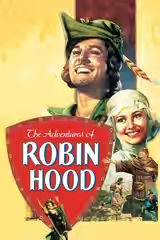
The Eagle is an amiable romantic adventure, but we recommend The Adventures of Robin Hood more strongly for its clear storytelling, good humour and Errol Flynn’s leading performance. Choose the Technicolor swashbuckler for romance and rebellion; choose The Eagle for Valentino’s lighter touch and Louise Dresser’s comedy, with a less persuasive love story.
Is The Eagle based on a true story or a book?
The Eagle is adapted from a novel by Alexander Pushkin, with a screenplay by Hanns Kräly, rather than presented as a true story. We recommend it for the lightness of its comedy and the appeal of its performers; familiarity with the novel is not the reason to watch.

Cast

If you liked this, try…

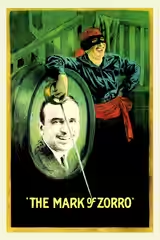
  1. The Mark of Zorro (1920) · not on Fi1m yetDouglas Fairbanks makes romantic adventure feel like an unusually enjoyable physical exercise.

  2. The Adventures of Robin Hood (1938, Fi1m 90)For romance and rebellion handled with colour, clarity and welcome good humour.

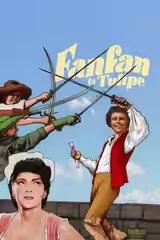
  3. Fanfan la Tulipe (1952) · not on Fi1m yetA French alternative with an appetite for flirtation and cheerfully improbable adventure.

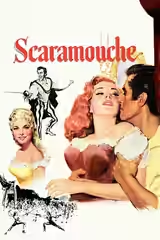
  4. Scaramouche (1952) · not on Fi1m yetDisguise, romance and swordplay, with enough comic ease to keep solemnity away.

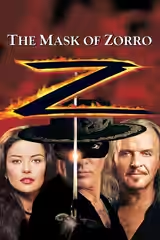
  5. The Mask of Zorro (1998) · not on Fi1m yetA later swashbuckler that remembers charm is as important as competent swordsmanship.

The Eagle (1925) review: charm and comedy outweigh thin romance (Norway) | Fi1m