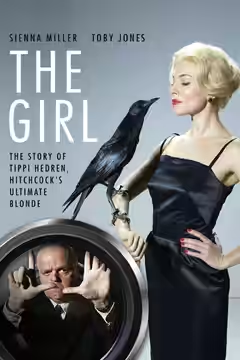
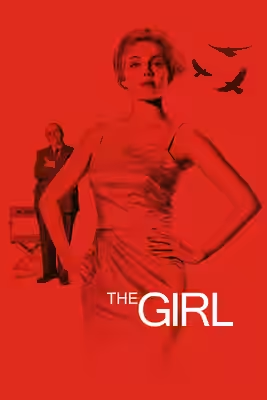
Toby Jones and Sienna Miller make The Girl worth considering for its performances. This is an unsettling backstage drama, but Gwyneth Hughes’s blunt screenplay gives its characters too little room beyond obsession and abuse.
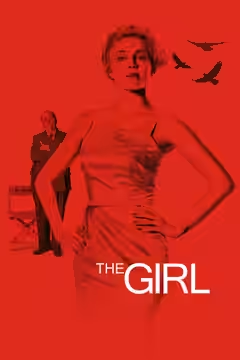
Julian Jarrold’s The Girl takes the business of making a star and asks what happens when the director treats the actress as someone he owns. Its performances justify a look, though the drama is narrow and often blunt. The story concentrates on Alfred Hitchcock’s obsession with Tippi Hedren, with little patience for the reassuring notion that artistic distinction excuses private behaviour. Gwyneth Hughes’s screenplay makes the abuse unmistakable, then struggles to tell us enough about the people involved.
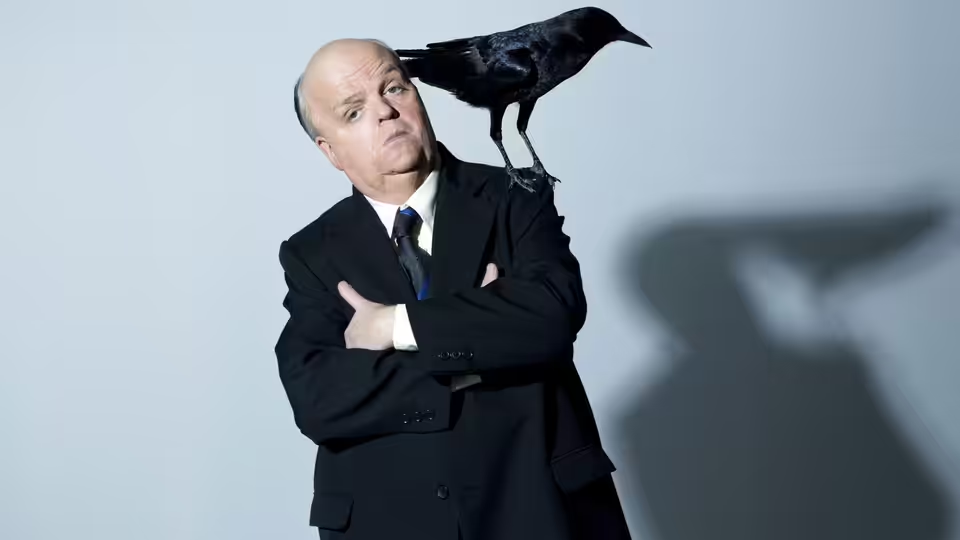
Toby Jones gives the director an unnerving precision, making the impersonation persuasive without allowing it to become the whole performance. The interest is in the attention he directs towards Hedren and how quickly that attention feels oppressive. We do not need a tidy diagnosis of the man, and the film is right not to offer one. But as the behaviour becomes more emphatic, the script leaves the actor fewer possibilities, until we begin to anticipate what a scene will tell us before it has properly started.
Sienna Miller has the difficult job of keeping Hedren present as a person while the story repeatedly positions her as the object of someone else’s attention. Her performance keeps us concerned for Hedren, but the writing does not provide enough independent life around the ordeal. We felt queasy during the hair-dyeing: the preparation of an actress becomes an uncomfortable example of how closely her appearance is managed. That concrete detail tells us more about the working relationship than another explanation of the director’s obsession would.
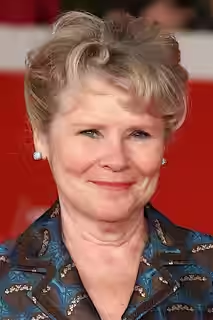
Imelda Staunton, as Alma Reville Hitchcock, is valuable because her presence makes us consider the people around the central pair. She suggests a complicated response to the director without requiring the screenplay to spell out every thought. There is a more expansive drama available in that circle, about the people who accommodate a powerful man and the reasons they find for doing so. The film gives it too little space.
John Pardue’s carefully composed shots of Hedren on set make the attention paid to her visible and oppressive. Darryl Hammer’s production design helps those scenes register as a workplace, where the abuse belongs to the everyday business of getting a film made. The restraint suits the subject: there is no need to make suffering exciting for it to hold our attention. As a backstage drama, this is most persuasive when the work itself helps us understand how much power the director has.
Andrew Hulme’s editing gives the 91-minute film a practical economy, though the central situation still begins to feel repetitive. Philip Miller’s music sustains the unease, but cannot provide the psychological detail missing from the script. Too often, a scene confirms a judgement we have already reached without changing our understanding of either character. The screenplay spends too long confirming the director’s cruelty, leaving the actors to find what complexity they can.
A backstage drama ought to have room for the actress’s work as well as the director’s fixation. Here we kept wanting more of Hedren’s life to enter the frame, rather than another confirmation of what she faces. That may be enough to frustrate viewers looking for a fuller portrait. Go cautiously, for the actors, and do not expect the writing to satisfy every question they raise.