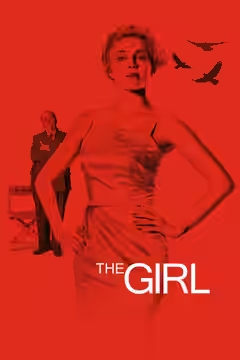
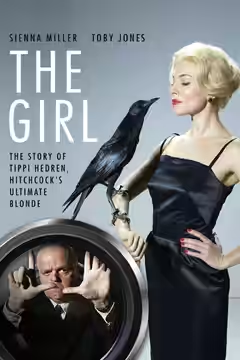
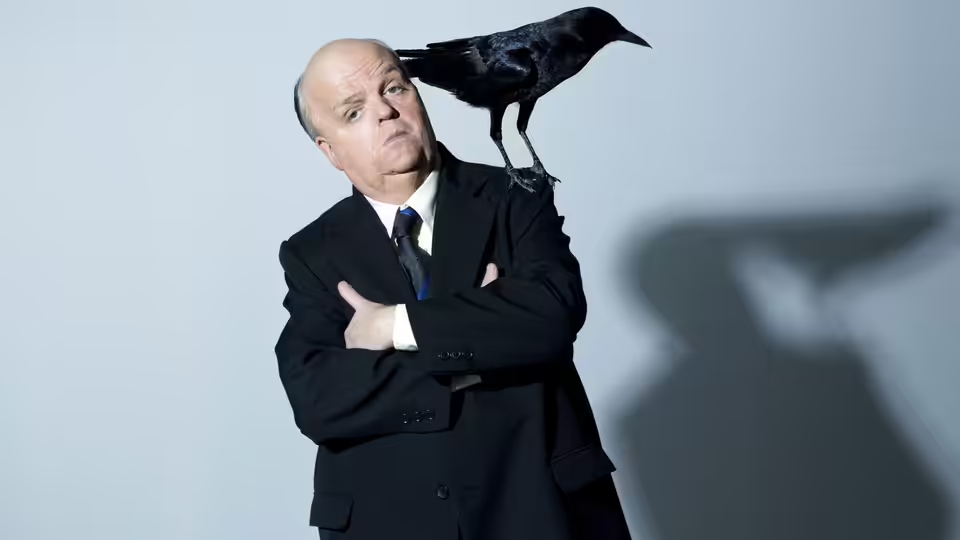
Alfred Hitchcock (Toby Jones) stands with a crow perched on his shoulder, arms crossed
Film review

The Girl

2012 · Directed by Julian Jarrold · 1h 31m

In a sentenceToby Jones makes being discovered by a famous director look like a good reason to change careers

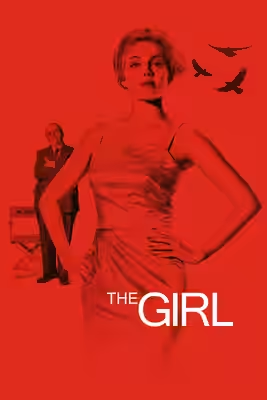
Alfred Hitchcock (Toby Jones) makes Tippi Hedren (Sienna Miller) his star, bringing her into a filmmaking partnership complicated by his sexual obsession. Hedren wants to establish herself as an actress, but the director’s interest extends beyond her work. Around them are Alma Reville Hitchcock (Imelda Staunton) and Peggy Robertson (Penelope Wilton), part of the director’s filmmaking circle. On set, Hedren is the focus of both the production and the man overseeing it. Even dyeing her hair becomes part of the attention paid to her appearance. Her opportunity depends on working with the director whose control increasingly intrudes upon her life.

Plays from YouTube when you press play; nothing loads from them until then.

Fi1m review

Toby Jones and Sienna Miller make The Girl worth considering for its performances. This is an unsettling backstage drama, but Gwyneth Hughes’s blunt screenplay gives its characters too little room beyond obsession and abuse.

Julian Jarrold’s The Girl takes the business of making a star and asks what happens when the director treats the actress as someone he owns. Its performances justify a look, though the drama is narrow and often blunt. The story concentrates on Alfred Hitchcock’s obsession with Tippi Hedren, with little patience for the reassuring notion that artistic distinction excuses private behaviour. Gwyneth Hughes’s screenplay makes the abuse unmistakable, then struggles to tell us enough about the people involved.

Toby Jones gives the director an unnerving precision, making the impersonation persuasive without allowing it to become the whole performance. The interest is in the attention he directs towards Hedren and how quickly that attention feels oppressive. We do not need a tidy diagnosis of the man, and the film is right not to offer one. But as the behaviour becomes more emphatic, the script leaves the actor fewer possibilities, until we begin to anticipate what a scene will tell us before it has properly started.

Sienna Miller has the difficult job of keeping Hedren present as a person while the story repeatedly positions her as the object of someone else’s attention. Her performance keeps us concerned for Hedren, but the writing does not provide enough independent life around the ordeal. We felt queasy during the hair-dyeing: the preparation of an actress becomes an uncomfortable example of how closely her appearance is managed. That concrete detail tells us more about the working relationship than another explanation of the director’s obsession would.

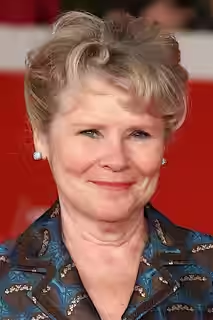
Imelda Staunton, as Alma Reville Hitchcock, is valuable because her presence makes us consider the people around the central pair. She suggests a complicated response to the director without requiring the screenplay to spell out every thought. There is a more expansive drama available in that circle, about the people who accommodate a powerful man and the reasons they find for doing so. The film gives it too little space.

John Pardue’s carefully composed shots of Hedren on set make the attention paid to her visible and oppressive. Darryl Hammer’s production design helps those scenes register as a workplace, where the abuse belongs to the everyday business of getting a film made. The restraint suits the subject: there is no need to make suffering exciting for it to hold our attention. As a backstage drama, this is most persuasive when the work itself helps us understand how much power the director has.

Andrew Hulme’s editing gives the 91-minute film a practical economy, though the central situation still begins to feel repetitive. Philip Miller’s music sustains the unease, but cannot provide the psychological detail missing from the script. Too often, a scene confirms a judgement we have already reached without changing our understanding of either character. The screenplay spends too long confirming the director’s cruelty, leaving the actors to find what complexity they can.

A backstage drama ought to have room for the actress’s work as well as the director’s fixation. Here we kept wanting more of Hedren’s life to enter the frame, rather than another confirmation of what she faces. That may be enough to frustrate viewers looking for a fuller portrait. Go cautiously, for the actors, and do not expect the writing to satisfy every question they raise.

Critical consensus AI synthesised

59
Positive
3
Mixed
3
Negative
2

The reviews are mixed, with praise clustering around the performances and the interest of the Hitchcock–Hedren relationship rather than the film’s strength as a standalone drama. Toby Jones’s portrayal of Hitchcock draws repeated approval for its precision, even from critics who find the writing thin. The backstage material also holds attention, while some favourable reviews value the restrained treatment of abuse and the care given to its psychological detail.

The spread is wide, and the sharpest disagreement concerns how much the film explains about its characters. The Guardian finds Jones’s unresolved motives compelling and regards the study of obsession highly. The Hollywood Reporter instead finds the script superficial, reducing a complex relationship to overly literal terms. Elsewhere, reservations concern the drama’s ability to sustain itself beyond its subject’s fascination; Vulture praises the composed images and Hitchcock references but finds the storytelling insufficiently imaginative and the resolution unconvincing.

The Guardian
26 December 2012 · John Crace
90*

Crace calls the film a class act and a peerless study of sexual obsession. He particularly praises Toby Jones’s portrayal of Hitchcock, which leaves the director’s motives intriguingly unresolved.

Read the full review →
Slant Magazine
12 October 2012 · Daniel Goldberg
70*

Goldberg finds the film a measured, harrowing portrait that stays with the viewer, though it lacks Hitchcock’s thrills and catharsis. He praises its pragmatic style and psychological detail in portraying Hedren’s abuse without sensationalizing it.

Read the full review →
Time Out
16 October 2012
70*

The review finds HBO’s look at Hitchcock and Hedren fascinating as a backstage drama. It praises the film’s behind-the-scenes focus.

Read the full review →
Film Comment
· Violet Lucca
64*

The page identifies this as a review pairing The Girl with Hitchcock, but the critic’s verdict is not visible. The available text frames the comparison around film history versus film fantasy, without revealing what the critic praises or faults.

Read the full review →
The Hollywood Reporter
6 October 2012 · festival review · David Rooney
60*

Rooney finds the film entertaining and absorbing, but ultimately superficial and short on psychological insight. He praises Toby Jones’s technically precise Hitchcock portrayal while faulting the script for reducing the characters’ complex dynamic to literal, shallow terms.

Read the full review →
The New Yorker
18 October 2012 · Richard Brody
50*

Brody finds the film mediocre as a drama but irresistibly fascinating as criticism of Hitchcock’s films and abuses. He singles out Imelda Staunton’s performance as Alma and the film’s depiction of Hedren’s hair dyeing as especially revealing.

Read the full review →

Straight answers AI written, from our review

Is The Girl worth watching?
The Girl is worth considering for Toby Jones and Sienna Miller’s unsettling performances, and we score it 64 out of 100. We recommend it cautiously to those interested in backstage dramas: the acting holds our attention, but the blunt, repetitive screenplay offers too little of Hedren’s life beyond Hitchcock’s obsession.
How long is The Girl, and what is it rated?
The Girl runs 1h 31m. It is a drama film.
Where can I watch The Girl in Hong Kong?
The Girl is not on any streaming or rental service in Hong Kong at the moment. It is available in 3 other countries; change your country at the top of the page to see where. Availability is checked daily.
How does The Girl compare to The Assistant?
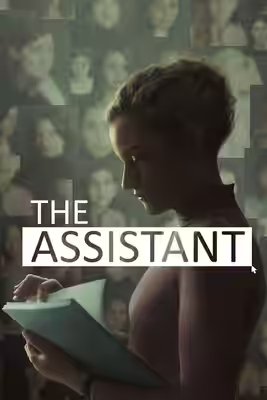
The Girl is more direct and less patient than The Assistant, which we recommend as the stronger account of workplace abuse and the routines protecting it. Jones and Miller give The Girl its main appeal; The Assistant suits viewers who prefer quiet observation, following a junior employee through a working day with the boss largely reduced to a voice on the phone.
What should I watch after The Girl?
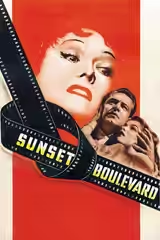
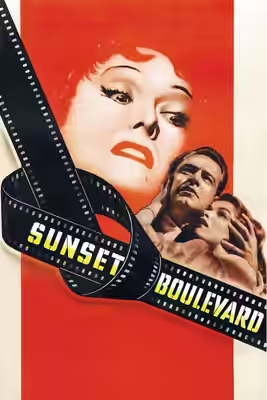
After The Girl, try The Assistant (2019, Fi1m 81): A quieter, more patient account of workplace abuse and the routines protecting it. Then Sunset Boulevard (1950, Fi1m 91): Hollywood ambition curdles into dependency, with more room for wit and desperation.

Cast

If you liked this, try…

  1. The Assistant (2019, Fi1m 81)A quieter, more patient account of workplace abuse and the routines protecting it.

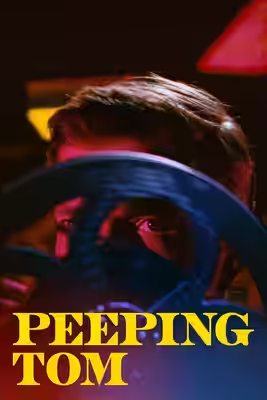
  2. Peeping Tom (1960) · not reviewed yetAnother disturbing look at a filmmaker whose attention becomes a threat.

  3. Clouds of Sils Maria (2014) · not reviewed yetAn actress and her assistant negotiate the uncomfortable overlap between work and intimacy.

  4. The Bitter Tears of Petra von Kant (1972) · not reviewed yetProfessional authority and sexual obsession turn an enclosed workplace into an ordeal.

  5. Sunset Boulevard (1950, Fi1m 91)Hollywood ambition curdles into dependency, with more room for wit and desperation.

Free account

Know what to watch tonight

Two lists that know where things are streaming, collections you can share, your own score beside ours, and Discover that remembers what you have seen.

  • Want to see, sorted by what is streaming now
  • Seen, with your score out of ten
  • No adverts, ever