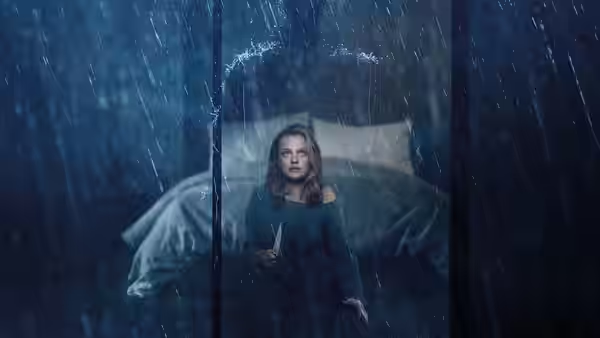
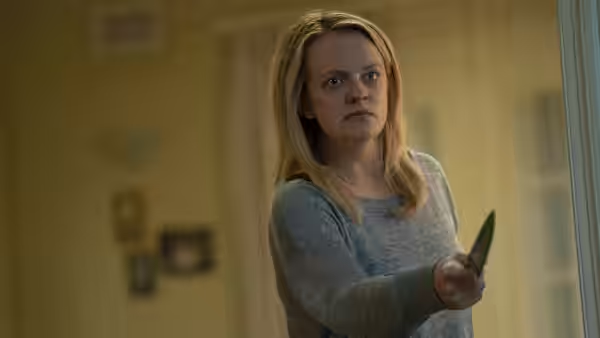
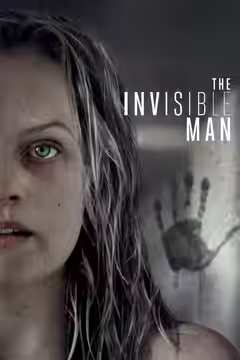
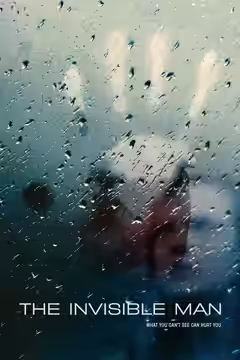
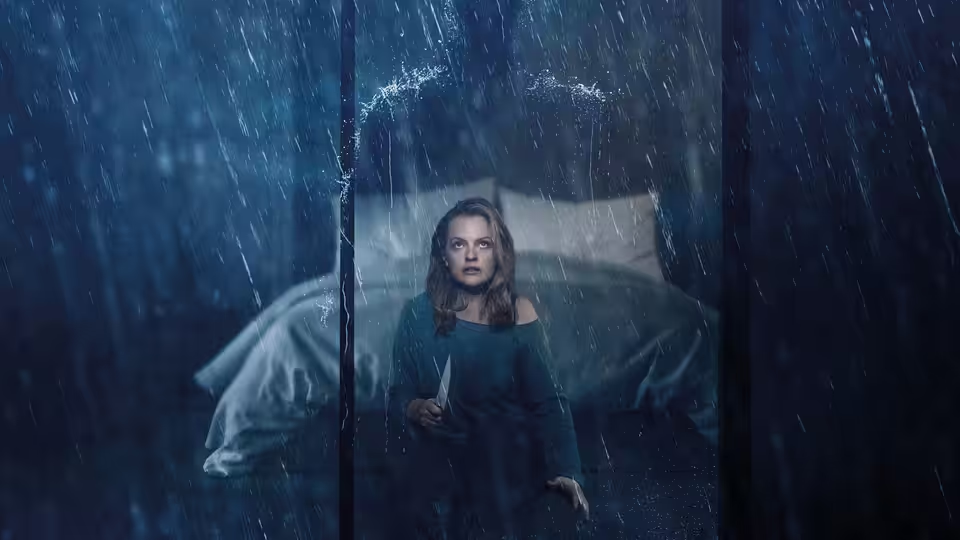
A woman sits on a bed behind rain-streaked glass, clutching a small object
Film review

The Invisible Man

2020 · Directed by Leigh Whannell · 2h 04m · MPA R

In a sentenceElisabeth Moss is told she is imagining it for two hours while the furniture disagrees

Cecilia Kass (Elisabeth Moss) gets out of her relationship with Adrian Griffin (Oliver Jackson-Cohen), a man who has controlled where she goes and whom she sees. Her sister Emily (Harriet Dyer) helps her leave. She takes refuge with a friend, James Lanier (Aldis Hodge), and his daughter Sydney (Storm Reid), and for weeks she can hardly bring herself past the front door. Then Adrian’s brother Tom (Michael Dorman) brings word that Adrian is dead. Cecilia begins to sleep again. Then, alone in James’s kitchen, she notices something has moved that she did not move. Nobody else sees anything. Nobody believes her. She becomes certain that Adrian is not dead, and has found a way to stand in a room without being seen.

Plays from YouTube when you press play; nothing loads from them until then.

Fi1m review

Leigh Whannell turns H. G. Wells’s monster into a controlling ex and, for an hour, makes an empty corner of a room the most frightening thing on screen. Elisabeth Moss is superb; the second half settles for a thriller with a body count.

Leigh Whannell has kept H. G. Wells’s title and almost nothing else. His invisible man is Adrian Griffin, a controlling partner, and he is barely in the film; it belongs to Cecilia, the woman who left him, and it is about what happens to a woman nobody believes. It runs 124 minutes and carries a 15. For an hour it is as controlled a horror film as we have seen in years. Then it has to show how the trick is done, and after that it is a good thriller rather than a frightening one.

Elisabeth Moss plays Cecilia, in the early scenes, as someone who has forgotten how to take up space. Her shoulders are pulled in, her eyes stay on the floor, and a stranger passing the house is enough to send her back inside. Whannell gives her few lines and she does not need them; you can read on her face which doorways and corners she has already checked. When the film later asks her to be quick and fierce she is, but it is the frightened woman at the start we believed, and that performance holds when the script wobbles.

The fear is made with the camera, and Stefan Duscio makes it patiently. He shoots rooms wide, Moss to one side and a great deal of nothing beside her, then drifts to a chair, a doorway, the end of a hall, and waits. Usually nothing happens. Alex Holmes designs Adrian’s house in concrete and glass, every wall a window; James’s house is wood and clutter and family photographs, and the film makes that frightening too, which is harder. Benjamin Wallfisch’s score is mostly a low mechanical hum kept so quiet that you notice when it stops, and Whannell and his editor Andy Canny let silences run well past the point where most horror films would have cut.

Here is what it did to us. For most of an hour we were looking at the wrong part of the screen on purpose. Moss would be talking in the middle of the frame and we would be checking the corners, the space behind her, the door she had left open. An early scene in the kitchen, Moss alone and the camera holding on the empty half of the kitchen, is built out of nothing, and it had us properly scared.

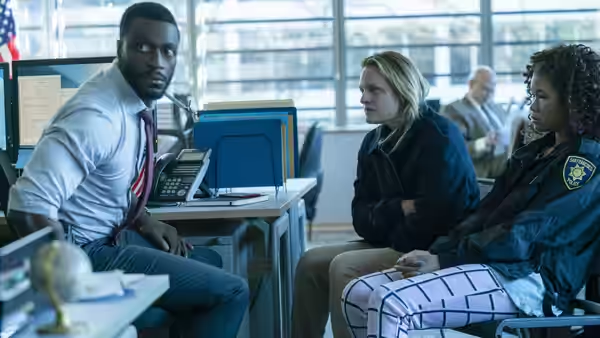
Aldis Hodge plays James, the friend who takes her in, with a steadiness that makes his doubt hurt more than hostility would. Storm Reid, as his daughter Sydney, watches everything and says little. Harriet Dyer’s Emily is a sister whose patience has a bottom to it. Oliver Jackson-Cohen is barely on screen as Adrian and the film keeps him in our heads anyway, because everyone talks about him the way you talk about weather that is on its way. Michael Dorman, as Adrian’s brother Tom, is exactly as pleasant as a man bringing news should be.

The trouble is the second half. Once we have seen how Adrian does it, dread turns into plot, and the plot does not survive a moment’s thought. Institutions behave as the film needs them to. People stand where the next scare needs them to stand. There is a fight through a treatment centre that belongs in a louder film. The second act takes a turn we will not describe, and the third ties everything off more neatly than the first hour had promised. In the last forty minutes we noticed we were no longer frightened, only interested, and we minded.

Then there is what the film is using. It is about coercive control, a man isolating a woman until nobody will take her word, and it uses that to make us jump. A few critics have found this exploitative. We think it mostly earns the right, because Moss never lets us forget what it is costing Cecilia, but the balance tips at the end, when her story becomes a mechanism for a finale. Watch it in the dark, with someone whose arm you can grab, and save the plot for the walk home, where it will not survive and will not need to.

Critical consensus AI synthesised

72
Positive
22
Mixed
3
Negative
4

Most critics come away rattled and impressed. The reviews are broadly positive, and the praise lands in two places: Elisabeth Moss, whose performance as Cecilia is singled out almost without exception for making her fear feel immediate and her resourcefulness credible, and Whannell’s direction, which builds dread from empty rooms, silence and a camera that lingers where nothing appears to be. Many also credit the film for turning H.G. Wells’s premise into a story about domestic abuse and disbelief.

The reservations cluster in the second half. Several critics find the plot develops holes, the final third runs long and the climax lands weakly. The dissenters go further: Slant Magazine and Polygon argue the film treats Cecilia’s trauma as a plot device rather than a subject, The New Yorker finds the direction thin and the ideas undeveloped, and IndieWire calls it muddled. The spread is wide at the bottom, but the bulk of the reviews sit comfortably in approval.

Los Angeles Times
26 February 2020 · Justin Chang
85*

Chang finds the film an intimate, expertly crafted and unsettling horror thriller that resonates with contemporary fears about abuse and disbelief. He especially praises Elisabeth Moss’s performance, whose quiet expressions of terror make Cecilia’s experience feel immediate.

Read the full review →
Variety
24 February 2020 · Critics Pick · Owen Gleiberman
85*

Gleiberman calls the film an ingenious, entertaining thriller with emotional force. He particularly praises Elisabeth Moss’s portrayal of a woman whose abuse goes unseen and disbelieved.

Read the full review →
The AV Club
25 February 2020 · B+ · Jesse Hassenger
83

Hassenger finds the film striking and tense, though not especially rich. He praises Elisabeth Moss’s performance for combining vulnerability with resourcefulness and making Cecilia’s perspective compelling.

Read the full review →
Empire
25 February 2020 · John Nugent
82*

The review finds the film tense, thematically rich and a bold, fresh reinvention, though it becomes more conventional as it progresses. It praises Elisabeth Moss’s performance and Whannell’s restrained use of camera movements to build dread.

Read the full review →
Evening Standard
27 February 2020 · ★★★★ · Charlotte O'Sullivan
80

O'Sullivan finds the film a timely, effective monster movie, though its plot holes and cheesy ending weaken it. She especially praises the clever camera-work and Elisabeth Moss's performance.

Read the full review →
Little White Lies
26 February 2020 · 3/4/3 · Hannah Strong
80

Strong finds the film an inventive, satisfying horror that updates its source material effectively, though its plot develops cracks on reflection. She praises Elisabeth Moss’s performance and the film’s technical craft, especially its use of empty space and sound to create tension.

Read the full review →

Straight answers AI written, from our review

Is The Invisible Man worth watching?
The Invisible Man is worth watching for anyone who wants an hour of patient, properly frightening horror and can forgive a louder second half, and we scored it 76. Elisabeth Moss is superb as a woman nobody believes, and Stefan Duscio's camera makes empty corners of rooms terrifying. Once the film shows how the trick is done, it becomes a good thriller rather than a scary one.
How long is The Invisible Man, and what is it rated?
The Invisible Man runs 2h 04m and is rated R by the MPA in the US. It is a thriller and science fiction film.
Where can I watch The Invisible Man in the US?
The Invisible Man is streaming on Amazon Prime Video in the US, and it is also available to rent from Apple TV and Amazon Prime Video from $3.99. Availability is checked daily; the links above go straight to each service.
How violent or frightening is The Invisible Man, and is it suitable for children?
The Invisible Man carries a 15 certificate in the UK and an R in the US, and it is not for children. The fear in the first hour comes from silence and empty rooms rather than gore, but the film is about a controlling ex-partner, includes a violent fight through a treatment centre and has a body count. The squeamish may cope; anyone unsettled by coercive control may not.
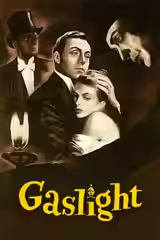
How does The Invisible Man compare to Gaslight?
The Invisible Man and Gaslight tell the same story, a man persuading a woman she is imagining things, but the earlier film is slower, plusher and holds its nerve to the end. Whannell's film is far more frightening for its first hour, then settles for a thriller. For sustained dread, choose Gaslight; for a scare you will feel in your shoulders, the newer film.
Is The Invisible Man based on a true story or a book?
The Invisible Man is based on H. G. Wells's novel, but Leigh Whannell keeps the title and almost nothing else. The invisible man becomes a controlling ex-partner and the film belongs to the woman who left him, so knowing the book is no help and no hindrance. It is not a true story, though it draws on real patterns of coercive control.
What should I watch after The Invisible Man?
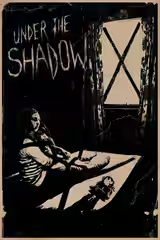
After The Invisible Man, try Gaslight (1944, Fi1m 81): The original film about a husband persuading a wife she is mad; still works. Then Repulsion (1965, Fi1m 88): Polanski makes a London flat close in on Catherine Deneuve, one crack at a time; and Under the Shadow (2016, Fi1m 80): Wartime Tehran, a mother, a daughter, and something in the flat nobody else believes in.

Cast

Awards

AACTA Award for Best Actress in a Leading Role, 2020

Nominated
AACTA Award for Best Actress in a Leading Role

AACTA Award for Best Cinematography, 2020

Won
AACTA Award for Best Cinematography

AACTA Award for Best Direction, 2020

Nominated
AACTA Award for Best Direction

AACTA Award for Best Editing, 2020

Won
AACTA Award for Best Editing

AACTA Award for Best Film, 2020

Nominated
AACTA Award for Best Film

AACTA Award for Best Production Design, 2020

Nominated
AACTA Award for Best Production Design

AACTA Award for Best Sound, 2020

Won
AACTA Award for Best Sound

Australian Film Institute Award for Best Screenplay, 2020

Nominated
Australian Film Institute Award for Best Screenplay

If you liked this, try…

  1. Gaslight (1944, Fi1m 81)The original film about a husband persuading a wife she is mad; still works.

  2. Repulsion (1965, Fi1m 88)Polanski makes a London flat close in on Catherine Deneuve, one crack at a time.

  3. Sleeping with the Enemy (1991) · not on Fi1m yetJulia Roberts fakes her death to leave a husband who straightens the towels.

  4. Under the Shadow (2016, Fi1m 80)Wartime Tehran, a mother, a daughter, and something in the flat nobody else believes in.

  5. Upgrade (2018) · not on Fi1m yetA body that will not obey its owner; leaner, nastier and funnier than this.