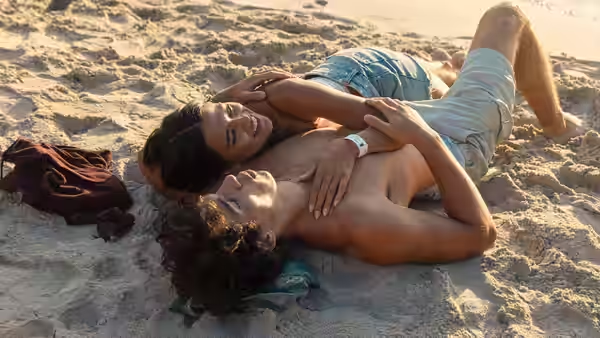
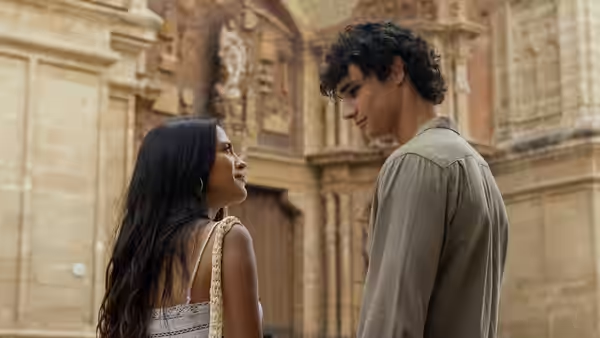
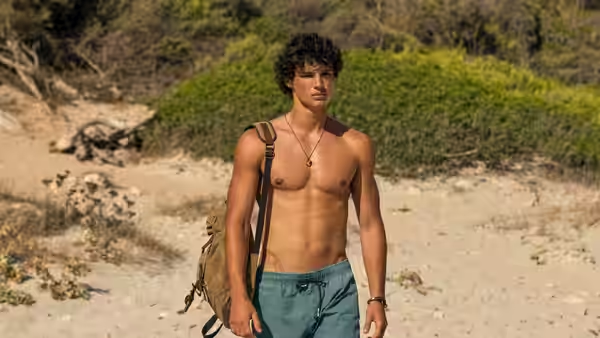
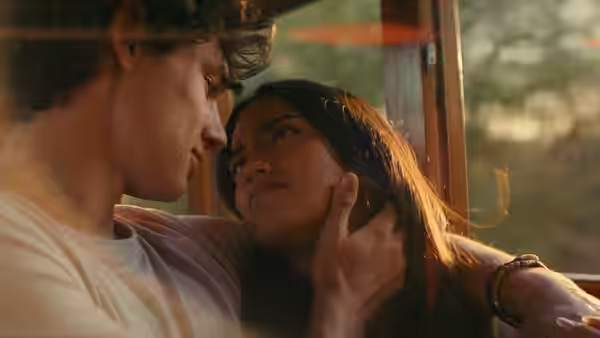
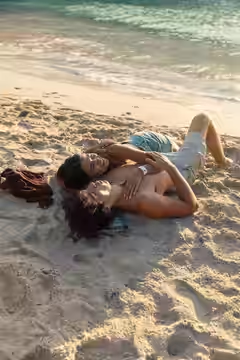
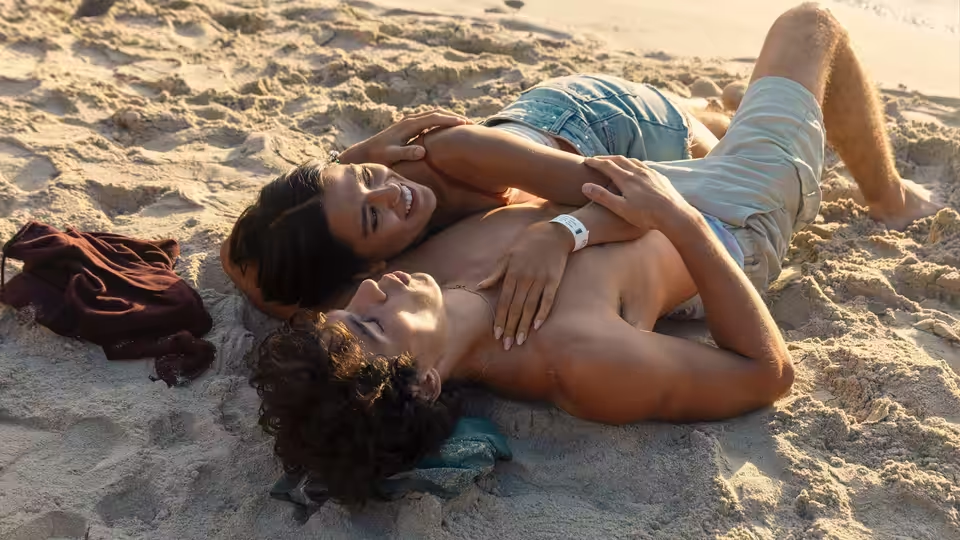
Oriah (Maia Reficco) and Julián (Fernando Lindez) lying together on the sand
Film review

The Last Sunrise

2026 · Directed by Carlson Young · 1h 47m

In a sentenceTwo beautiful people and a bright blue sea, and the sea gets the better close-ups

Oriah ‘Ry’ Pera (Maia Reficco) is a dancer with epilepsy, and she arrives on Mallorca for the summer with her mother, Isolde (Eva Longoria), who would rather she rested than risked anything. On a nude beach she collides with Julián (Fernando Lindez), a local fisherman, and the two keep running into each other around the island until neither can pretend it is an accident. Amara (Chloé Sweetlove) and Mateo (Andrés Velencoso) fill out the summer. Ry wants to dance, to swim, to be nineteen in the heat and to see what Julián turns into once the sun is up; her condition, and her mother, stand in the way. The first act lays out the terraces, the harbour and the boats, and the question of how much of any of it Ry will be allowed to have.

Plays from YouTube when you press play; nothing loads from them until then.

Fi1m review

Carlson Young’s Mallorca romance, from Anna Todd’s novel, sends a dancer with epilepsy into the arms of a fisherman and then photographs them like the scenery. Handsome, tidy and almost entirely without heat; the reviews so far are right about it.

Carlson Young directs The Last Sunrise from a novel by Anna Todd, who also produces, with a screenplay by Anna Klassen, and the idea is old and sturdy. A girl with a serious illness goes somewhere hot for the summer, meets a boy who lives there, and has to decide how much of herself to risk on him. Oriah ‘Ry’ Pera (Maia Reficco) is a dancer with epilepsy; Julián (Fernando Lindez) is a fisherman on Mallorca; her mother Isolde (Eva Longoria) would like her to sit in the shade. The tagline promises one summer to feel everything. It runs 107 minutes and we felt little in any of them, which for a romance is the one failure that matters.

The meeting is the best thing in it. Ry and Julián first collide on a nude beach, and for a few minutes the film has some mischief about it: two embarrassed people arguing about where to look, and a camera that shares the problem. Then everyone gets dressed and stays dressed, in every sense, for the remaining hour and a half. Reficco is likeable and alert, and she does the small physical work of a dancer well, always aware of where her feet are. Lindez is handsome and calm and the script gives him nothing to be calm about. They are photographed side by side a great deal and touch rather less, and when they kiss it is lit and framed like the rest of the island, as something to be looked at rather than felt.

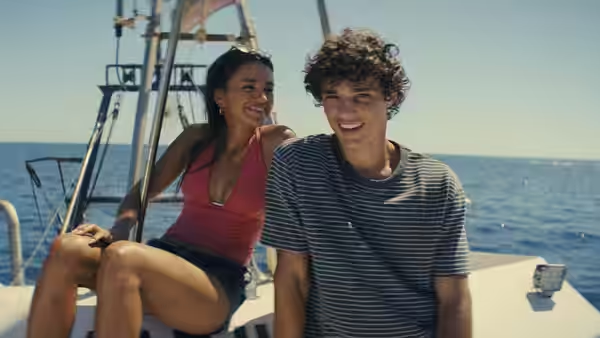
Rob C. Givens shoots Mallorca at the hour when the light goes amber and the sea turns the colour of a hotel pool, and he shoots it that way in scene after scene. Coves from above, a boat cutting a white line through blue, a terrace at sunset, a girl in linen walking away from the camera. Víctor Molero’s production design and Miguel Cervera’s costumes agree with him: whitewashed walls, wooden hulls, clothes with no creases in them. Every frame could sell the holiday. Almost none tells us who lives here, what Julián’s job costs him, or what the island is like in the parts a visitor does not photograph. Pedro Morla plays a fisherman, credited simply as Fisherman, and that is about the depth of the film’s interest in fishing.

Klassen’s screenplay handles the epilepsy as a scheduling device. Ry’s condition is established early, honestly enough, and then it is put away until the plot needs a jolt, at which point a seizure arrives on cue and is handled the way the genre has taught us to expect. We were bored for a long stretch of the middle, and then we were cross, because the illness is the one true thing in the film and it is being used to move the furniture. Longoria, as the mother who has seen what the condition does, plays her scenes straight and small. She is the only adult treated as a person rather than an obstacle, and even she is mostly an obstacle.

Julia Wong and Regino Hernández cut the summer as a series of montages, and Isom Innis and Kambiz Aghdam’s score swells the moment two people look at one another, so we are told what to feel a second before the actors are allowed to try. The pattern repeats: a scene of talk, a montage of the island, a song, a long look, a cut to the sea. By the fourth pass we could have called the shots ourselves. Amara (Chloé Sweetlove) and Mateo (Andrés Velencoso) drift through as friends and complications, and neither gets a scene that is about them.

The summer-abroad romance has a template, and there is no shame in using one; the good ones fill it with particular people in a particular place, so that you remember the town and the argument and not just the light. This one fills it with light. The three reviews we have read are all unfavourable, for much the same reasons, and we are not going to argue with them.

Teenagers who want the island and the boy will get both, in focus, at the right time of day, and may be content. Anyone hoping for the film the title promises, with a deadline in it and something at stake before the sun goes down, will find it glimpsed in two scenes between Reficco and Longoria and then lost under another sunset. With the sound down it makes a decent screensaver. With the sound up you can hear what the people in it are saying, and that is where the trouble starts.

Critical consensus AI synthesised

3 of 6
Positive
0
Mixed
0
Negative
3

With only 3 reviews in so far, the reception is uniformly negative. All three see a formulaic YA romance that follows the template without adding to it: the emotional beats arrive on schedule, the central pairing of an epileptic dancer and a local fisherman generates little heat, and the glossy Mallorca setting does more work than the script. The New York Times finds it closer to a travel commercial than a love story, The AV Club calls it a cynical copy of similar films, and The Guardian faults the indifferent direction and a lack of any visual or dramatic texture. Nobody has yet found much to defend.

The New York Times
27 August 2026 · Brandon Yu
40*

The critic views the film as a formulaic streaming summer romance lacking originality, more akin to a travel commercial than a genuine love story. He notes the steamy romance between the epileptic dancer protagonist and the local fisherman, highlighting the predictable plot and clichéd dynamics.

Read the full review →
The AV Club
26 August 2026 · Kayleigh Donaldson
30*

The critic finds the film forgettable and a cynical rip-off of similar YA romances, lacking passion or stakes despite its glossy appearance. She singles out its formulaic delivery of emotional beats and lack of heat as major flaws.

Read the full review →
The Guardian
26 August 2026
25*

The critic calls the film a bland, soapy YA romance that favors cheap melodrama over charm and fails to use its Mallorca setting effectively. They single out the indifferent direction and lack of visual or dramatic texture for criticism.

Read the full review →

Straight answers AI written, from our review

Is The Last Sunrise worth watching?
The Last Sunrise is not worth watching for most people, and we scored it 34. It is handsomely shot and Maia Reficco is likeable, but the romance has almost no heat and the epilepsy is used as a plot device rather than a subject. Teenagers who want the island and the boy, in focus at sunset, may be content.
How long is The Last Sunrise, and what is it rated?
The Last Sunrise runs 1h 47m. It is a romance and drama film.
Where can I watch The Last Sunrise in Mexico?
The Last Sunrise is streaming on Amazon Prime Video in Mexico. Availability is checked daily; the links above go straight to each service.
How violent or frightening is The Last Sunrise, and is it suitable for children?
The Last Sunrise is a 15 in the UK and an R in the US, and it is neither violent nor frightening. The meeting on a nude beach and a seizure played for a jolt are the reasons for the certificate; there is little else to alarm anyone. It is a soft romance aimed at older teenagers, not a film for children.
How does The Last Sunrise compare to Before Sunrise?
The Last Sunrise is the weaker film beside Before Sunrise by a wide margin. Linklater's night of conversation lets two strangers talk their way into a romance, awkwardly and believably; Young's Mallorca summer photographs its couple like the scenery and cuts to the sea whenever they might say something. Choose the earlier film unless you only want the view.
Is The Last Sunrise based on a true story or a book?
The Last Sunrise is based on a novel by Anna Todd, who also produces, not on a true story. Our review does not measure it against the book, so we cannot say how faithful it is. Knowing the source does not matter; the film lays out its illness, its island and its fisherman plainly enough in the first act.
What should I watch after The Last Sunrise?
After The Last Sunrise, try Before Sunrise (1995, Fi1m 89): One night, two strangers, a European city, and dialogue that earns the romance. Then Call Me by Your Name (2017, Fi1m 86): A summer abroad where the heat is felt, not merely photographed; and Y tu mamá también (2001, Fi1m 87): A road trip to the coast in which the country matters as much as the kissing.

Cast

If you liked this, try…

  1. Before Sunrise (1995, Fi1m 89)One night, two strangers, a European city, and dialogue that earns the romance.

  2. Call Me by Your Name (2017, Fi1m 86)A summer abroad where the heat is felt, not merely photographed.

  3. Summertime (1955) · not on Fi1m yetDavid Lean sends a lonely American to Venice and lets the city do damage.

  4. Y tu mamá también (2001, Fi1m 87)A road trip to the coast in which the country matters as much as the kissing.

  5. The Fault in Our Stars (2014) · not on Fi1m yetThe sick-teenager romance done with more nerve and a better script.