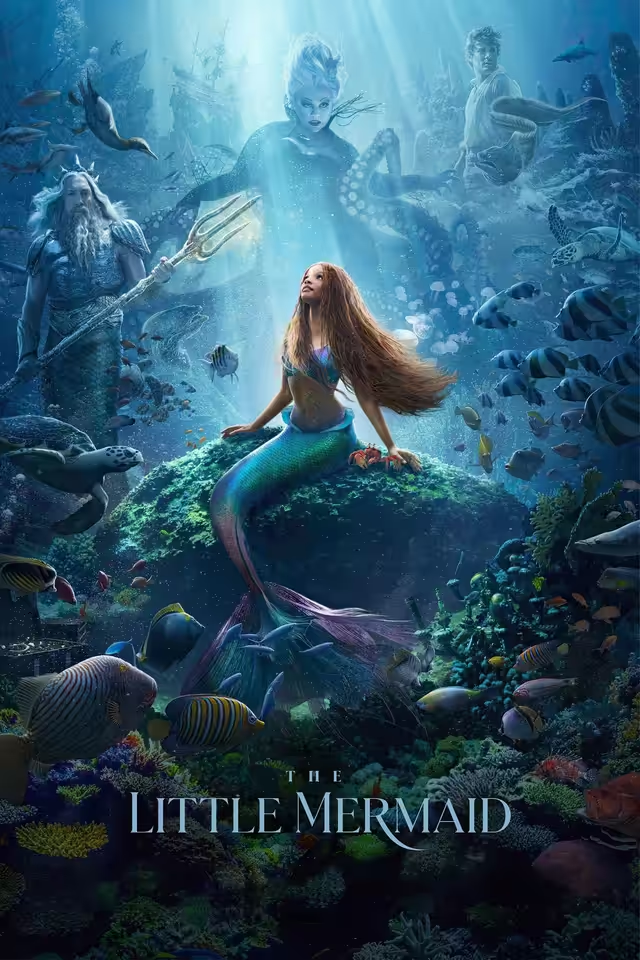
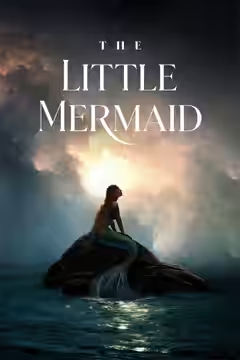
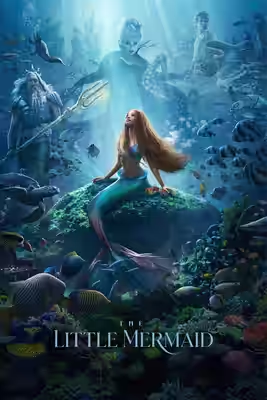
Halle Bailey sings ‘Part of Your World’ as if her life depends on it, and for four minutes the film is alive. Around her, Rob Marshall’s remake is long, murky under the water and afraid to change anything.
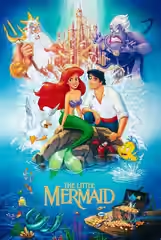
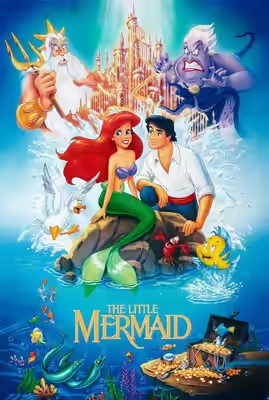
Disney has spent a decade turning its cartoons back into photographs, and The Little Mermaid was always going to be the hard one. The 1989 film is drawn in colours the sea does not have, and most of its cast are fish. Rob Marshall, who made Chicago (2002) and Mary Poppins Returns (2018), keeps almost every scene, song and line the audience remembers and renders it all as if it had really happened. It runs 135 minutes, and the second of those hours is where the caution shows.
It has one great asset and it knows it. Halle Bailey plays Ariel with her chin up and her eyes wide, a teenager who has decided the world is elsewhere and will not be talked out of it, and when she gets to ‘Part of Your World’ the film stops being an exercise. She sings it as a plea rather than a wish, and by the last line we were moved far more than we expected to be by a song we have heard in every school hall in the country. It is the only sequence here that is better than the cartoon. Then Alan Menken’s old melody ends and the film has to go back to being about a crab.
The sea is where the trouble is. Dion Beebe shoots the underwater kingdom in a grey-green haze that is meant to read as depth and reads as murk; Ariel’s red hair is often the only colour in the frame and the only thing we can follow. The fish are real fish, so Sebastian is a crab with a crab’s face and Daveed Diggs’s voice coming out of it, and Flounder (Jacob Tremblay) is a flat, wet, vaguely alarmed thing with nothing to act with. ‘Under the Sea’ is staged as a reef in bloom, busy and competent, and we sat through it without once wanting to sing. The joke of the original was that the fish had faces. Marshall has taken the faces away and kept the choreography.
Melissa McCarthy plays Ursula as a nightclub act, all shoulders and painted mouth, and ‘Poor Unfortunate Souls’ is the second time the film wakes up. She is not frightening, but she is enjoying herself, and enjoyment is thin on the ground down there. Javier Bardem’s Triton is a bearded man in a chair looking sorrowful, and the sorrow does not vary. Above the waves, Jonah Hauer-King gives Eric a restlessness of his own, so that for once the prince wants something too, and their day in the town is the best stretch of David Magee’s screenplay. Noma Dumezweni has some dry warmth as Eric’s mother, a queen who wants him kept off the water, and Art Malik’s Grimsby is the courtier who has seen all this before. Awkwafina’s Scuttle talks very fast and then raps, and we will leave it there.
The land is better lit and better built. John Myhre gives the castle a sunlit harbour and a library full of maps, and Colleen Atwood dresses the market in cottons and the court in blue silk, so that Ariel in a borrowed dress looks like a girl who has never worn one. Menken’s new songs are the weak spot: they sit between the old ones like corridors between rooms, and the one given to Eric on a clifftop tells us what Hauer-King had already shown. Wyatt Smith cuts at a steady, unhurried pace that suits a musical and does not suit 135 minutes. Somewhere in the second hour we caught ourselves counting the songs left.
Marshall understands a number. Chicago is a set of them held together with a plot, and it works because the plot is short. Here he has been asked to build a whole world, and worlds have to be crossed, and the crossing is dull. Among Disney’s remakes this one sits in the middle of the pile.
Take the children; they will not mind the murk, and they will be quiet for the songs. Go yourself for Bailey, who deserves a film built around what she can do rather than around what someone else once drew. Sit near the front, where at least the sea is large. It opened in UK cinemas on 26 May 2023 and carries a PG.