Film review

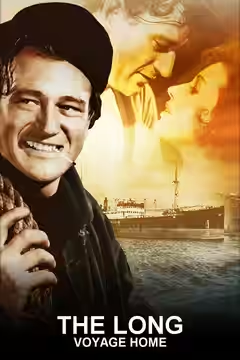
The Long Voyage Home

1940 · Directed by John Ford · 1h 45m · MPA NR

In a sentenceEvery man aboard wants to go home and none of them can remember the way

DramaWar

The Glencairn, a British tramp steamer, lies at anchor off an island in the West Indies, and the crew are not allowed ashore. Ole Olsen (John Wayne), a young Swede who has been at sea for years, wants only to get back to his mother’s farm. Driscoll (Thomas Mitchell), the loud Irish centre of the fo’c’sle, has plans for the evening, and when Bella (Rafaela Ottiano) rows out with a boatload of women and rum the Captain (Wilfrid Lawson) finds his deck turned into a party and then a brawl. Smitty (Ian Hunter), an Englishman who drinks alone and says nothing about his past, watches from the rail. The ship sails for an American port, loads a hold of explosives bound for England in wartime, and the men set out across an Atlantic where submarines are waiting.

Fi1m review

Ford stitches four O’Neill one-act plays into one voyage on a tramp steamer, and Gregg Toland lights it more beautifully than anything else in the director’s career. The story underneath is patched and sometimes maudlin. Worth your evening, in the dark.

John Ford made The Long Voyage Home in 1940, the same year as The Grapes of Wrath, and it looks like nothing else he made. Dudley Nichols has taken four one-act plays by Eugene O’Neill about the crew of a tramp steamer and stitched them into a single voyage, from a Caribbean anchorage to a British port with a hold of explosives in between. It is, we think, the most beautifully photographed film of Ford’s career. It is also patched together, and in places it sags.

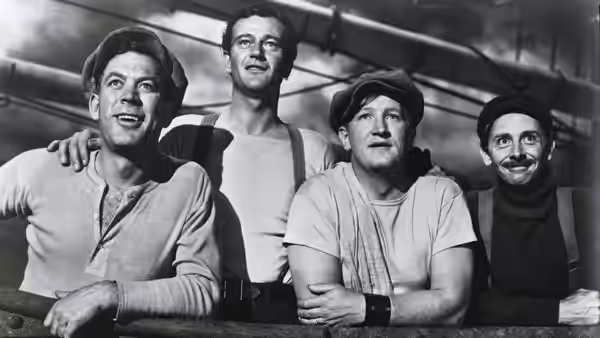
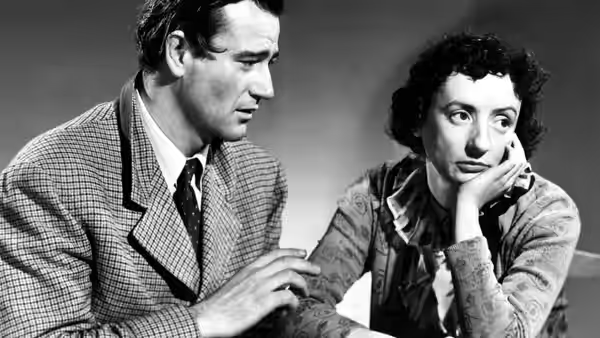
Gregg Toland shot it the year before Citizen Kane, and you can watch him working out what he would do there. The first twenty minutes are close to a silent film. The Glencairn sits off an island at night, the men lean on the rail, and women in white dresses stand on the shore under palms. When Bella (Rafaela Ottiano) rows out with a boatload of women and rum, Toland lights the boat from below so the faces float on the dark. Below deck the fo’c’sle is a low box of smoke, lit from one lamp, half of every face black. Nothing has happened yet and already the men look like ghosts. We were not ready for how much that got to us.

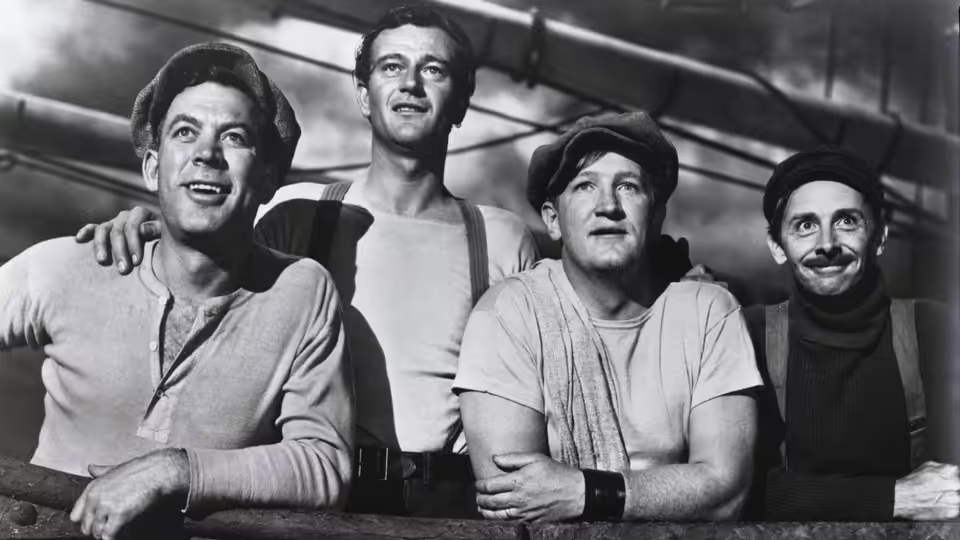
Ford’s company is all here. Thomas Mitchell’s Driscoll is the loud Irish heart of the ship, first into every fight and first to buy the round after it. Barry Fitzgerald’s Cocky has an opinion on everything. John Qualen’s Axel and Ward Bond’s Yank fill the bunks, and Arthur Shields, as the old Donkeyman who stays aboard when the party starts, gets a quiet talk on deck that tells you all you need about a man who has stopped wanting anything. Ian Hunter’s Smitty drinks alone, speaks properly and gives nothing away, and Joe Sawyer’s Davis is the one who decides that is suspicious.

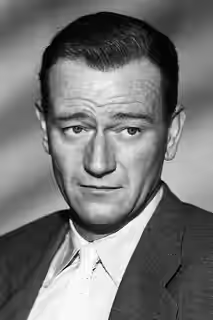
Then there is John Wayne, top-billed and hardly the lead. Ole Olsen is a big slow Swedish boy who has been at sea too long and wants to go home to his mother’s farm. Wayne plays him with a wobbly Swedish accent and no vanity at all, and it moved us more than we expected. When the others tease him about the farm he simply describes it, the land and the animals, and his face opens up; it is the only time in the film anyone looks happy. Ford keeps him slightly apart from the others, and the second half turns on whether he gets where he is going. We will not say.

The seams show. Four plays make four episodes, and Nichols has not hidden the joins: an anchorage, a sailing, a storm, a scare, a port, each with its own shape and its own curtain. Sherman Todd cuts the storm so that we always know which man is where on a deck that is mostly water, and it is the most physically convincing stretch of the film. Richard Hageman’s score is sparing and stays out of the night scenes, which is right. But Ford cannot resist a song, a toast, a tear on a rough man’s cheek, and there are moments, mostly involving Mitchell, where the film asks us to be moved and we found ourselves waiting instead.

The stretch that has aged best is the Atlantic crossing, when a hold full of munitions and a crew with nothing to do but drink and think produce a suspicion about one of their own. Ford stages it in the fo’c’sle with the lamp swinging and nobody raising his voice for a long time, and we sat still through the whole of it. We will not say what they find. The war is everywhere and hardly named: the ship is British, the cargo is for England, and this was 1940, more than a year before Ford’s own country joined in. For a Hollywood film of the moment it is unusually plain about what the men on these boats were carrying.

The last act moves to London, to a dockside pub where Mildred Natwick’s Freda pours the drinks, and it tips into a melodrama the earlier scenes had done without. We can see why critics in 1940 treated the film as close to a milestone, and why it has faded a little since. Toland’s way of lighting a room was copied for decades. Nobody copied the story. Watch it at night with the lights off. Perhaps a third of its 105 minutes are among the finest images American cinema produced in that decade, which is a reason to see a film, and not quite a reason to love it.
Critical consensus AI synthesised

76
Positive
4
Mixed
2
Negative
0

Most critics admire the film, and the praise clusters around two things: Ford’s handling of O’Neill’s short plays and Gregg Toland’s cinematography. Reviewers keep returning to the night scenes at sea and to the high-contrast, spectral photography, which several consider the film’s chief distinction. The ensemble is praised throughout, with Thomas Mitchell named most often, and one recent writer argues that John Wayne’s supporting turn as a Swedish sailor longing for home has been undervalued.

The reservations are about tone and pace. Variety finds the tempo slow and parts of the story confusing, and Time Out treats Toland’s camerawork as a corrective to Ford’s maudlin streak rather than an ornament. Even admirers concede that the grim, impersonal beauty may weigh on some viewers. The spread is fairly wide: the notices from 1940 are the warmest, the two mixed verdicts come from Variety and Time Out, and the more recent writers settle in between.

The New Yorker
12 October 1940 · John C. Mosher
90*

The critic calls the film one of the magnificent pictures of film history for its eloquent depiction of the sea and its conveyance of O'Neill's characters with simplicity, violence, and futility. Ford's direction excels at capturing night scenes on the ocean and freighter, though the film has an impersonal, grim beauty that some may find oppressive.

Read the full review →
The New York Times
9 October 1940
90*

The critic praises John Ford for fashioning a stark, tough-fibered modern Odyssey out of O'Neill's short plays that honestly reveals man's wanderings and pathetic shortcomings while showing nobility emerging from human weakness. It is hailed as one of the most honest pictures ever placed on the screen, with excellent ensemble acting led by Thomas Mitchell and Barry Fitzgerald.

Read the full review →
Slant Magazine
11 July 2023 · Derek Smith
80*

The critic calls the film one of John Ford’s most haunting and poetic works, praising its blend of rousing adventure in the opening with underlying melancholy and strong character work. Special praise goes to Gregg Toland’s spectral cinematography and the film’s visually expressive, almost painterly compositions.

Read the full review →
Time Out
10 September 2012 · GA
65*

The film adapts O'Neill's plays into a tribute to seamen with Ford's typical mix of camaraderie, brawling and homespun philosophy. It is chiefly noted for Gregg Toland's high-contrast camerawork, which offsets the director's maudlin tendencies, while a strong cast handles mixed accents gamely.

Read the full review →
Variety
31 December 1939 · ** · Variety Staff
50*

The critic finds the adaptation of Eugene O'Neill's one-act plays typically Fordian in its emphasis on characterizations and sea adventures aboard a tramp steamer carrying explosives. The story moves at a slow tempo with some confusing elements, though strong performances by Thomas Mitchell and realistic storm sequences stand out.

Read the full review →
Collider
14 April 2024 · Liam Gaughan
80*

The critic praises John Wayne's underrated supporting performance as a Swedish sailor longing for home, noting his dramatic range and comedic timing in an ensemble drama. They highlight the film's authentic depiction of maritime life during WWII as a standout element in Ford's collaboration with Wayne.

Read the full review →

Cast

Awards

Academy Awards, 1941

Nominated
Best Cinematography, Black-and-White
Nominated
Best Film Editing
Nominated
Best Original Score
Nominated
Best Picture
Nominated
Best Special Effects
Nominated
Best Writing, Adapted Screenplay

If you liked this, try…

L'Atalante poster

L'Atalante

1934 · Vigo’s barge newlyweds; another boat full of people who cannot decide where home is.

The Grapes of Wrath poster86

The Grapes of Wrath

1940 · Ford and Toland the same year, on dry land, with the same faces and more anger.

The Cruel Sea poster

The Cruel Sea

1953 · The Atlantic war told from a wet British deck, and almost entirely without sentiment.

Leviathan poster

Leviathan

2012 · A trawler documentary shot from cameras lashed anywhere; Toland’s black sea, decades on.

Master and Commander: The Far Side of the World poster86

Master and Commander: The Far Side of the World

2003 · Weir’s frigate is a workplace first and an adventure second, much as Ford’s freighter is.