Film review

The Man in the Iron Mask

1998 · Directed by Randall Wallace · 2h 12m · MPA PG-13

In a sentenceTwo Leonardo DiCaprios, four ageing Musketeers and a script that announces every feeling before anyone is allowed to have it

AdventureActionDrama

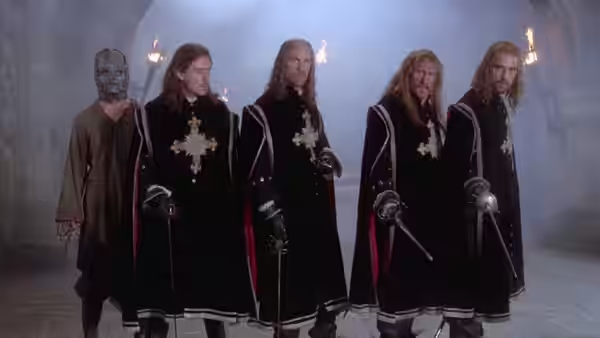
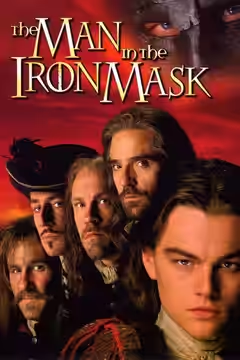
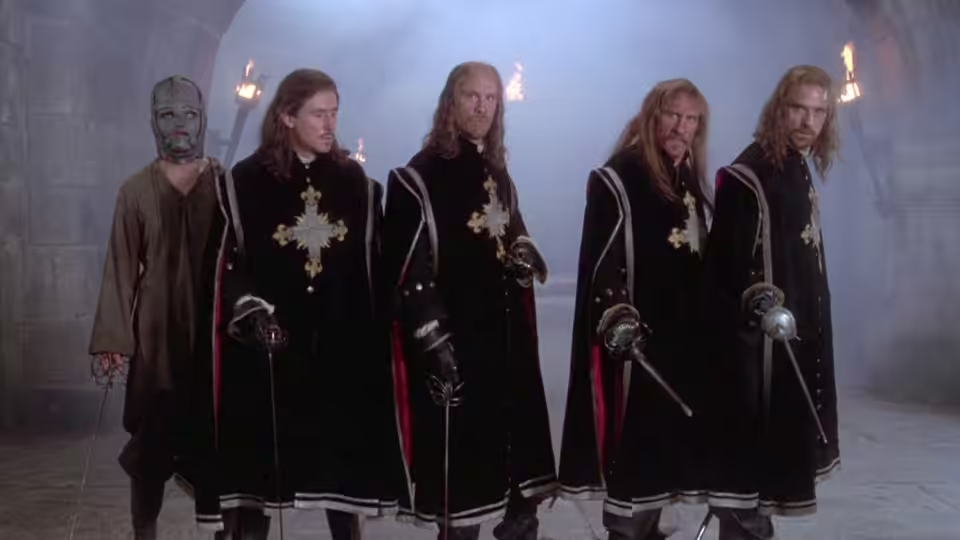
Paris, under the young King Louis XIV (Leonardo DiCaprio). The city is rioting over rotten grain while the king holds banquets and looks over the women at them. The Musketeers who served his father are scattered: Aramis (Jeremy Irons) has become a priest, Athos (John Malkovich) is raising his son Raoul (Peter Sarsgaard), Porthos (Gérard Depardieu) is drinking his way through retirement, and D’Artagnan (Gabriel Byrne) still commands the palace guard and still believes in the crown. When Louis decides he wants Raoul’s fiancée Christine (Judith Godrèche) for himself, he sends the young man to the front. Aramis, meanwhile, knows of a prisoner kept in an iron mask, and of a plan that might put a better man on the throne of France.

Plays from YouTube when you press play; nothing loads from them until then.

Fi1m review

Randall Wallace’s Dumas is handsome, sincere and clumsy, with Gabriel Byrne and Jeremy Irons doing quiet, good work while DiCaprio sulks in a wig and the script says everything twice. A Sunday afternoon film, and no more than that.

Randall Wallace writes, produces and directs his own version of the Alexandre Dumas novel, and what he wants is plain enough: an old-fashioned swashbuckler with a conscience, in which four retired Musketeers decide that a bad king can be replaced by a good one. It runs 132 minutes and believes every word of itself. It says “honour” a great deal. That sincerity is the best and the worst thing about it, because Wallace never trusts a moment to speak for itself when a speech is available.

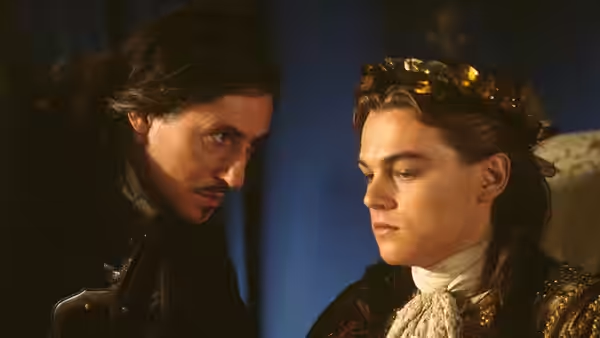
Leonardo DiCaprio plays the king and the prisoner, and the two halves do not weigh the same. His Louis is a petulant boy in a wig who wants what he sees and has never been told no, and DiCaprio plays him as exactly that, which is honest but not interesting; we did not for a moment believe that an army or a court would follow him. Philippe, the man in the mask, suits him better. Gentleness asks less of an actor than menace does, and the scenes in which he blinks at daylight and is taught how to eat like a king have a softness the rest of the film lacks. But the two never feel like the same face on two different men. They feel like a scowl and a smile.

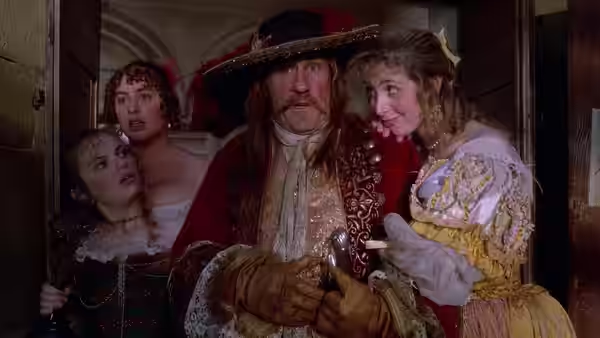
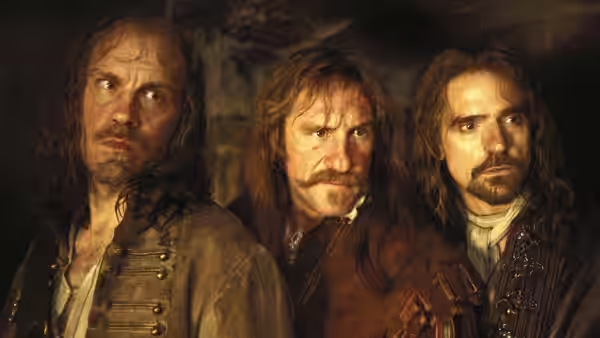
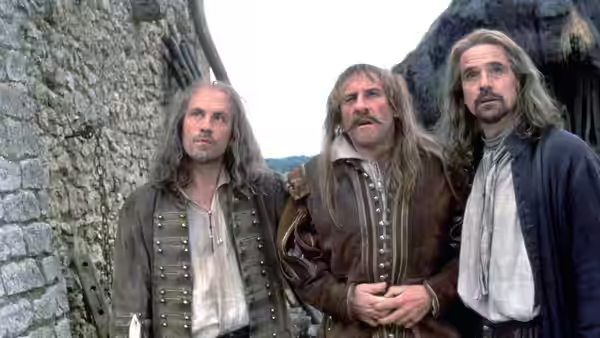
The older actors carry the picture. Gabriel Byrne is the best thing in it, a D’Artagnan torn between his oath and his disgust, and he plays it small, mostly in the way he looks at Louis when Louis is not looking back. Jeremy Irons is dry and watchful and seems to be enjoying a private joke about being paid to wear a cassock. John Malkovich’s Athos is a grieving father, and Malkovich grieves the way he does everything, with a whisper that keeps turning into a shout; it is either moving or absurd depending on the line, and Wallace has written both kinds. Gérard Depardieu is asked to be the comic relief, which means drink, a bare backside and a suicide attempt played for laughs. We winced at the Porthos business, not because it is coarse but because it puts a fine actor in a place where nothing he does can land.

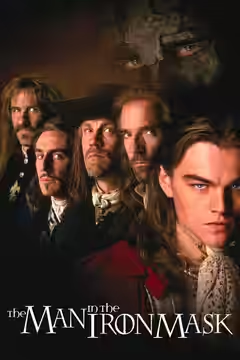
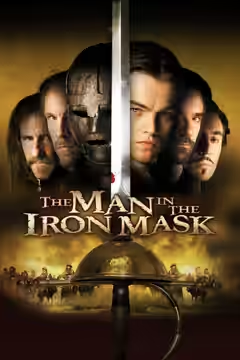
The film looks expensive and mostly earns it. Peter Suschitzky lights the interiors in candle-gold and brown so that the court seems to be sitting inside a jewellery box, and Anthony Pratt’s palace is all mirrors, gilt and long tables covered in food while the city outside eats rot. James Acheson dresses Louis in white and gold and the Musketeers in leather that has plainly been slept in, and the mask itself is a proper ugly thing of riveted iron. Nick Glennie-Smith’s score is the loudest voice here, brass and choir under every declaration, telling us what to feel about two seconds before the actors get the chance. William Hoy cuts the swordfights cleanly, but there are fewer of them than the poster promises and none last long.

The writing is the trouble. People in this film do not talk; they announce. Christine and Raoul (Judith Godrèche and Peter Sarsgaard) are given a love story of three scenes and asked to make us weep over it. Hugh Laurie and David Lowe stand about as the king’s advisors and are handed nothing. Anne Parillaud, as the Queen Mother, gets one scene with Byrne that has real adult feeling in it, and it stands out because nothing around it does.

And yet. We will not describe the last twenty minutes, but there is a moment late on when the four old men stand together and say the words everyone has been waiting two hours for them to say, and we were moved, having laughed at the film ten minutes earlier. It works because Wallace finally slows down, lets Suschitzky hold on four faces, and for once does not give anyone a speech. It is the only time the film shows rather than tells, and it shows what the whole thing might have been.

Richard Lester’s The Three Musketeers, from 1973, had wit and mud and men who fought badly because they were tired. This one has neither wit nor mud, and everyone fights well. Most critics found it too silly to forgive, and we are a few points kinder, because the cast are good company and the sets are worth looking at. Watch it at home on a wet afternoon, with someone who will not mind you talking over Depardieu.
Critical consensus AI synthesised

47
Positive
3
Mixed
1
Negative
5

The reviews lean negative, with five of the nine unfavourable, though almost every critic finds something to enjoy. Praise clusters on the cast, particularly the veteran actors playing the ageing Musketeers, and on the costumes and sets, which Empire says linger in the memory. Gabriel Byrne is picked out by RogerEbert.com as the most charismatic of the company. DiCaprio’s double performance divides the critics more than anything else: Variety and Collider call it the film’s strongest asset, while Time Out finds him miscast as the adult king.

The reservations cluster on tone and script. Several critics complain that the film cannot decide whether it is a tragedy, a farce or a romance, and the dialogue is repeatedly called wooden or worse. Depardieu draws unkind notices for overacting. The spread is wide, and it splits along time: the 1998 reviews are mostly cold, while later reappraisals from /Film and Collider defend it as silly but likeable entertainment.

Variety
10 March 1998 · Todd McCarthy
70*

DiCaprio gives a wonderful double performance as the ruthless king and his sensitive brother in this sober, serious-minded costumer with an involving narrative and magnetic cast. It falls short on boisterous excitement due to mundane action but offers agreeable middle-of-the-road entertainment.

Read the full review →
Empire
1 January 2013 · Caroline Westbrook
65*

Wallace delivers a flawed but fun adaptation of the Dumas tale, providing pacy swordplay and sumptuous costumes and sets that linger in the memory. It is consistently entertaining but badly let down by dialogue bordering on the moronic.

Read the full review →
Time Out
10 September 2012 · NF
40*

The critic finds the film uneven due to inconsistent tone and DiCaprio's miscasting as the adult king, though the supporting Musketeers are better, with Depardieu overacting.

Read the full review →
Los Angeles Times
13 March 1998 · Kenneth Turan
30*

The film swashes until it buckles under too many disparate elements—swordplay, tragedy, slapstick, and romance—without a consistent style or unifying tone beyond crude humor. It has energy and star power but more spectacle than imagination or sense.

Read the full review →
RogerEbert.com
13 March 1998 · Roger Ebert
30*

The film is a loosely adapted costume swashbuckler that takes too long to set up its plot and lacks focus, though it becomes modestly interesting once the central substitution scheme is underway. Gabriel Byrne stands out with the most charisma among the strong cast.

Read the full review →
The New York Times
13 March 1998 · Janet Maslin
30*

DiCaprio delivers dual roles as a spoiled, vain king and his noble twin in an amusingly ludicrous update of the Dumas tale with a 1990s spin. The film trades classic inspiration for coarse, modern blockbuster elements and wooden dialogue.

Read the full review →

Cast

Awards

European Film Academy Achievement in World Cinema Award, 1998

Nominated
European Film Academy Achievement in World Cinema Award

Golden Raspberry Award for Worst Screen Couple/Ensemble, 1998

Won
Golden Raspberry Award for Worst Screen Couple/Ensemble

If you liked this, try…

The Three Musketeers poster

The Three Musketeers

1973 · Richard Lester’s version, funnier, dirtier and better at swordplay than this one.

Cyrano de Bergerac poster88

Cyrano de Bergerac

1990 · Depardieu in a plume, given proper verse and a director who trusts him.

The Prisoner of Zenda poster

The Prisoner of Zenda

1937 · The royal double swapped for the throne, done with lightness and Ronald Colman.

The Princess Bride poster86

The Princess Bride

1987 · Revenge, fencing and a masked man, with jokes that are actually funny.

Rob Roy poster

Rob Roy

1995 · Honour taken seriously, and a final duel worth the long walk to it.