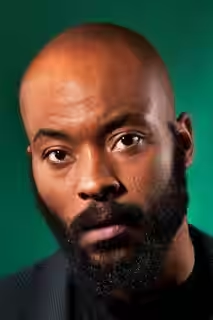
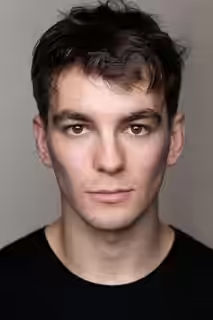
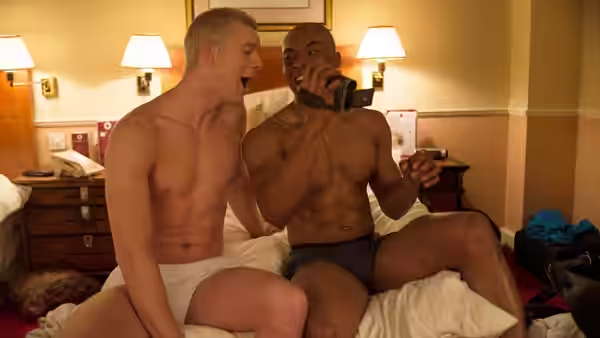
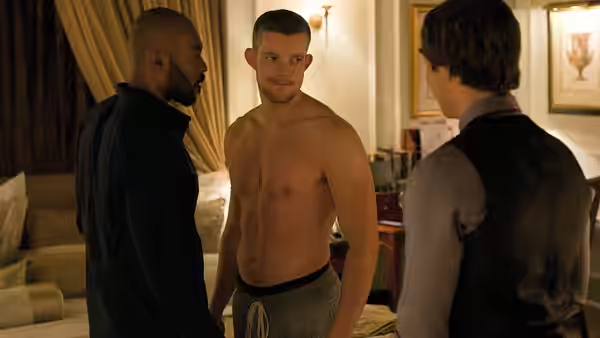
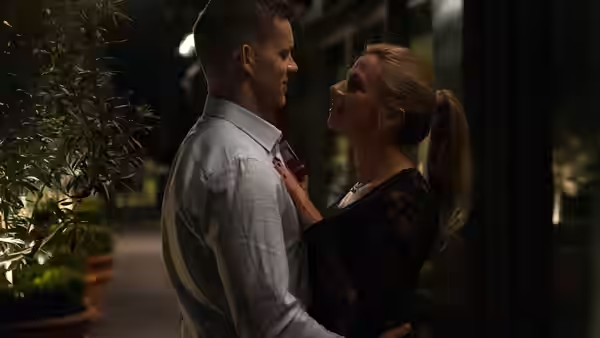
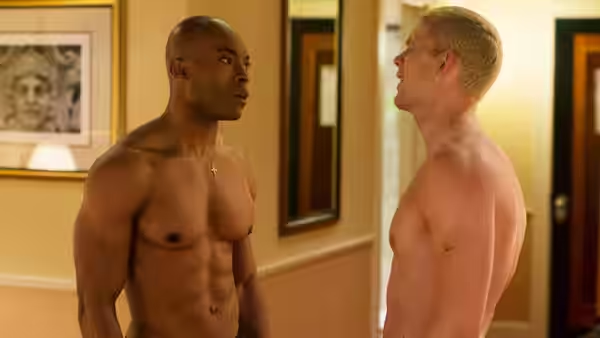
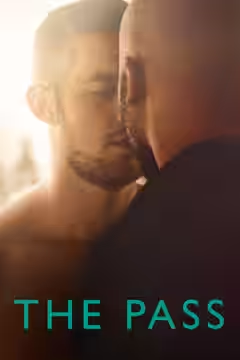
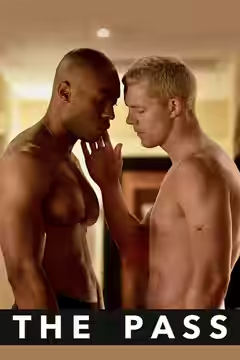
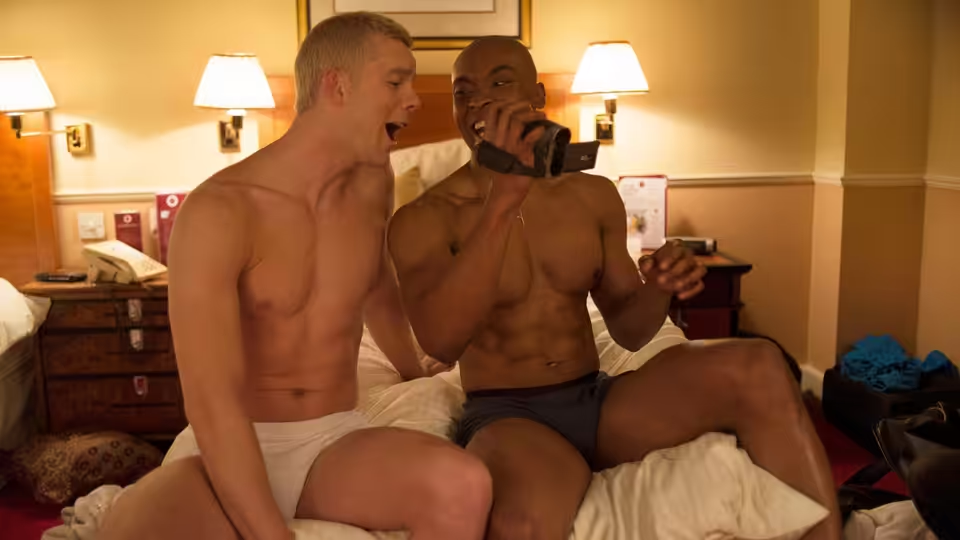
Jason (Russell Tovey) and Ade (Arinze Kene) sit shirtless on a hotel bed, filming with a camcorder
Film review

The Pass

2016 · Directed by Ben A. Williams · 1h 27m

In a sentenceThree hotel rooms, ten years apart, and a man who has got very good at not being in them

Jason (Russell Tovey) and Ade (Arinze Kene) are nineteen, footballers, and sharing a hotel room abroad the night before a match. One of them is going to be picked. They do what young men in hotel rooms do: wind each other up, trade insults, argue about pizza, and say nothing about the one thing both of them are thinking. Jason, the louder and the more certain of his own future, is already telling the story of his career. Ade is quicker, kinder and still watching to see what Jason wants. By the time the lights go off something has passed between the two beds. The film then jumps five years, and five again, to other hotel rooms, where Lyndsey (Lisa McGrillis) and Harry (Nico Mirallegro) each find Jason waiting with a plan.

Plays from YouTube when you press play; nothing loads from them until then.

Fi1m review

Ben A. Williams’s film of John Donnelly’s play about a closeted footballer barely leaves its hotel rooms and does not need to. Russell Tovey is first-rate as a man who has traded himself for a career; the middle section works too hard to make its point.

Two nineteen-year-olds in a hotel room, the night before a match, with one place in the team between them. That is the whole of the first act of The Pass, and it is the best stretch of a good, small film. Jason (Russell Tovey) is the one who talks. Ade (Arinze Kene) is the one who listens and then says the thing Jason did not want said. John Donnelly, adapting his own play, lets them fill forty minutes with dares and insults and a long argument about pizza, and underneath all of it is a question neither boy will ask out loud. Ben A. Williams directs it without fuss. The hotel room is beige, the window shows nothing, and the camera stays close enough that we can see Jason decide, several times, not to look at his roommate.

We recommend it, with the usual caveat about a play on film, and with a stronger one: the people who call it urgent and unmissable have oversold it. It is worth your evening if you like watching two actors in a room, which is what it is.

Tovey and Kene are plainly older than nineteen and get away with it because the swagger is right. Jason strips, flexes, stamps about half-dressed, checks himself in the mirror and pretends not to; Ade lies on the bed and lets him. Then the lights go down and the first act ends on something small and quiet, and we were surprised by how little it was on screen and how much it obviously cost. Tovey plays the seconds afterwards with his back to us. It is the moment the whole film is built on and Williams does not underline it.

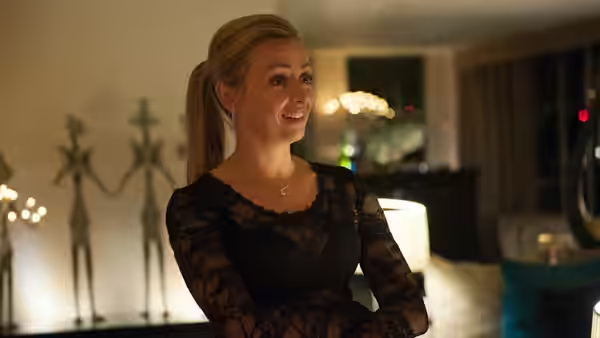
Five years on, Jason is a star, and the hotel suite is bigger and whiter. Lyndsey (Lisa McGrillis), a dancer, has been brought to it for reasons that become clear, and McGrillis gives the film a welcome dose of someone who can see straight through its lead and says so. This is the section where the play shows. People deliver positions rather than talk, a mobile phone does more plotting than it should, and the turn at the end of the act is the one time we could feel the writer’s hand on our shoulder. Most critics have noted the staginess and most have forgiven it; we forgive the first and third acts and not quite the second.

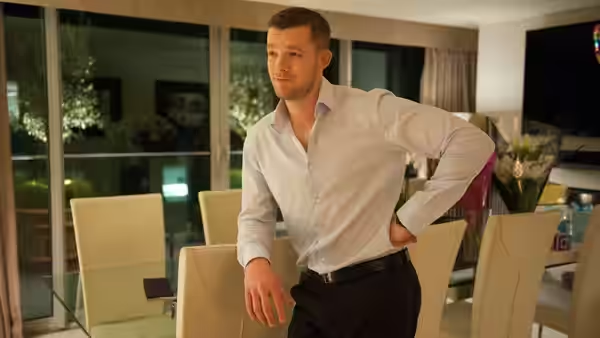
The third act returns to a hotel, the most expensive yet, and to Ade, and we will not say in what circumstances. We will say that it is where Tovey earns the praise he has had. Jason’s voice has gone flat and his body has gone stiff, and he has turned the old game of dares into something colder, pulling Harry (Nico Mirallegro), a young member of the hotel staff, into it because he no longer knows how else to be in a room with a man. We did not like Jason. We did not like him at nineteen and we liked him less at twenty-nine. We were moved anyway, more than we expected, by the sight of someone trying to restart a joke with the only person who ever understood it, ten years too late. Kene matches him, and does it with less: a stillness, a refusal to be wound up, that tells us where Ade has been without a speech.

The craft is modest and mostly sound. The three rooms are graded from cheap to lavish so that the furniture tells us how Jason’s career has gone before anyone mentions it. The cutting is patient in the first act and twitchier in the second, which fits the material if not always the mood. Williams never opens the film out to a stadium or a pitch, and we think that was right; the football is the thing Jason has chosen over everything else, and keeping it offscreen makes the choice look exactly as hollow as it is.

At 87 minutes, with a 15 certificate, it asks little of a night in. Watch it with someone who follows the game and someone who does not. They will disagree about Jason, and the film will have done its job.
Critical consensus AI synthesised

75
Positive
8
Mixed
3
Negative
0

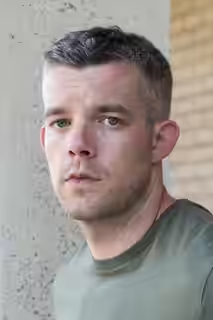
Most critics come away admiring The Pass, and almost every review lands in the same place: Russell Tovey. His performance as Jason, a closeted footballer who moves from innocence to fear and loneliness, is called nuanced, layered, vulnerable and exposed, and several reviewers credit him with making a difficult, sometimes cruel man touching. Arinzé Kene is praised alongside him for matching his presence, and a few critics single out the writing as sharp, witty and gripping.

The reservations cluster around the film’s origins as a play. Again and again the word is stagey: static staging, a chamber-piece feel, dialogue that occasionally sounds forced. Eye for Film adds that the small scale and moments of melodrama hold it back, and The Wrap calls it modest. The spread is narrow, with no outright negatives; Den of Geek is the warmest, calling it urgent and raw.

Little White Lies
8 December 2016 · 3/4/4 · Tom Williams
80

The critic calls the film refreshing, nuanced and urgently worthwhile, despite some forced dialogue. They praise Russell Tovey’s nuanced portrayal of a closeted footballer under pressure.

Read the full review →
Empire
5 December 2016 · Ian Freer
75*

Freer finds the drama compelling despite its static, stagey feel. He singles out Russell Tovey’s layered performance and the sharp writing for giving the intimate story depth.

Read the full review →
Evening Standard
9 December 2016 · Charlotte O'Sullivan
75*

O'Sullivan finds the film a wrenching, sharply observed look at betrayals and the cost of protecting a public image. She singles out Russell Tovey's performance as sublime and praises Arinzé Kene for matching his magnetic presence.

Read the full review →
The Guardian
8 December 2016 · Peter Bradshaw
75*

Bradshaw finds the drama ambitious and insightful, though its stage origins sometimes show. He particularly praises Russell Tovey’s performance as his character moves from innocence to fear and loneliness.

Read the full review →
Variety
16 March 2016 · festival review · Catherine Bray
75*

Bray finds the film absorbing and theatrically constrained, but says its tense chamber-piece approach works. She especially praises Russell Tovey’s knockout performance as a closeted soccer player.

Read the full review →
Screen Daily
16 March 2016 · Fionnuala Halligan
64*

The page identifies this as Fionnuala Halligan’s review of Ben A. Williams’s 2016 film. The paywall hides the verdict and any specific praise or complaint.

Read the full review →

Straight answers AI written, from our review

Is The Pass worth watching?
The Pass is worth watching for anyone who likes two actors in a room, and we scored it 72. Russell Tovey is first-rate as a footballer who has traded himself for a career, and the first and third acts in their hotel rooms are quietly affecting. The middle section is stagier and works too hard; those who called it unmissable oversold it.
How long is The Pass, and what is it rated?
The Pass runs 1h 27m. It is a drama and romance film.
Where can I watch The Pass in Saudi Arabia?
The Pass is not on any streaming or rental service in Saudi Arabia at the moment. It is available in 7 other countries; change your country at the top of the page to see where. Availability is checked daily.
How violent or frightening is The Pass, and is it suitable for children?
The Pass is a 15-certificate drama with no violence or frights to speak of; the adult content is sexual and emotional rather than physical. It is three men and a woman talking, insulting and undressing in hotel rooms over ten years, with a closeted footballer at its centre. It is not for children, but older teenagers interested in the subject would find nothing to alarm them.
How does The Pass compare to Weekend?
The Pass and Weekend are both small British films about two men, mostly talk, in one or two rooms, but Weekend is the better and the warmer of the two. Haigh's film is a love story told across a single weekend; Donnelly's is about a man who refuses one, told across a decade. Start with Weekend if you want to be moved, The Pass if you want to watch someone fail to be.
What should I watch after The Pass?
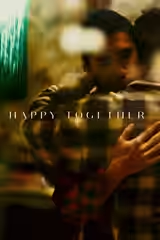
After The Pass, try Weekend (2011, Fi1m 86): Two men, one Nottingham flat, two days, and a conversation that turns out to be everything. Then God's Own Country (2017, Fi1m 84): A Yorkshire farmer learns to want something; mud, lambing and a great deal of not talking; and Happy Together (1997, Fi1m 86): Two men in a rented Buenos Aires room, breaking up and starting again, beautifully shot.

Cast

If you liked this, try…

  1. Weekend (2011, Fi1m 86)Two men, one Nottingham flat, two days, and a conversation that turns out to be everything.

  2. God's Own Country (2017, Fi1m 84)A Yorkshire farmer learns to want something; mud, lambing and a great deal of not talking.

  3. The Damned United (2009) · not reviewed yetFootball as ego and loneliness, with the pitch kept almost entirely out of view.

  4. Happy Together (1997, Fi1m 86)Two men in a rented Buenos Aires room, breaking up and starting again, beautifully shot.

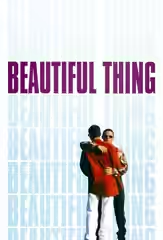
  5. Beautiful Thing (1996, Fi1m 80)A Thamesmead estate, two teenage boys, and a film that is kind without going soft.