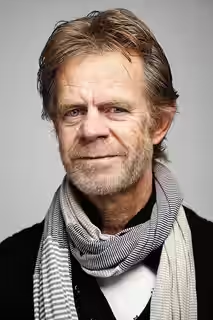
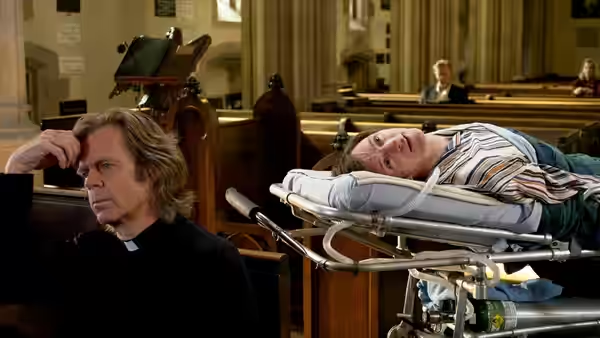
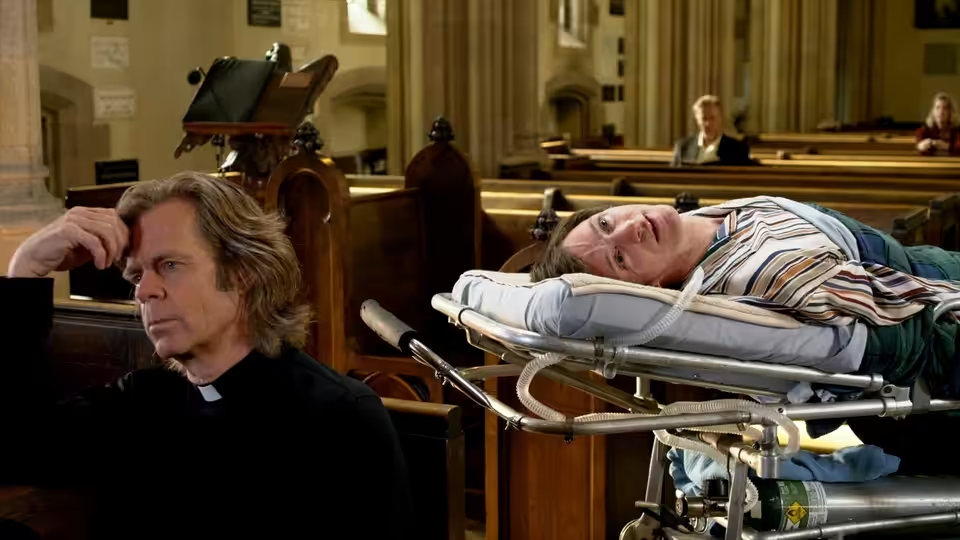
Father Brendan (William H. Macy) sits beside Mark (John Hawkes), who lies on a stretcher in church
Film review

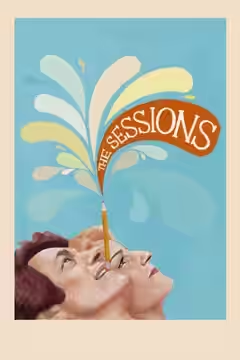
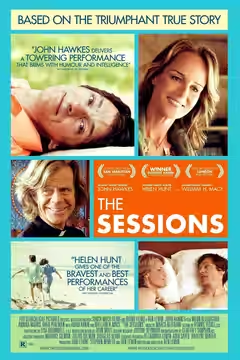
The Sessions

2012 · Directed by Ben Lewin · 1h 35m · Medierådet A

In a sentenceA sex surrogate offers practical advice; the priest has rather more to think about

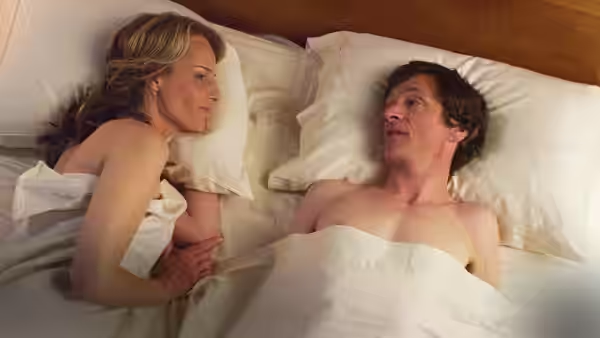
Mark (John Hawkes) is a disabled man seeking sexual intimacy. Cheryl (Helen Hunt), a sex surrogate, offers practical help, while Father Brendan (William H. Macy), Mark’s priest, provides someone to consult about the moral questions. Mark has to explain what he wants, confronting embarrassment as well as his physical limitations. With Cheryl, the conversation concerns bodies and the work of becoming comfortable with another person. With Father Brendan, his desires become a matter for spiritual advice, with humour finding its way into a discussion Mark takes seriously. Getting help means speaking openly about something he finds difficult to discuss.

Plays from YouTube when you press play; nothing loads from them until then.

Fi1m review

Ben Lewin’s The Sessions is a warm, frank comedy-drama about sex and disability, carried by John Hawkes and Helen Hunt. The filmmaking is ordinary and some moral questions get short shrift, but the intimacy feels earned.

The Sessions is good company for a subject that films so often approach with a lowered voice. Writer-director Ben Lewin treats Mark’s wish for sexual intimacy as a reasonable human want, and gives embarrassment room to be funny without making disability the joke. We recommend it for the performances, with some patience required for the rather plain filmmaking. It does, however, hurry past some of the harder questions raised by Mark’s encounters.

John Hawkes gives Mark enough wit and vulnerability to prevent him becoming merely someone whose progress we are supposed to applaud. Humour belongs to his personality, which matters in a film where every awkward exchange could otherwise become a lesson in being kind. The performance allows need, self-consciousness and pleasure in other people’s company to exist together. Mark is engaging without having to spend every moment proving that he deserves affection.

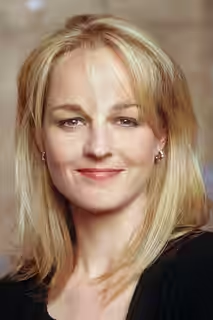
Helen Hunt is just as important as Cheryl, the sex surrogate whose practical approach makes the intimate conversations believable. Her restraint gives the relationship weight: she need not underline every sympathetic response for us to understand that she is paying attention. We were moved by her matter-of-fact exchanges with Mark about sex, because she allows his embarrassment without making a ceremony of her patience. Both performances make frankness feel possible even when confidence is in short supply.

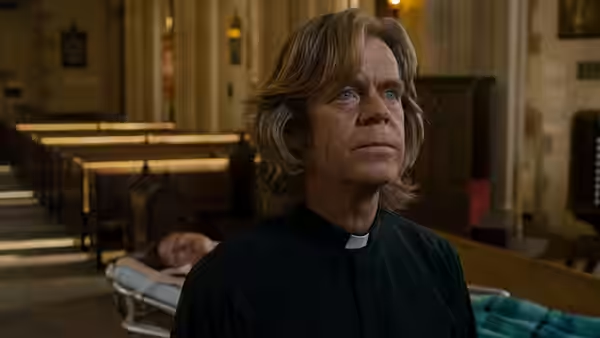
William H. Macy’s Father Brendan supplies a different kind of listening, and the discussions with the priest give Mark’s desires a moral complication. These scenes also contain some welcome humour, although the dialogue can make the priest sound too conveniently equipped with a response. Ben Lewin seems keener to keep the conversation companionable than to follow its harder implications. That limits the drama without cancelling the warmth of the performance.

Geoffrey Simpson’s cinematography is serviceable, and the static staging gives it little chance to do more than accommodate the conversations. John Mott’s production design is similarly unobtrusive; we seldom find ourselves studying the surroundings instead of the people. There is sense in that restraint, but the images do not always contribute enough when the dialogue has already explained a feeling. Several conversations might have gained from less explanation and a little more trust in a pause.

Lisa Bromwell’s editing keeps the film brisk, though some emotional complications need longer than the story gives them. At 95 minutes, there is little danger of exhaustion, but more time spent on uncertainty might have helped. Marco Beltrami’s music supports the tenderness without becoming what we remember; the actors’ voices are more distinctive. The principal weakness is how readily the film smooths a difficult subject into something agreeable.

This suits an evening when we want adults to talk about sex without behaving as though the subject has just been invented. Anyone hoping for a searching examination of the ethics will have to supply some of it afterwards. Watch it for John Hawkes and Helen Hunt, and allow for a script that is sometimes too anxious to put everyone at ease.

Critical consensus AI synthesised

78
Positive
19
Mixed
2
Negative
0

Most critics respond warmly to The Sessions, with praise centred on its performances and frank, humane treatment of sex and disability. John Hawkes is singled out for conveying Mark’s wit, vulnerability and warmth, while Helen Hunt draws admiration for her restraint and emotional openness. The reviews frequently credit the film with finding humour in awkward intimacy without patronising its central character, and with being moving without relying on misery or heavy melodrama.

Reservations concern the conventional storytelling more than the acting, and the spread runs from enthusiastic to mixed, with no outright negative verdicts. IndieWire finds the approach to sexuality intelligent but the storytelling talky and static. Radio Times is more troubled by the way the film glosses over moral dilemmas. The Skinny praises its frankness while questioning the unequal treatment of nudity. Elsewhere, complaints about thinness, sentimentality and an overly brisk resolution temper an otherwise favourable consensus.

RogerEbert.com
24 October 2012 · ★★★½/4 · Roger Ebert
88

The review is warmly positive about the film. It singles out the performances, especially Helen Hunt’s, for praise.

Read the full review →
The Guardian
24 January 2012 · festival review · Jeremy Kay
85*

The critic calls the film an unexpected crowd-pleaser that celebrates life rather than sinking into misery. They single out John Hawkes’s mesmerising performance and the story’s grace, humour and tenderness.

Read the full review →
Variety
23 January 2012 · festival review · Peter Debruge
85*

Debruge calls the film an exceptional, expertly acted crowd-pleaser with tenderness and humor. He especially praises John Hawkes’s performance for conveying Mark’s spirit and vulnerability despite the role’s physical constraints.

Read the full review →
Time Out
14 January 2013 · ★★★★ · Guy Lodge
80

Lodge gives the film four stars, indicating a positive verdict. The available description singles out its deeply felt approach to disability.

Read the full review →
Total Film
15 January 2013 · ★★★★ · Ellen E
80

The review praises the film for avoiding patronising disability tropes and treating O’Brien as a rounded person. It singles out the strong performances by John Hawkes, Helen Hunt and William H. Macy.

Read the full review →
IndieWire
18 October 2012 · B · James Rocchi
77

Rocchi finds the film standard-issue but humane and intelligent, with an unusually adult approach to sexuality. He singles out the grounded performances and frankness about sex, while criticizing the talky, static storytelling.

Read the full review →

Straight answers AI written, from our review

Is The Sessions worth watching?
The Sessions is worth watching for John Hawkes and Helen Hunt’s warm, frank performances, and we score it 79 out of 100. We recommend it for an adult comedy-drama about sex and disability, though the plain filmmaking and hurried treatment of difficult moral questions limit its depth.
How long is The Sessions, and what is it rated?
The Sessions runs 1h 35m and is rated A by the Medierådet in Denmark. It is a drama and romance film.
Where can I watch The Sessions in Denmark?
The Sessions is available to rent from Apple TV from kr 39.00. Availability is checked daily; the links above go straight to each service.
How violent or frightening is The Sessions, and is it suitable for children?
The Sessions has a UK 15 certificate and is not suitable for children under 15; its frank treatment of sex makes it an adult watch. Mark’s conversations with a sex surrogate concern bodies, desire and embarrassment. We recommend it to older teenagers and adults comfortable with intimate sexual discussion.
How does The Sessions compare to Coming Home?
The Sessions is the warmer, more conversational choice beside Coming Home, whose veterans’ ward scenes offer the more remarkable filmmaking. Both explore disability, desire and intimacy, but Coming Home develops into a love triangle within a Vietnam drama. We favour The Sessions for humour and practical conversations about sex, while Coming Home offers stronger atmosphere before settling into a more conventional romance.
What should I watch after The Sessions?
After The Sessions, try Coming Home (1978, Fi1m 76): For another adult account of disability, desire and the complications of intimacy. Then The Lunchbox (2013, Fi1m 75): A quieter courtship, sustained by attentive performances and the courage of small disclosures; and Ali: Fear Eats the Soul (1974, Fi1m 88): An unlikely romance takes prejudice seriously without denying its lovers warmth or awkwardness.

Cast

Awards

Academy Awards, 2013

Nominated
Best Supporting Actress

Sundance Audience Award: U.S. Dramatic, 2012

Won
Sundance Audience Award: U.S. Dramatic

Sundance Special Jury Prize for Ensemble Cast, 2012

Won
Sundance Special Jury Prize for Ensemble Cast

If you liked this, try…

  1. Good Luck to You, Leo Grande (2022) · not on Fi1m yetFrank sexual conversation becomes compelling drama through patience, humour and two attentive performances.

  2. 37 Seconds (2019) · not on Fi1m yetAnother candid treatment of disability and sexual curiosity, with a persuasive, complicated heroine.

  3. Coming Home (1978, Fi1m 76)For another adult account of disability, desire and the complications of intimacy.

  4. The Lunchbox (2013, Fi1m 75)A quieter courtship, sustained by attentive performances and the courage of small disclosures.

  5. Ali: Fear Eats the Soul (1974, Fi1m 88)An unlikely romance takes prejudice seriously without denying its lovers warmth or awkwardness.