Film review

Coming Home

1978 · Directed by Hal Ashby · 2h 07m · MPA R

In a sentenceJon Voight furious in a wheelchair, Jane Fonda growing her hair out, and the Rolling Stones on every jukebox in California

DramaRomanceWar

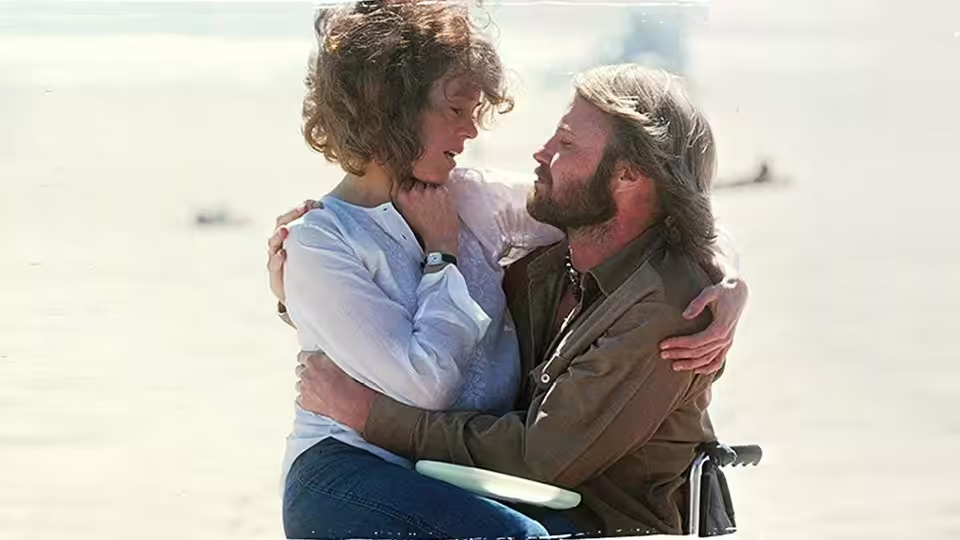
California, 1968. Marine Captain Bob Hyde (Bruce Dern) is about to ship out to Vietnam and cannot wait; his wife Sally (Jane Fonda) has a good haircut, a house on the base and nothing to do once he has gone. She moves to a place by the beach, takes up with Vi Munson (Penelope Milford), whose brother Bill (Robert Carradine) is a patient at the veterans’ hospital, and volunteers on the wards herself. There she collides, literally, with Luke Martin (Jon Voight), a paraplegic sergeant she knew at school, who spends his days face down on a gurney raging at the staff, the food and the war. Sally wants to be useful. Luke wants everyone to leave him alone. Bob, from the other side of the world, wants a war he can believe in.

Plays from YouTube when you press play; nothing loads from them until then.

Fi1m review

Hal Ashby’s Vietnam drama is close to remarkable for an hour, in a veterans’ ward that looks and sounds like the real thing. It then becomes a love triangle, a good one, and settles for being a good film rather than an important one.

Hal Ashby’s Coming Home begins in 1968 with a group of men in wheelchairs around a pool table, arguing about whether they would go back. Nobody has scripted them; they sound like men who have been having the conversation for months. It sets the standard for the first hour, which is as truthful as anything the American cinema managed about that war. Then the film settles into what the tagline promised, a woman between two men, and while it does that well, it does it the way a dozen other films have.

The ward is where Ashby and Haskell Wexler do their best work. Wexler shoots the hospital on long lenses in the light that happens to be there, so the corridors are dim and the day room is over-bright and the patients are in the frame whether the story needs them or not. Jon Voight’s Luke Martin enters it face down on a gurney, propelling himself with a cane, and Jane Fonda’s Sally knocks his catheter bag off on her first morning. He screams at her. It is the least sentimental introduction to a love story we can think of, and the film knows it.

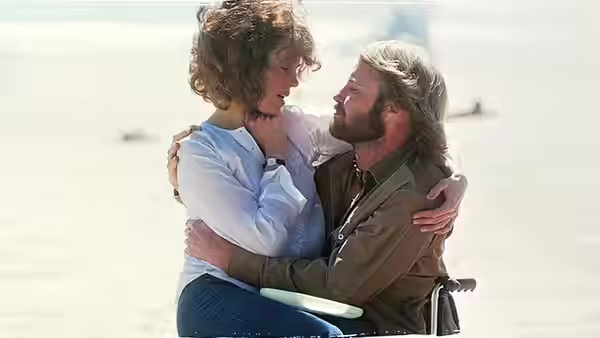
Voight is the reason to see it. He plays the early scenes as pure fury, thrashing against orderlies, hurling his body about the ward as if it belonged to someone else, and then lets the anger drain out over the next forty minutes until what is left is a watchful, funny, wary man who has decided to live. We were shaken by him. There is a scene where he is finally in a wheelchair rather than on the gurney and he simply sits still for a moment, and the stillness said more about what he had lost than the shouting had.

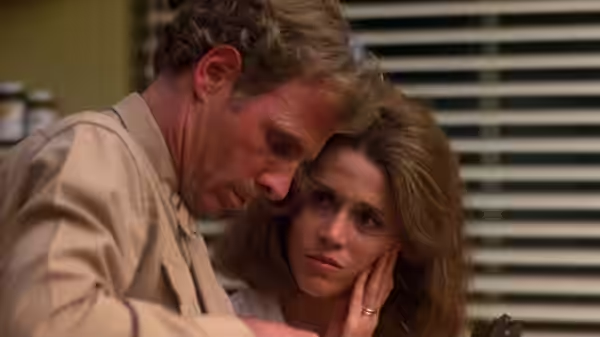
Fonda has the harder job because Sally is the film’s argument, and Ashby signposts it. Ann Roth dresses her first in a stiff set of officer’s-wife outfits and a hairdo that looks lacquered on; by the beach house the hair is loose and the clothes are somebody else’s. Michael D. Haller gives her a base bungalow with everything in its place and then a wooden house by the water with sand on the floor. It is a little neat. Fonda earns it anyway, chiefly by never playing Sally as stupid before her awakening, only as a woman who had not yet been asked a question.

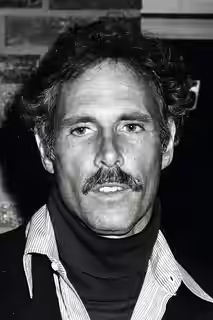
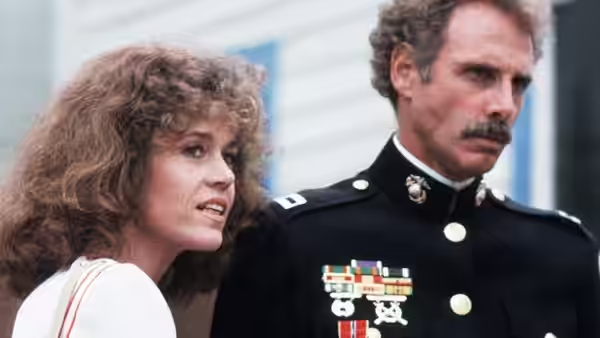
Bruce Dern’s Bob has less screen time and uses all of it. He is stiff, decent and eager, a man who has wanted a war his whole life and is slightly embarrassed by how much. Dern gives him a laugh that arrives a beat late and a way of standing that never relaxes, and when the film returns to him later it has earned the right to. Robert Ginty’s Dink Mobley, Bob’s friend and fellow officer, is the film’s picture of the man who came back without noticing anything.

The script, by Waldo Salt and Robert C. Jones from Nancy Dowd’s story, loses its nerve in the second hour. Penelope Milford’s Vi is sharp and sad and the film keeps forgetting her; Robert Carradine’s Bill, hollow-eyed and frightened, is a thread the film picks up too late. Luke’s politics arrive as speeches, delivered to cameras or to schoolchildren, where the pool table had made them without a word. Don Zimmerman cuts the middle stretch as a run of songs and drives and beds, and the soundtrack, period records rather than a composed score, mostly the Rolling Stones, sits on top of scenes that could have carried themselves. When it works, as in one long drive with the radio on, it works because the song is allowed to finish.

Against Ashby’s own run of the seventies, The Last Detail (1973) and Shampoo (1975), this is the one where the message shows. Those films let the audience find the meaning; this one hands it over. And yet the last ten minutes, which we will not describe, cut between two men and two ways of being a man in America, and they moved us more than the previous hour had led us to expect. It is the film the first act promised, arriving late.

Watch it for Voight, for the ward, and for the ending. It runs 127 minutes, carries an 18 for its frankness about sex and its language, and is better in company, with someone who will argue about whether the middle hour is a love story or a lecture.

Critical consensus AI synthesised

70
Positive
7
Mixed
0
Negative
2

Most critics admire Coming Home, and the praise lands first on the actors. Jon Voight’s paralysed veteran and Jane Fonda’s army wife are singled out almost everywhere, with several reviews noting how frankly the film treats her sexuality for its period, and Collider argues that Bruce Dern’s returning soldier is the performance that lingers. Hal Ashby is credited with a stance that is against the war without being against the soldiers, and the documentary-style look and period detail are widely noted.

The reservations cluster on the love triangle. Several reviews feel the film opens with something close to reportage about wounded men and then settles into a conventional romance. The spread is wide, and both negative notices date from the film’s first release: The New York Times finds its intentions unrealised, and The New Yorker calls it sloppy and doctrinaire. Later critics are consistently warmer, and Film Comment treats the melodrama as the point rather than a fault.

Empire
1 January 2000 · Alan Morrison
90*

The critic praises the strong erotic chemistry and career-best performances from Jon Voight and Jane Fonda as a wheelchair-bound veteran and an army wife who begin an affair. Hal Ashby's film is singled out for its careful anti-war stance that critiques America's abandonment of wounded soldiers without being anti-soldier.

Read the full review →
Variety
31 December 1977
90*

The review praises it as an excellent Hal Ashby film illuminating conflicting Vietnam attitudes through three main participants. It highlights strong performances by Fonda, Voight and Dern along with a discreetly erotic sex scene.

Read the full review →
Film Comment
· David Ehrenstein
70*

The critic positions Coming Home as a modern melodrama equivalent to Written on the Wind, arguing that its Vietnam War elements serve mainly as background for the genre's emotional mechanics rather than driving the drama. Ehrenstein affirms the value of recognizing and examining such melodramatic structures in contemporary films instead of dismissing them.

Read the full review →
The New York Times
16 February 1978 · Vincent Canby
40*

The film starts with documentary-like truth in depicting troubled veterans but soon devolves into a conventional romantic triangle about two vets and one woman. Canby faults its soggy score and unrealized intentions despite some moving moments.

Read the full review →
The New Yorker
13 February 1978 · Pauline Kael
30*

Kael sees the film as mythologizing the sixties through an inauthentic portrait of a woman radicalized by the war and her affair with a paraplegic veteran. She criticizes its sloppy construction and doctrinaire tone despite entertaining elements.

Read the full review →
Paste
1 July 2024 · Oktay Ege Kozak
90*

The romance between a lonely wife and a wounded veteran develops organically without easy melodrama or schmaltz. Its frank depiction of female sexuality was rare even for the 1970s, and the film succeeds both as romance and astute political commentary.

Read the full review →

Cast

Awards

Academy Awards, 1979

Nominated
Best Director
Nominated
Best Film Editing
Nominated
Best Picture
Nominated
Best Supporting Actor
Nominated
Best Supporting Actress
Won
Best Actor
Won
Best Actress
Won
Best Writing, Original Screenplay

Cannes Film Festival, 1978

Won
Best Actor

Directors Guild of America Award for Outstanding Directing – Feature Film, 1978

Nominated
Directors Guild of America Award for Outstanding Directing – Feature Film

Golden Globes, 1978

Nominated
Best Director
Nominated
Best Motion Picture – Drama
Nominated
Best Screenplay
Nominated
Best Supporting Actor – Motion Picture
Won
Best Actor – Motion Picture Drama
Won
Best Actress – Motion Picture Drama

Los Angeles Film Critics Association Award for Best Actor, 1978

Won
Los Angeles Film Critics Association Award for Best Actor

Los Angeles Film Critics Association Award for Best Actress, 1978

Won
Los Angeles Film Critics Association Award for Best Actress

Los Angeles Film Critics Association Award for Best Film, 1978

Won
Los Angeles Film Critics Association Award for Best Film

National Board of Review Award for Best Actor, 1978

Won
National Board of Review Award for Best Actor

National Society of Film Critics Award for Best Actor, 1978

Nominated
National Society of Film Critics Award for Best Actor

National Society of Film Critics Award for Best Actress, 1978

Nominated
National Society of Film Critics Award for Best Actress

New York Film Critics Circle Award for Best Actor, 1978

Won
New York Film Critics Circle Award for Best Actor

If you liked this, try…