Film review

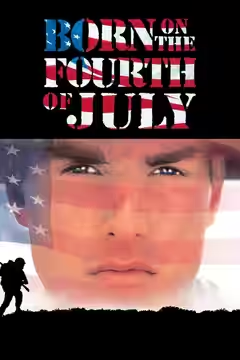
Born on the Fourth of July

1989 · Directed by Oliver Stone · 2h 25m · MPA R

In a sentenceTom Cruise gets the wheelchair, the moustache and the rage; John Williams gets to play a trumpet over all of it

DramaWar

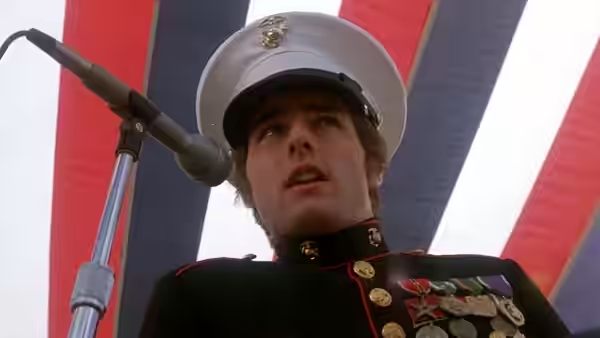
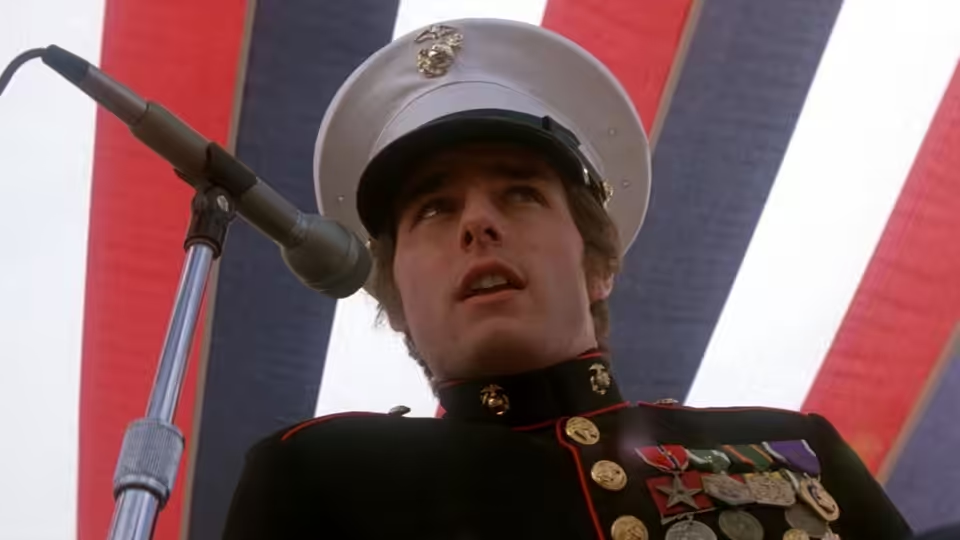
Ron Kovic (Tom Cruise) grows up in Massapequa, on Long Island, with the birthday in the title. He plays soldiers in the woods, watches the Fourth of July parade go past the house each summer, wrestles for his school, and listens to two Marines in dress blues tell a gymnasium of boys that the Corps takes only the best. His mother (Caroline Kava) is devout and proud; his father (Raymond J. Barry) says less. There is a girl, Donna (Kyra Sedgwick), he never quite asks out, and a dance with her at the prom, in the rain, the night before he leaves for boot camp. Then Vietnam, a firefight that goes badly wrong, a bullet that leaves him paralysed from the chest down, and a veterans’ hospital where the rats are bolder than the staff.

Fi1m review

Oliver Stone’s film about Ron Kovic is loud, long and given to sermons, and for stretches it is as strong as anything he has made. Tom Cruise’s Kovic and a hospital sequence we will not forget carry it past the speeches.

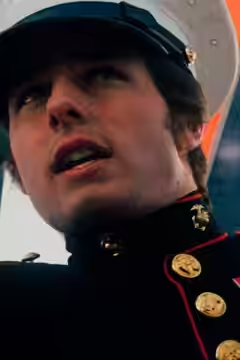
Ron Kovic grows up in Massapequa, on Long Island, with the birthday in the title. He plays soldiers in the woods, watches the parade every summer and listens to two Marines in dress blues tell a gymnasium of boys that the Corps takes only the best. Oliver Stone, who wrote the script with Kovic, follows him to Vietnam, to a bullet that leaves him paralysed from the chest down, and home to a country that has moved on without him. It runs 145 minutes and is loud for most of them. We think it is a good film, and about twenty minutes and several trumpet solos short of a fine one.

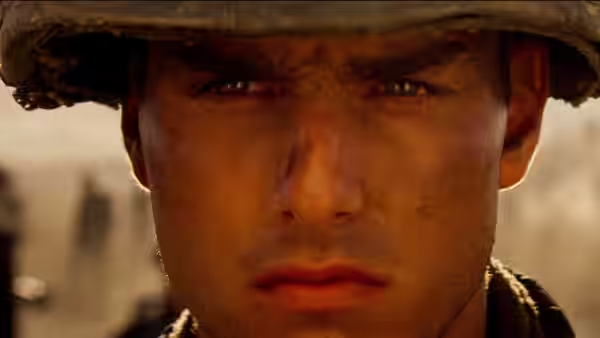
Robert Richardson shoots the Long Island childhood in a back-lit haze, sparklers and flags and a mother in a summer dress, so that we know this is a memory rather than a place. The film’s case is that pictures are what the boy went to war for. Kyra Sedgwick’s Donna gets a dance with him at the prom, in the rain, and Stone shoots it straight. Then the light goes white. Vietnam is bleached sand and a drained sky, and the firefights are chaos: nobody can see, everybody is shouting.

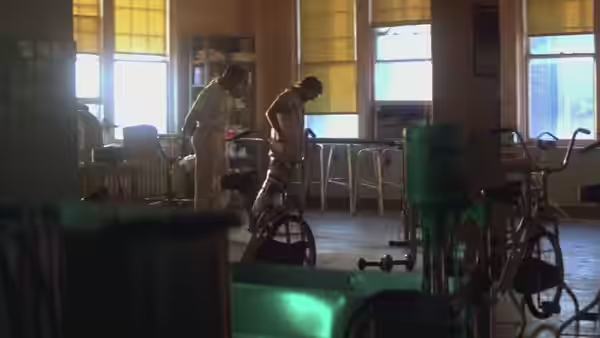
The veterans’ hospital is the sequence that decides the film, and it horrified us. Bruno Rubeo’s ward is green paint, rows of beds, rats on the floor and a pump that keeps stopping. The staff are too few and past caring, and when Kovic breaks his leg trying to prove he will walk again he is left strapped face down to a frame while the machinery fails around him. Joe Hutshing and David Brenner cut it long, without relief. What did it, for us, was not the rats. It was Cruise’s voice on the ward at night, asking for help in the tone of a man who already knows nobody is coming.

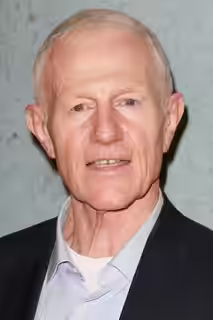
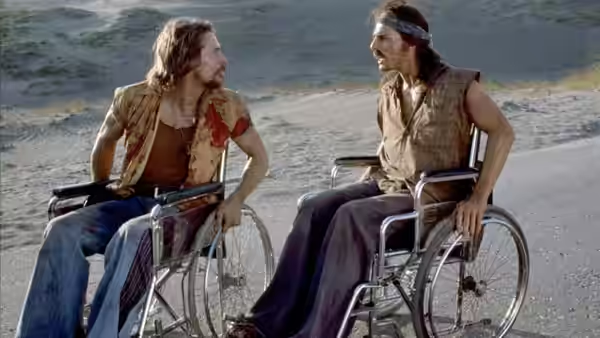
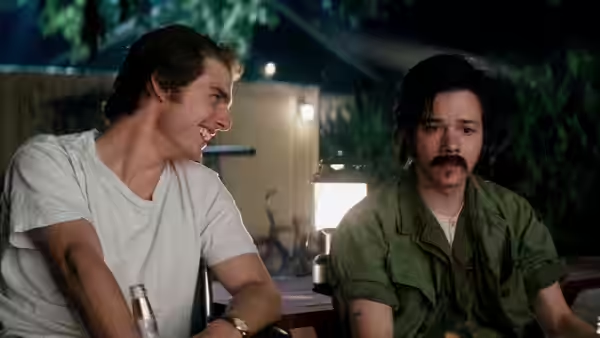
Cruise does not ask to be liked. The schoolboy Kovic is eager and foolish; the veteran is long-haired, moustached and drinking, wheeling himself into rooms where he is not wanted. The best scene in the film is a family one. Kovic comes home drunk and screams at his mother about what the war has taken from his body, in words she will not have in the house. Caroline Kava plays Mrs Kovic as a woman who cannot hear what her son is telling her, and Raymond J. Barry, as his father, gets through the row by picking things up off the floor and then carrying him up to bed.

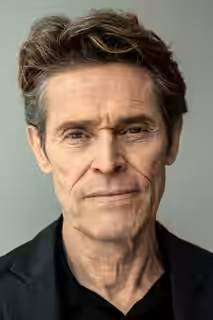
A stretch in Mexico, in a town of bars and brothels full of men in wheelchairs, is the film at its sharpest. Willem Dafoe plays Charlie, another paralysed veteran, with a grin that has gone bad, and the argument he and Kovic have by the roadside, about which of them killed more children, is played without anyone reaching for a moral. Judy Ruskin Howell dresses the veterans in denim and army surplus, so that from a distance the beach looks like a bivouac.

What does not work is the volume. John Williams has written a trumpet theme of real beauty and Stone uses it every time he wants us to feel something, so that by the second hour a swell of brass has come to mean here it comes again. And the film shows Kovic’s anger far more carefully than his reasons. Most critics have taken his change of mind on trust because Cruise makes it believable. We believed him too. We just wanted to know what he had been told.

Set against Platoon, which Stone made three years earlier, this is the broader film and the less disciplined one. Platoon stayed in the jungle. This one wants the whole country, and the country does not fit in 145 minutes without somebody standing on a chair. It is an 18 certificate, and it earns that in the hospital rather than the jungle. Watch it in one sitting and do not skip the ward, however much you want to.
Critical consensus AI synthesised

79
Positive
10
Mixed
2
Negative
0

Most critics admire it, and the praise gathers first around Tom Cruise. Nearly every review calls his Ron Kovic a transformation, the star made convincing as a paralysed veteran stripped of dignity and turned into an activist. Stone’s ambition is the other point of agreement: reviewers see a wider canvas than Platoon, with Kovic’s journey from small-town patriot to protester standing for the country’s own loss of faith. The hospital sequences are singled out more than once.

The reservations are about Stone rather than Cruise. Several reviews find the film too long, too loud and given to sermonising, with heavy episodes and swelling music doing work the writing should. The two mixed notices push further: the Los Angeles Times argues it stirs the emotions without engaging the mind on how Kovic’s politics change, and The New Yorker finds it a scream of rage built from portentous blackouts. Nobody dismisses it; the spread runs from raves to grudging respect.

Radio Times
★★★★★ · Adrian Turner
100

Stone's biographical drama is a masterpiece occupying a broader canvas than Platoon, with Tom Cruise utterly convincing as the wounded veteran turned anti-war activist. The film reeks of authentic experience and regret from Kovic and Stone.

Read the full review →
RogerEbert.com
20 December 1989 · ★★★★/4 · Roger Ebert
100

The film is one of the best of the year and a powerful statement about an American changing his mind about the Vietnam War. It excels through Tom Cruise's transformative performance as Ron Kovic and its focus on ideology and personal experience rather than just battle or recovery.

Read the full review →
Variety
1 January 1989 · Variety Staff
90*

Stone's collaboration with Kovic results in a gripping, devastating film that shows America to itself in an unforgettable way. It creates a portrait of a pure-hearted boy whose beliefs are shattered by Vietnam, with stunning performances from Cruise and Dafoe amid visceral realism.

Read the full review →
The AV Club
18 July 2012 · B+ · Scott Tobias
83

The critic finds the film an operatic, iconography-laden epic that equates Ron Kovic's story with America's own journey from 1950s idealism to Vietnam-era disillusionment. Stone's excesses are noted but ultimately redeemed by the film's patriotic sweep and Tom Cruise's transformative performance.

Read the full review →
Empire
1 January 2000 · Barry McIlheney
80*

The critic praises the film's moving portrayal of one man's extraordinary life across turbulent decades and Tom Cruise's remarkable, transformative performance as the standout element. Some flaws are noted, including an overlong and overwrought structure with uneven handling of politicization, but these do not detract from its overall impact and emotional punch.

Read the full review →
Slant Magazine
24 August 2006
80*

In a profile of Oliver Stone, the film is praised for using American iconography to dramatize the shift from blind faith in military action to doubt and skepticism, presenting Kovic's arc as a potent symbol of generational change.

Read the full review →

Cast

Awards

Academy Awards, 1990

Nominated
Best Actor
Nominated
Best Cinematography
Nominated
Best Original Score
Nominated
Best Picture
Nominated
Best Sound
Nominated
Best Writing, Adapted Screenplay
Won
Best Director
Won
Best Film Editing

If you liked this, try…