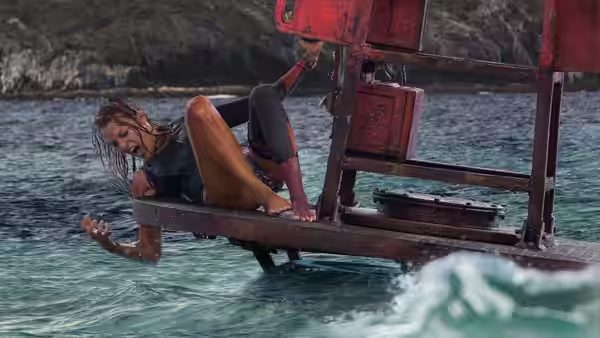
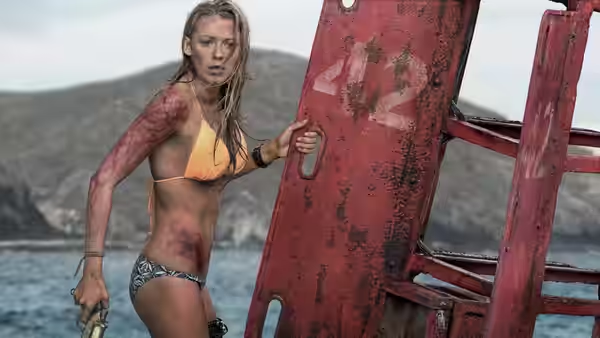
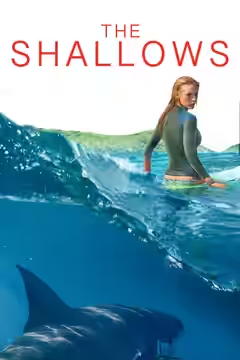
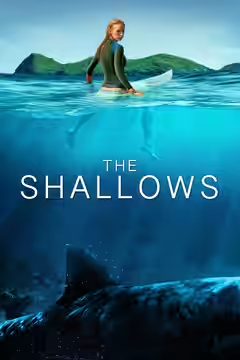
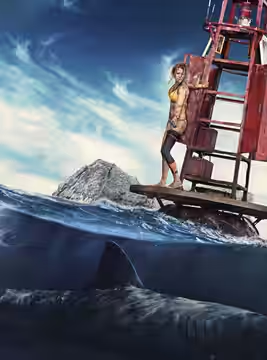
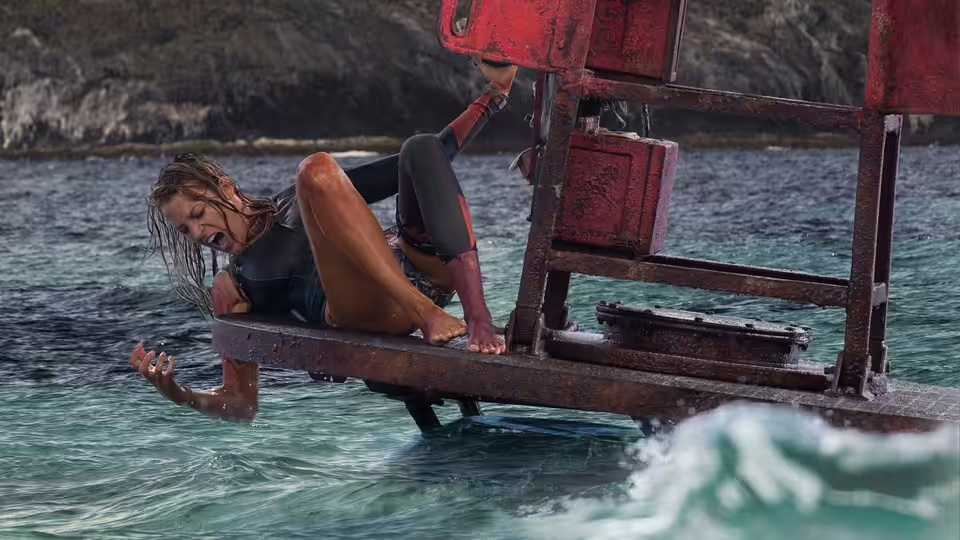
Nancy Adams (Blake Lively) clings to a red buoy above the water
Film review

The Shallows

2016 · Directed by Jaume Collet-Serra · 1h 26m · FSK 12

In a sentenceEighty-six minutes, one rock, one seagull, and a shark with a personal grudge

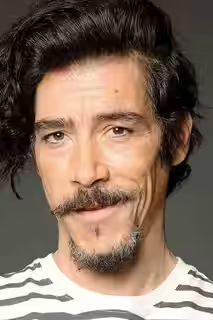
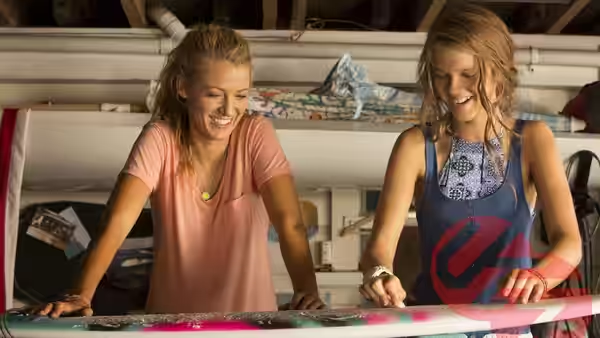
Nancy Adams (Blake Lively) has come alone to a secluded beach to surf. A local, Carlos (Óscar Jaenada), drives her down and will not tell her its name. She paddles out, shares the break with two surfers, and takes a video call on the sand from her sister Chloe (Sedona Legge) and her father (Brett Cullen), who wants to know whether she is giving up. Late in the afternoon she goes back out for one more wave and finds a dead whale drifting in the shallows. A great white is feeding on it. It bites her, and she drags herself onto a rock a short way from shore, with the tide coming in, a bleeding leg, and an injured seagull for company.

Plays from YouTube when you press play; nothing loads from them until then.

Fi1m review

Jaume Collet-Serra’s shark film is lean, bright and properly frightening for most of its 86 minutes, and Blake Lively carries it nearly alone. The finish is silly; the hour on the rock is as good as this kind of thing gets.

Jaume Collet-Serra has spent two films putting Liam Neeson in confined spaces, a plane in Non-Stop (2014) and a car in Run All Night (2015), and here he strips the idea to its bones. One woman, one rock, one shark, 86 minutes. The Shallows is a B-picture and knows it, and it is a good one: tense, clean, well lit and over before it can bore you. It spends its last fifteen minutes doing the things shark films do when they run out of ideas, and we minded less than we expected to.

Anthony Jaswinski’s script gets Nancy into the water fast. She has lost her mother, and the beach is bound up with that. Blake Lively plays her as competent before she is frightened, a woman who checks the swell and times the sets, and when the trouble starts the competence is what she has left. She tourniquets a leg with the cord from a wetsuit and keeps up a conversation with a seagull on the rock. Lively is funny in the way frightened people are funny, snapping at the bird, apologising to it, and she carries long stretches of the film alone.

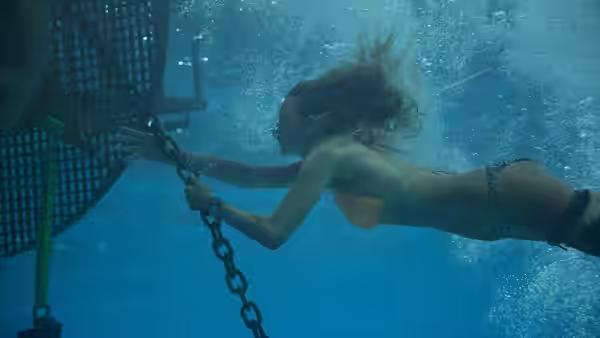
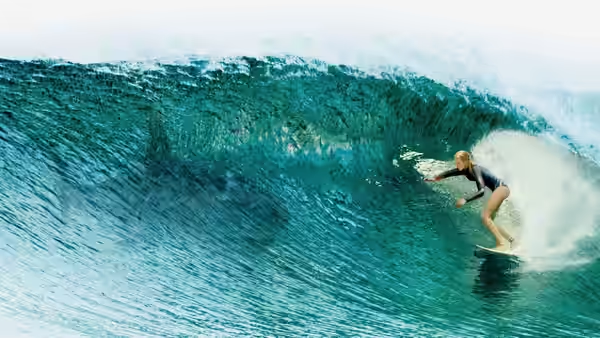
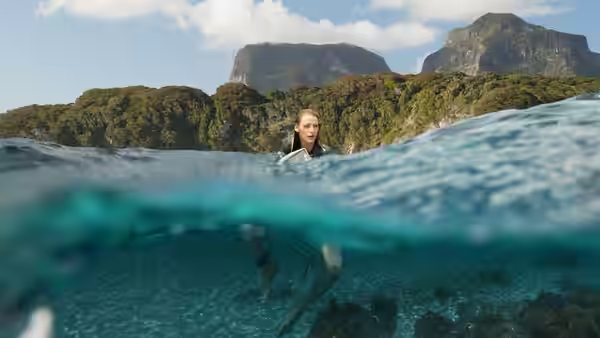
Flavio Martínez Labiano shoots the water from everywhere a camera will go. Half the frame is above the surface and half below, so we see Nancy’s legs hanging from the board while she looks the other way. The shark is first shown as a shape inside the curl of a wave with the sun behind it. Blood spreads in a slow cloud that Labiano films from underneath, and the cove, turquoise and gold until then, is suddenly a place we wanted to leave. Hugh Bateup gives Nancy a rock the size of a kitchen table, with a tide line on it we learn to read.

Joel Negron cuts the surfing as a short bright montage and then slows down once she is stranded, so that minutes on the rock feel like minutes. He lays Nancy’s phone on the frame as a graphic, the video call sitting in a corner of the sky, which spares us exposition. Marco Beltrami’s score stays low under the waiting and comes up hard for the attacks; it is not subtle and it is not meant to be.

We flinched at the first bite, properly. It is staged from the surface, a jolt and then nothing, and the nothing is worse. Later Nancy does something to her own leg with her jewellery, and we watched most of it through our fingers, while admiring that Collet-Serra holds the shot and lets Lively’s face do the screaming. It is the best sequence in the film and it is over quickly. We came out grinning, which is not what we expected from a film about a woman bleeding on a rock.

The weaknesses are all off the rock. Jaswinski has given Nancy a dead mother and a worried father, and every so often the shark has to wait while she remembers them. The video call with Brett Cullen is written to tell us what the film is about, and the film did not need telling. The shark circles the rock as though it had taken the business personally, and the effects, so good in silhouette, look worse in daylight. The last act moves to a buoy, takes a turn we will not describe, and is sillier than everything before it. Most critics have stopped there, complaining of the backstory and the finish. We think they are weighing the wrong parts: the backstory is a few minutes, the finish is ten, and in between is an hour of thriller built as well as the genre allows.

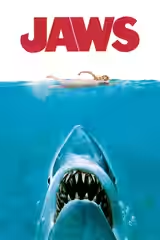
Next to Jaws (1975) this is a small thing; Spielberg had a town and three men in a boat, and Collet-Serra has a woman and a bird. Against the director’s Neeson films it is tighter and better looking. The gull, credited as Sully ‘Steven’ Seagull, gives the second-best performance.

Watch it at home with the lights down and the sound up, and forgive it the buoy. It carries a 15 certificate for the leg, which it earns.
Critical consensus AI synthesised

64
Positive
13
Mixed
4
Negative
5

Most critics come away pleased with The Shallows, and the praise is consistent about where the credit lies. Blake Lively’s performance is singled out again and again as the thing holding the film together, a committed, convincing and occasionally dryly funny turn in what is close to a one-woman show. Jaume Collet-Serra’s staging of a single stretch of water as a trap draws nearly as much admiration, as does the cinematography that makes the sea and the shark beneath it so effective. Several reviews rank it above every shark film since Jaws.

The reservations cluster at the edges of the story. The backstory about Nancy’s mother is widely judged unnecessary, and the climax is faulted for strained logic and a sentimental finish. The spread is wide: The Guardian admires the construction almost without reservation, while The Hollywood Reporter finds it inept and unable to build suspense. The New Yorker, alone, argues that Lively’s dramatic potential goes unused.

The Guardian
23 June 2016 · Jordan Hoffman
90*

Hoffman calls the film a minor masterpiece and praises its clever construction. He singles out the arresting cinematography and the film’s escalating, suspenseful survival scenario.

Read the full review →
Evening Standard
12 August 2016 · David Sexton
85*

Sexton calls the film possibly the best shark movie yet and praises it as perfect summer entertainment. He singles out Blake Lively’s performance and the film’s pace and propulsion.

Read the full review →
IndieWire
23 June 2016 · B+ · David Ehrlich
83

Ehrlich praises the film as an exceptionally effective shark thriller, calling it the best since Jaws. He especially singles out Blake Lively’s performance and the stranded seagull as a delightful supporting character.

Read the full review →
Little White Lies
23 June 2016 · 4/4/3 · Adam Nayman
80

Nayman finds the film entertaining but ultimately disappointing, wishing it were better. He praises the ocean setting and Collet-Serra’s visual transformation of paradise into purgatory.

Read the full review →
Los Angeles Times
23 June 2016 · Justin Chang
80*

Chang finds the film a satisfying, unpretentious summer thriller. He especially praises Blake Lively’s committed performance and the director’s skill at sustaining suspense.

Read the full review →
Time Out
31 July 2016 · ★★★★ · Joshua Rothkopf
80

The critic calls it an enjoyably trashy, entertaining summer film. The page singles out Blake Lively as well suited to the shark-survival story.

Read the full review →

Straight answers AI written, from our review

Is The Shallows worth watching?
The Shallows is worth watching for anyone who wants a short, bright, properly frightening shark film, and we scored it 82. Blake Lively carries nearly all of it alone on a rock, and the hour she spends there is as good as this kind of thing gets. The last fifteen minutes are silly, and we suggest forgiving them.
How long is The Shallows, and what is it rated?
The Shallows runs 1h 26m and is rated 12 by the FSK in Germany. It is a horror and drama film.
Where can I watch The Shallows in Germany?
The Shallows is available to rent from Amazon Prime Video and Apple TV from €0.99. Availability is checked daily; the links above go straight to each service.
How violent or frightening is The Shallows, and is it suitable for children?
The Shallows is a 15 certificate in the UK, and it earns it with one sequence in which Nancy treats her own bitten leg, which we watched through our fingers. The first bite is a jolt staged from the surface, and the waiting afterwards is tense rather than gory. Not for children or the squeamish; older teenagers who can take a wound should be fine.
How does The Shallows compare to Jaws?
The Shallows is a smaller film than Jaws, with one woman and a seagull where Spielberg had a town and three men in a boat, and the older film is the better of the two. What The Shallows has is speed and clarity: 86 minutes, almost all of them on a rock. Watch Jaws for the people, The Shallows for a lean evening of suspense.
What should I watch after The Shallows?
After The Shallows, try Jaws (1975, Fi1m 93): The one every shark film is measured against, and it still frightens. Then All Is Lost (2013, Fi1m 82): Robert Redford alone on a sinking boat, almost wordless, and gripping throughout; and 127 Hours (2010, Fi1m 81): One man, one rock, one terrible decision; Danny Boyle makes the canyon feel vast.

Cast

If you liked this, try…

  1. Jaws (1975, Fi1m 93)The one every shark film is measured against, and it still frightens.

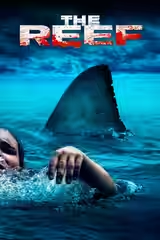
  2. The Reef (2010) · not reviewed yetAustralian swimmers, a capsized yacht and a real great white; no effects, no mercy.

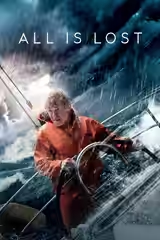
  3. All Is Lost (2013, Fi1m 82)Robert Redford alone on a sinking boat, almost wordless, and gripping throughout.

  4. 127 Hours (2010, Fi1m 81)One man, one rock, one terrible decision; Danny Boyle makes the canyon feel vast.

  5. Crawl (2019, Fi1m 76)A hurricane, a flooded house and alligators; lean, nasty and done in ninety minutes.