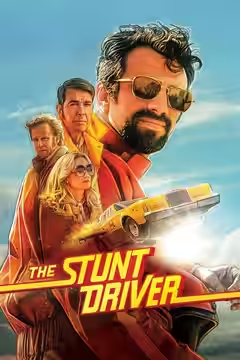
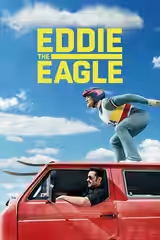
Michael Dowse’s film about the stuntman Ken Carter has a fine, frightened performance from Jay Baruchel and a real feel for its era. It is also slow where it should be tense, and funnier in memory than it was while we sat through it.
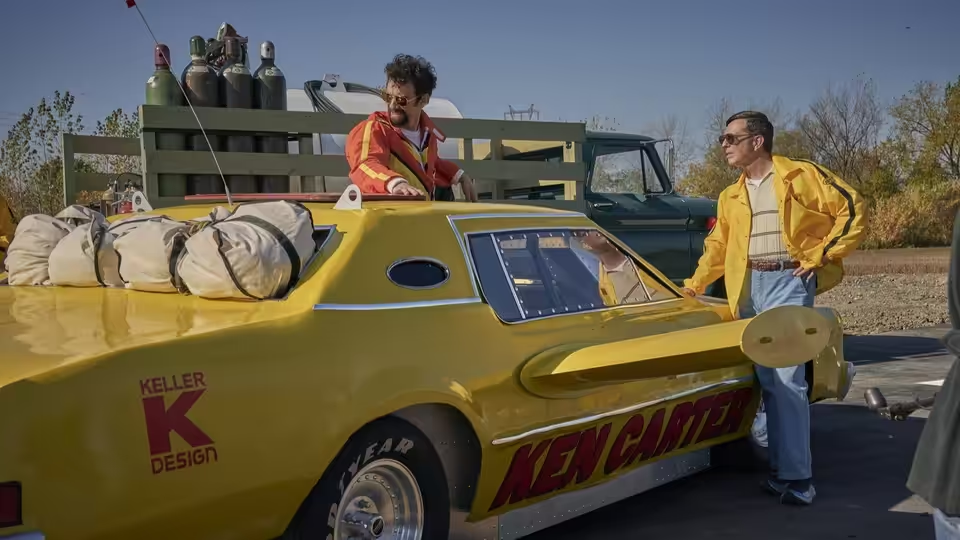
Ken Carter was a stunt driver from Montreal who decided, in the 1970s, that he would drive a rocket-powered car off a ramp and over the St Lawrence River. Michael Dowse, who wrote and directed, has made a film not about the jump but about the years of trying to reach the top of the ramp. The Stunt Driver is a comedy in shape and a sad film underneath, and the sad film is the better one. We liked it, with reservations, and the reservations are mostly about time.
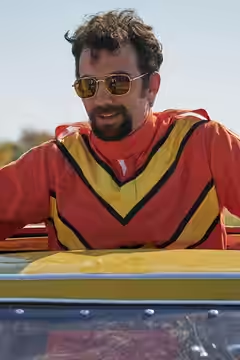
Jay Baruchel plays Carter with a slow, slightly sing-song way of speaking and a smile that arrives a beat after the joke. He has the patter of a man who has sold a great many tickets, and Baruchel lets us see, in the pauses, that the man is frightened and has been for years. It is a smaller performance than the character’s reputation would suggest, and it is the right size. When Carter stands at the foot of the unfinished ramp and talks about being remembered, Baruchel plays it straight, and it works.
Sara Mishara shoots it in several ways at once: clean for the drama, and grainier, softer and more washed-out for the stretches that pretend to be footage from the time, and the joins are hard to spot. Jean-Andre Carriere fills Carter’s world with plywood, chrome and hand-lettered signs, a small operation dressed up as a large one, and Véronique Marchessault puts the men in the wide collars and tight nylon of the period without winking at any of it. The ramp itself, a slope of earth and timber climbing out of a field toward the water, is the film’s best image. Mishara holds on it long enough that it stops being funny, and we were moved by it more than we expected, because it is plainly the work of one stubborn man and plainly not enough.
Ed Helms plays Dick Keller, the man in the suit around the project, with a nervous patience that gets funnier the longer it is tested. Ben Foster’s Evel Knievel is on screen for a handful of scenes and takes each of them. Carter measures himself against Knievel, and Foster plays the star as a man who has never had to measure himself against anybody. Laurence Leboeuf’s Gloria is written thinly, the woman who waits at home, and Leboeuf gets more out of a look across a kitchen than the script gives her in words.
The trouble is pace. Dowse’s script circles the same problem, that the jump costs more than Carter has, and Reginald Harkema’s cutting lets the second and third go-rounds run as long as the first, so that by the hour mark the film is idling in a field. Around then, during another argument about money, we looked at our watch, and then felt guilty about it, because Baruchel was doing something careful with his face at the time. Cristóbal Tapia de Veer’s score, rising synthesiser lines and wordless voices, keeps promising an event the film keeps postponing, and after a while the promising becomes part of the wait.
Dowse and Baruchel made Goon (2011) together, and this is a gentler cousin of that film: another kind man in a dangerous trade, another film that likes its hero more than it needs to test him. Goon had games to give it shape. This has one jump, and everything before it is preamble, and Dowse has not found a way to make preamble move. The reviews so far are split between those who found it a warm throwback and those who found it a long afternoon, and we can see both films in it.
See it for Baruchel, for the ramp, and for Foster’s few minutes as Knievel. It will do at home, where its slowness reads as ease rather than a fault, and where you can pause during the money scenes and put the kettle on. We will not say whether the car leaves the ramp. Carter would have wanted you to buy a ticket to find out.