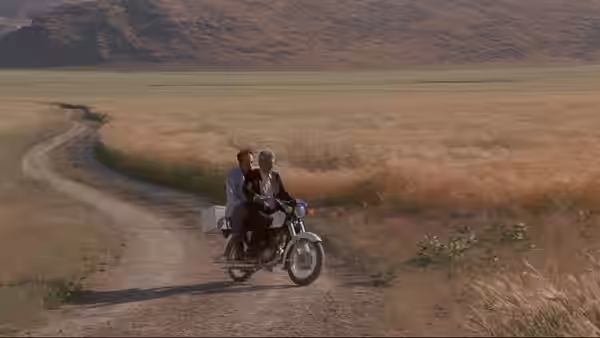
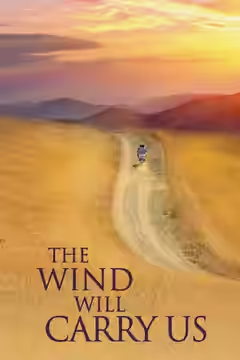
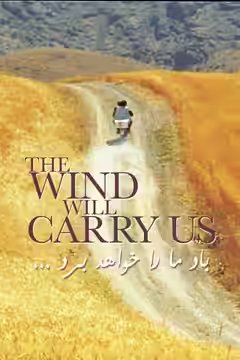
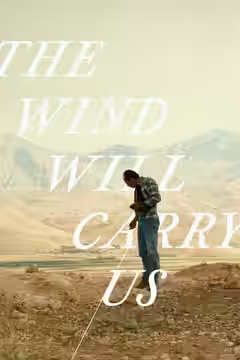
Two men ride a motorcycle along a dirt track through open fields
Film review

The Wind Will Carry Us

1999 · Directed by Abbas Kiarostami · 1h 58m

In a sentenceA car crosses the countryside, and for once we are happy to let it take its time

A car crosses a dusty landscape, and outsiders arrive in a remote village. Their dealings with the inhabitants form an uneasy part of daily life, with the surrounding countryside always close at hand. Behzad (Behzad Dorani) is the central figure; Farzad (Farzad Sohrabi) also appears, alongside an ensemble including Noghre Asadi. Everyday encounters take precedence over a steadily advancing chain of events. Other people and activities remain out of sight, while questions of life and death complicate the strangers’ relationship with the place they have entered.

Plays from YouTube when you press play; nothing loads from them until then.

Fi1m review

The Wind Will Carry Us makes a quietly funny, absorbing drama from outsiders and a remote village. Abbas Kiarostami’s patience is mostly repaid, though the repetitions occasionally make the watching feel like work.

The Wind Will Carry Us is funny, humane and worth the attention it demands, with a reservation about how often it asks us to wait. Abbas Kiarostami builds his drama around the uneasy dealings between outsiders and the inhabitants of a remote village. He gives ordinary activity room to continue without immediately explaining its importance, allowing us to become interested before telling us why we should be. At 118 minutes, that is a substantial request, but usually a rewarding one.

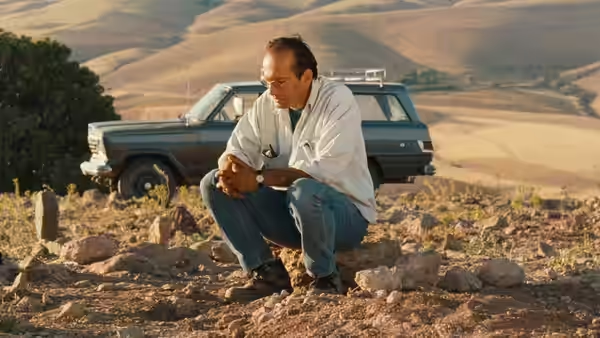
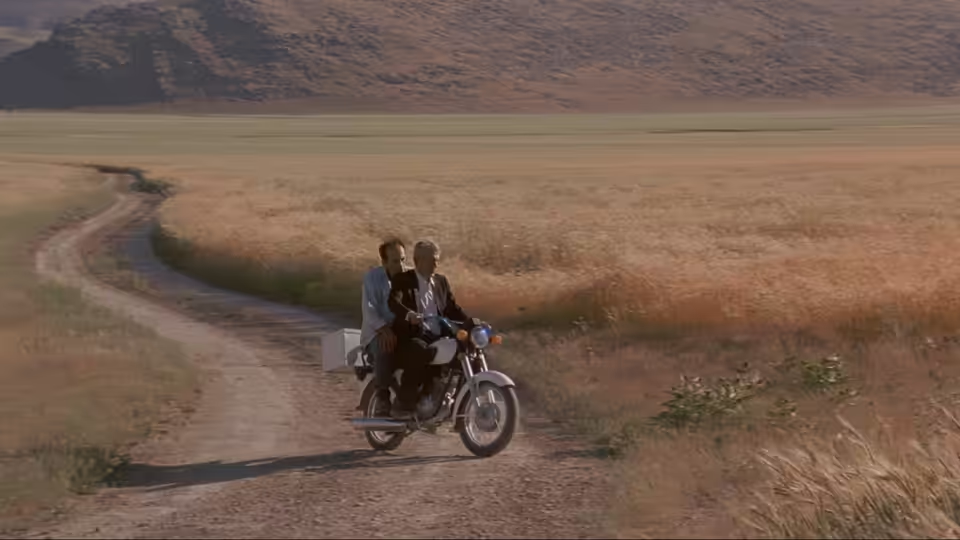
The opening long shot follows a car across a dusty landscape. We relaxed as it travelled through the frame: there was time to look at the country around it without worrying about the next event. Mahmoud Kalari’s landscape photography works because the countryside remains worth looking at even when the story appears to have paused. His carefully composed views establish the village and its surroundings as places deserving attention independently of whatever the visitors have come to do.

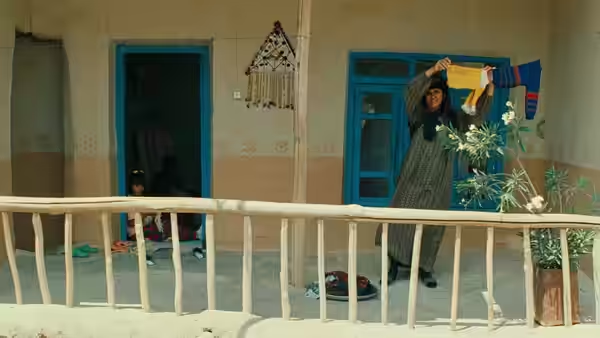
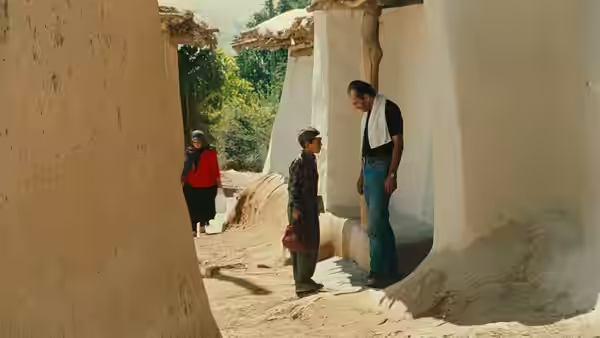
Behzad Dorani’s Behzad gives us someone to watch without settling the question of what we should make of him. That uncertainty helps the comedy, since we cannot simply adopt his attitude towards each encounter and assume he is right. The awkwardness between the sophisticated arrivals and the villagers is funny without making the community itself a quaint attraction. Kiarostami allows these exchanges to remain uncomfortable, and the inhabitants to retain interests beyond accommodating their visitors.

Much of the film’s curiosity comes from people and events kept outside the frame. We have to listen, notice what we have not been shown and decide how much weight to give the information available. Kiarostami, who also edits, allows those gaps to stand rather than supplying a reassuring view of everything being discussed. This can be absorbing, although anyone who needs each scene to deliver a definite answer will have a difficult evening.

Peyman Yazdanian supplies the music, while the detailed sound gives the village a life beyond the composed images. People do not cease to matter merely because the camera cannot see them, and the attention paid to what remains off-screen helps us remember that. Kalari’s photography offers ample opportunity to admire the countryside, but the sound encourages us to stay interested in its inhabitants. That makes a difference in a film which spends so much time looking at the place.

The weakness is repetition, and there are stretches when watching daily life becomes simply waiting for the film to move. Kiarostami’s editing does not always make another delay feel necessary, particularly once we have understood how deliberately he is withholding information. The unanswered questions can begin to seem more important than the encounters themselves. These are real irritations in a film asking for close attention, though the humour and interest in the villagers generally bring us back.

Within contemplative drama, that humour is a considerable virtue. Kiarostami does not demand that every view of the countryside be received in reverent silence, and the visitors’ awkwardness gives us something familiar to respond to. The concern with life and death grows from this attention to ordinary behaviour, rather than requiring everyone to speak solemnly about it. Give it an evening when watching other people’s daily lives sounds like enough.

Critical consensus AI synthesised

82
Positive
9
Mixed
0
Negative
1

Most critics respond warmly to The Wind Will Carry Us, with praise clustering around Kiarostami’s landscape photography, precise compositions and patient attention to everyday life. The reviews find humour and compassion in an approach that puts observation ahead of conventional storytelling. Several also admire the way unseen people and off-screen events ask viewers to fill in the gaps. For its admirers, the film’s apparent simplicity allows for a demanding but rewarding consideration of life and death.

The divide concerns how much that patience yields. Most critics welcome the ambiguity and unhurried sense of time, though some stress the demands these place on viewers. Eye for Film supplies the lone negative assessment, finding the story opaque and repetitive while still admiring the village and countryside. The spread is therefore wide but lopsided: the principal dissent rejects qualities that the other reviews largely regard as strengths.

Empire
1 January 2000 · William Thomas
95*

The critic calls the film utterly brilliant, praising its humanism and its tribute to the Kurdish people. They also single out its challenge to intellectual torpor and its preference for everyday observation over conventional narrative.

Read the full review →
IndieWire
28 July 2000 · Mark Peranson
90*

Peranson calls the film probably a masterpiece and Kiarostami’s finest work since Close-Up. He praises its depth, exacting visual composition, and indelible images.

Read the full review →
The New York Times
28 July 2000 · A. O. Scott
90*

Scott praises the film as funny, accessible, and visually arresting, and recommends seeing it in a theater. He singles out Kiarostami’s vivid landscapes and immersive, poetic sense of time.

Read the full review →
Time Out
· GA
90*

The critic calls it a subtle, richly rewarding work of genius. The review singles out its deceptively simple approach and opens by noting a long shot of a car crossing a dusty landscape.

Read the full review →
The AV Club
29 March 2002 · Keith Phipps
85*

Phipps finds the film consistently comic, challenging, and deeply rewarding. He especially praises Kiarostami’s use of nature and the film’s late action that reframes what came before.

Read the full review →
Slant Magazine
12 May 2025 · ★★★★ · Jordan Cronk
80

Cronk presents the film as a defining, career-summing work by Kiarostami. He praises its careful visual form and the Criterion restoration’s vivid image and richly detailed sound, while noting the loss of extras from the prior release.

Read the full review →

Straight answers AI written, from our review

Is The Wind Will Carry Us worth watching?
The Wind Will Carry Us is worth watching for its quiet humour, landscape photography and interest in village life; we score it 84 out of 100. We recommend it to viewers who enjoy patient, observant drama, though its repetitions sometimes turn close attention into waiting for something to happen.
How long is The Wind Will Carry Us, and what is it rated?
The Wind Will Carry Us runs 1h 58m. It is a drama film.
Where can I watch The Wind Will Carry Us in Malaysia?
The Wind Will Carry Us is not on any streaming or rental service in Malaysia at the moment. It is available in 4 other countries; change your country at the top of the page to see where. Availability is checked daily.
How does The Wind Will Carry Us compare to Local Hero?
The Wind Will Carry Us is more withholding than Local Hero, though both find humour in visitors dealing with small communities that resist their expectations. We favour The Wind Will Carry Us for leaving its encounters uncomfortable rather than softening them with fondness for eccentricity; Local Hero better suits an evening when gentle comedy sounds more appealing than unanswered questions.
What should I watch after The Wind Will Carry Us?
After The Wind Will Carry Us, try Local Hero (1983, Fi1m 86): Another visitor discovers that a small community refuses to follow his timetable. Then The Spirit of the Beehive (1973, Fi1m 87): A rural setting and unexplained absences reward the same close attention; and Paterson (2016, Fi1m 84): Daily repetition makes room for poetry without insisting that every moment matters.

Cast

Awards

Grand Jury Prize of the Venice Film Festival, 1999

Won
Grand Jury Prize of the Venice Film Festival

If you liked this, try…

  1. Local Hero (1983, Fi1m 86)Another visitor discovers that a small community refuses to follow his timetable.

  2. Good Morning (1959) · not on Fi1m yetNeighbourhood routines and stubborn silences become the basis of patient, affectionate comedy.

  3. The Spirit of the Beehive (1973, Fi1m 87)A rural setting and unexplained absences reward the same close attention.

  4. Le quattro volte (2010) · not on Fi1m yetRural routines, animals and mortality observed with patience and quiet humour.

  5. Paterson (2016, Fi1m 84)Daily repetition makes room for poetry without insisting that every moment matters.

The Wind Will Carry Us (1999) review: A slow film worth the wait (Malaysia) | Fi1m