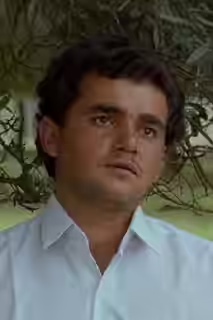
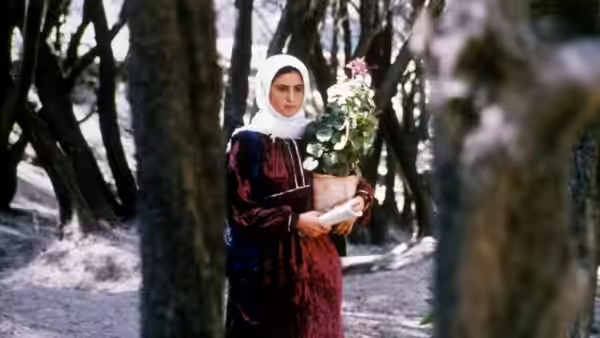
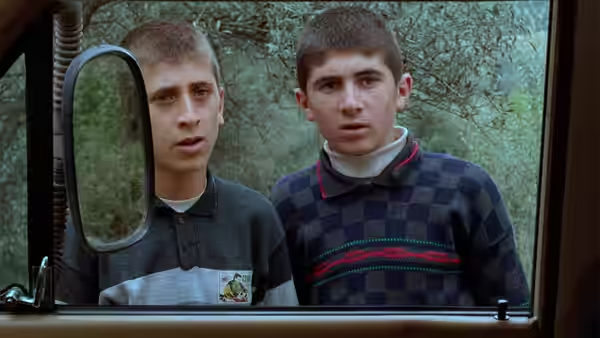
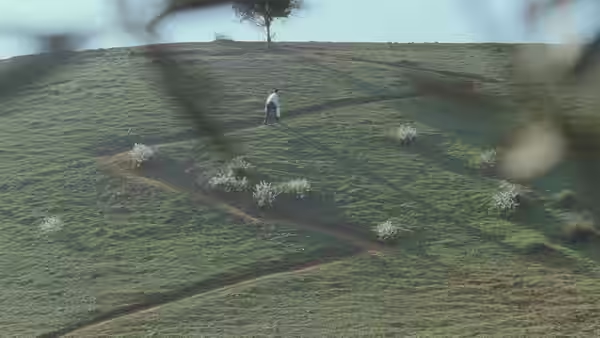
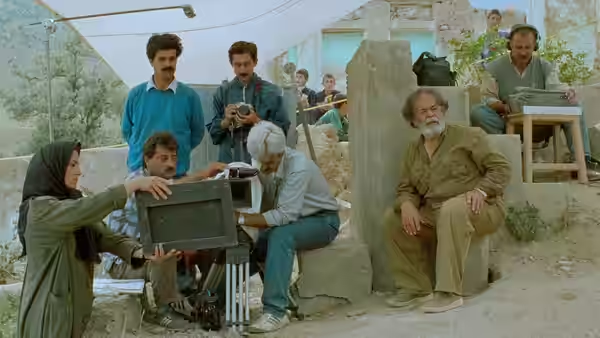
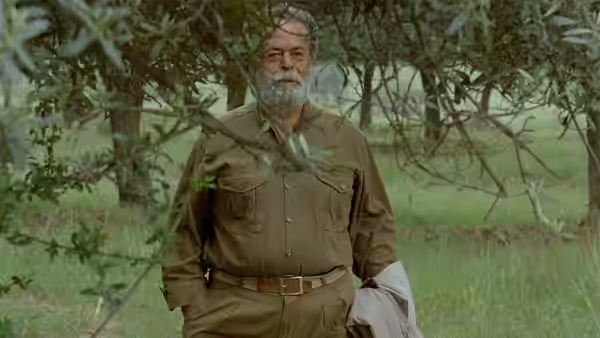
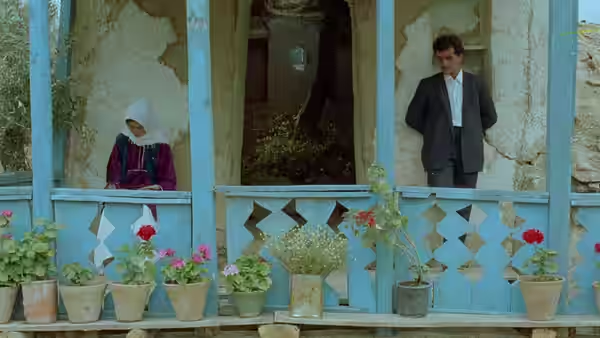
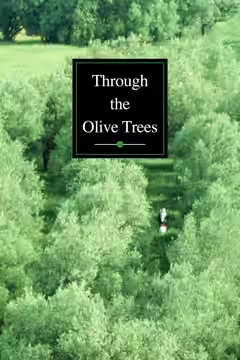
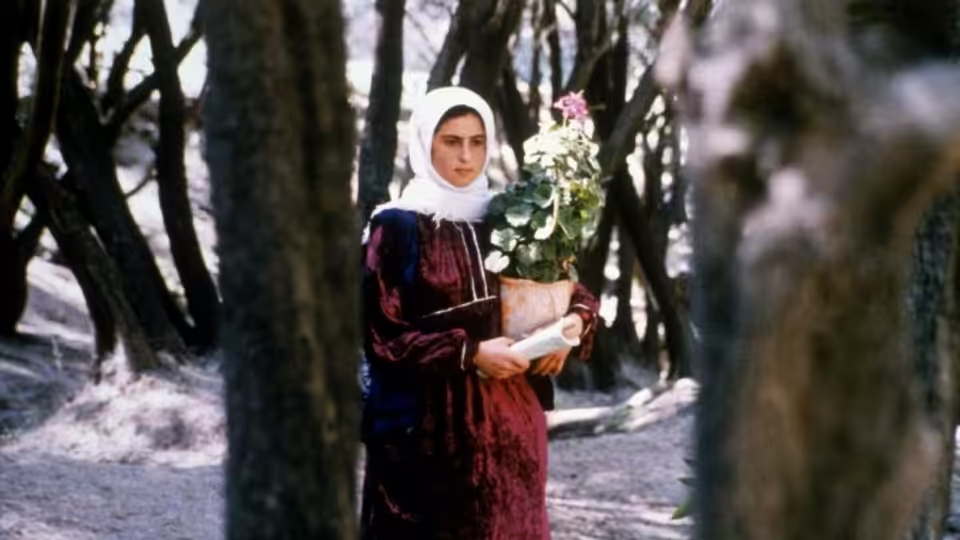
A young woman holds flowers and papers among the trees
Film review

Through the Olive Trees

1994 · Directed by Abbas Kiarostami · 1h 44m

In a sentenceThe film director can wait; we would rather get to know the villagers

Rural Iran provides the setting for a drama in which fiction and everyday life overlap. Hossein (Hossein Rezai), Tahereh (Tahereh Ladanian), Farhad (Farhad Kheradmand) and Mrs. Shiva (Zarifeh Shiva) appear alongside a Film Director (Mohammadali Keshavarz). The inhabitants of a rural community become the focus of a film that uses nonprofessional performers and questions how much separates a person from a part. Attention rests on the people and their lives, with little conventional action to drive the story forwards.

Fi1m review

Abbas Kiarostami’s rural drama is warm, quietly affecting and occasionally too patient for its own good. The nonprofessional performers make it worth the time, though its slight action leaves some stretches feeling longer than they need to.

Through the Olive Trees is an affecting, sometimes over-patient drama whose people give us good reason to stay. Abbas Kiarostami brings fiction and rural life into close contact, with little conventional action to hurry either along. The interest lies in the inhabitants and in the business of turning their lives into something we can watch. His curiosity about those people sustains the film through most of its slower stretches.

With a Film Director (Mohammadali Keshavarz) among the characters, the business of making a film is never far from our thoughts. Hossein Rezai plays Hossein, Tahereh Ladanian plays Tahereh and Farhad Kheradmand appears as Farhad. Those shared names make the overlap between person and part especially noticeable. They cannot tell us how much is invented, of course. We were moved by the nonprofessional performers, whose connection to the rural community gives the film a closeness that no elaborate plot could guarantee.

That closeness matters because a film about filming other people can become pleased with its own cleverness. Here, the rural inhabitants have enough presence to keep that tendency in check. Their resilience is affecting, though the question of what has been invented occasionally becomes a distraction. Once we have registered the uncertainty, we are ready to get on with knowing them.

Hossein Jafarian and Farhad Saba’s cinematography makes the rural setting feel inhabited. We are interested in it because of the people who live there, which seems the right measure of the photography’s success. Abbas Kiarostami also handles the production design, and there is no sense of the surroundings competing with the cast for our admiration. The place holds our attention without becoming the only thing there is to look at.

The main reservation is pace. He also edits, and across 104 minutes the slight action sometimes leaves our attention with too little to do. The writing, credited to Hengameh Panahi and Abbas Kiarostami, gives the overlap of fiction and lived experience plenty of attention. There are stretches when we feel we have understood the approach and are waiting for our understanding of the people to deepen.

The music, credited to Chema Rosas and Amir Farshid Rahimian, does not make us feel instructed in how to respond. Our affection stays with the performers. The film belongs with dramas that ask us to take everyday lives seriously without promising a succession of large events. Such films still need movement, and this one occasionally mistakes our willingness to wait for an unlimited supply of patience.

We would recommend it to anyone with a taste for quiet, self-conscious drama and an interest in how people appear before a camera. The slow stretches are part of the price, and we cannot pretend every one of them earns its place. Do not choose it to fill the time while doing something else.
Critical consensus AI synthesised

3 of 6
Positive
1
Mixed
2
Negative
0
Variety
19 May 1994 · festival review · Deborah Young
70*

Young finds the film’s approach to fiction and reality moving and its portrait of rural resilience affecting, though its minimal action may lull some viewers. She especially praises how the nonprofessional actors connect audiences directly with the area’s real inhabitants.

Read the full review →
The New York Times
24 September 1994 · festival review
66*

The URL identifies this as a festival review, but the blocked page does not reveal the critic’s verdict. Its headline points to a focus on how the film blurs truth and fiction in rural Iran.

Read the full review →
Time Out
· GA
64*

The page identifies this as a review, but the review text is unavailable, so its verdict cannot be determined. No specific praise or complaint can be verified from the provided material.

Read the full review →

Straight answers AI written, from our review

Is Through the Olive Trees worth watching?
Through the Olive Trees is worth watching if we have a taste for quiet, patient drama; we score it 77 out of 100. The nonprofessional performers make its rural community affecting, but the slight action and slow stretches demand sustained attention, and not every stretch earns its length.
How long is Through the Olive Trees, and what is it rated?
Through the Olive Trees runs 1h 44m. It is a drama film.
Where can I watch Through the Olive Trees in Hong Kong?
Through the Olive Trees is not on any streaming or rental service in Hong Kong at the moment. It is available in 2 other countries; change your country at the top of the page to see where. Availability is checked daily.
How does Through the Olive Trees compare to Close-Up?
Through the Olive Trees is the more narrowly appealing choice beside Close-Up, which we recommend even to those wary of films about cinema. Both patiently explore performance and identity, but Close-Up centres on a real impersonation case, while Through the Olive Trees finds its warmth among rural inhabitants whose lives overlap with filmmaking.
What should I watch after Through the Olive Trees?
After Through the Olive Trees, try Close-Up (1990, Fi1m 92): Another patient encounter with performance, identity and the people caught between them. Then Columbus (2017, Fi1m 82): Quiet conversations and lived-in places matter more than a busy plot.

Cast

Awards

International Submission to the Academy Awards, 1995

Nominated
International Submission to the Academy Awards

If you liked this, try…

  1. Close-Up (1990, Fi1m 92)Another patient encounter with performance, identity and the people caught between them.

  2. Day for Night (1973) · not on Fi1m yetFor filmmaking as daily work, with affection for the people doing it.

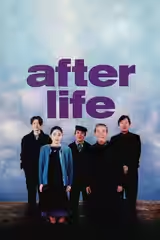
  3. After Life (1998) · not on Fi1m yetQuiet filmmaking becomes a way to attend closely to other people’s lives.

  4. The Green Ray (1986) · not on Fi1m yetOrdinary encounters reward close attention, with room for awkwardness and uncertainty.

  5. Columbus (2017, Fi1m 82)Quiet conversations and lived-in places matter more than a busy plot.