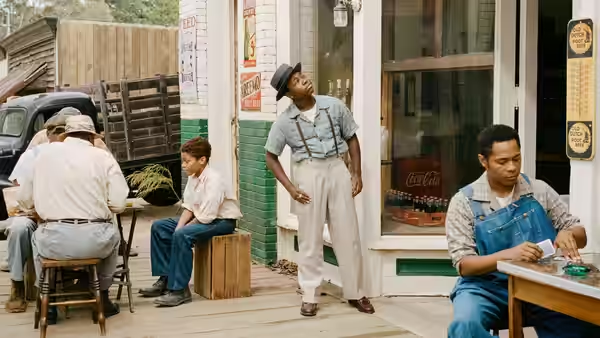
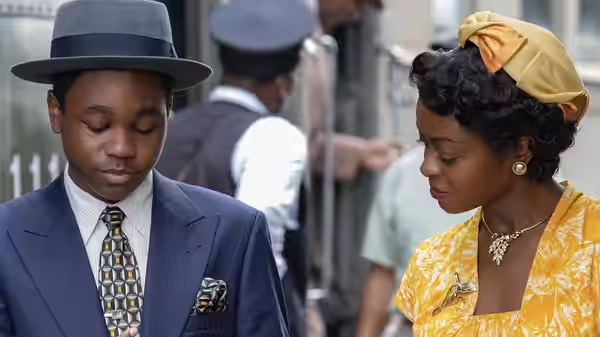
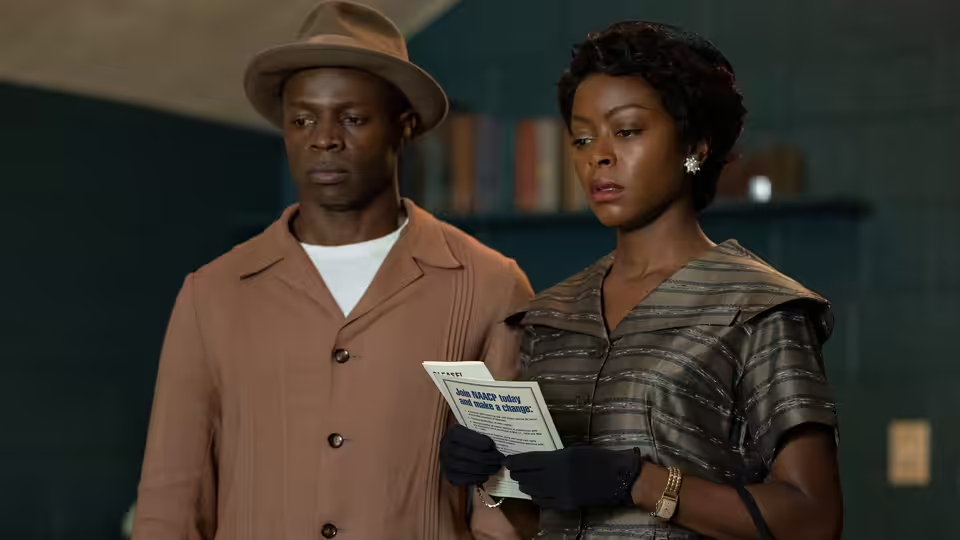
Mamie Till-Mobley (Danielle Deadwyler) and Gene Mobley (Sean Patrick Thomas) read a pamphlet indoors
Film review

Till

2022 · Directed by Chinonye Chukwu · 2h 11m

In a sentenceDanielle Deadwyler makes herself understood long before the music decides we need help

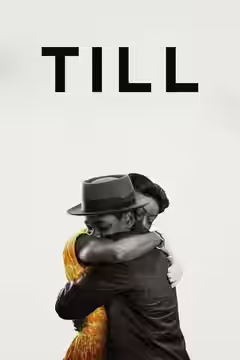
Mamie Till-Mobley (Danielle Deadwyler) wants to protect her son without denying him the pleasures of childhood. Emmett Till (Jalyn Hall) enjoys a family life that includes Alma (Whoopi Goldberg), while his mother weighs the dangers surrounding him. Racism makes even her ordinary hopes for his future uncertain. The opening stays close to mother and son, establishing their affection before Mamie’s struggle for justice takes her into public life. For now, she must balance her wish to let Emmett enjoy himself with her knowledge of how vulnerable he is.

Plays from YouTube when you press play; nothing loads from them until then.

Fi1m review

Chinonye Chukwu’s Till is carried by Danielle Deadwyler’s precise, deeply moving performance. Its family scenes earn the emotion, though an insistent score and explanatory dialogue sometimes make a sensitive film feel more conventional than it needs to.

Chinonye Chukwu’s Till is a deeply affecting drama, though it sometimes explains feelings that Danielle Deadwyler has already made clear. Its most useful decision is to give Mamie Till-Mobley a private life before asking us to consider her public importance. We spend time with a mother who takes pleasure in her son’s company. That attention to ordinary affection makes the film worth watching even when the writing becomes dutiful.

Jalyn Hall gives Emmett Till an openness that matters to everything around him. His pleasure in being young gives Deadwyler something to respond to besides the demands of the historical subject. We were moved by their ease together, particularly the way her watchfulness sits alongside his enjoyment of himself. These scenes allow a boy to occupy our attention without making every moment an announcement of the suffering associated with his name.

Deadwyler is equally persuasive when Mamie has to contain feelings she cannot put aside. Her restraint never looks effortless, and that is an important part of the performance. We remain aware that speaking publicly can require her to conceal feelings she cannot afford to let interrupt her. Chukwu’s attention to her face is justified by how much Deadwyler gives us to consider, including the uncertainty that a more straightforwardly heroic portrayal might have tidied away.

Bobby Bukowski’s cinematography gives the family scenes a warmth that helps us understand what Mamie values. The colour permits pleasure, and prevents the historical subject from determining the mood of every image. Curt Beech’s production design contributes to that sense of a life with comforts and interests of its own. The surroundings are handsome, occasionally a little too reassuring, but the domestic setting supports the actors without competing for our attention.

Ron Patane’s editing is most effective when it gives Deadwyler room to let a reaction develop. The scenes built around her have a patience that the music does not always share. Abel Korzeniowski’s score repeatedly presses the sadness harder than it needs to, reducing the space in which we can respond for ourselves. We can hear what it is trying to do, but an actor working with this much precision does not need such persistent assistance.

The screenplay by Chinonye Chukwu, Keith Beauchamp and Michael Reilly has a related difficulty with historical explanation. Some exchanges seem arranged to bring us up to date, and the people briefly sound as though they are addressing an audience beyond the scene. This is where Till settles into familiar biographical-drama habits, making its significance clear at the expense of its characters’ spontaneity. The family scenes have already shown that Chukwu can make the stakes understood without quite so much instruction.

Allow this film your attention rather than fitting it around other things. There is distress here, but also enough interest in affection and ordinary happiness to make the experience more than an exercise in endurance. Expect a familiar dramatic shape and some unnecessary prompting from the music. Watch for Deadwyler, especially when nobody is asking her to speak.

Critical consensus AI synthesised

70
Positive
15
Mixed
7
Negative
2

Most critics find Till moving and sensitively directed, with praise clustering around Danielle Deadwyler’s performance as Mamie Till-Mobley. Across positive and sceptical reviews, her expressive, restrained portrayal gives the grief and growing public resolve a force that even detractors acknowledge. Chinonye Chukwu’s attention to Mamie’s inner life, her restraint in depicting violence and the scenes of family affection also earn approval, though agreement on the filmmaking is less firm than on its lead.

The spread is wide, with reservations centring on familiar biographical conventions, sentimentality and a script that sometimes depends too heavily on Deadwyler. Several critics find the intimate treatment of grief more persuasive than the account of activism. Vulture argues that caution limits the film and that Mamie’s life beyond her son’s death remains underdeveloped; Sight and Sound goes further, finding that obviousness and repetition flatten the emotional impact despite the strength of the performances.

The i Paper
4 January 2023 · Christina Newland
90*

Newland finds the film a towering, emotionally affecting account of Mamie Till’s grief and courage. She especially praises Danielle Deadwyler’s performance and the film’s focus on Black family life beyond grief and death.

Read the full review →
The New Yorker
13 October 2022 · Richard Brody
90*

Brody regards the film as a powerful work of cinematic portraiture. He especially praises Danielle Deadwyler’s expressive performance and the force of Chukwu’s visual approach.

Read the full review →
Empire
4 January 2023 · Ian Freer
80*

Freer finds the film an absorbing, emotionally powerful account of Mamie Till’s transformation into an activist. He especially praises Danielle Deadwyler’s restrained, deeply affecting performance.

Read the full review →
Evening Standard
6 January 2023 · ★★★★ · Charlotte O'Sullivan
80

The critic calls the film a triumph of humanity and rejects the idea that it is merely a worthy, plodding biopic. She praises Danielle Deadwyler’s extraordinary performance and Chinonye Chukwu’s humane, fluid filmmaking.

Read the full review →
Little White Lies
4 January 2023 · 3/4/4 · Rógan Graham
80

The critic finds the film deeply moving and powerful, though it slips into familiar Oscar-biopic territory. They single out Danielle Deadwyler and Jalyn Hall’s performances and Chukwu’s restraint in depicting Emmett’s death for praise.

Read the full review →
Radio Times
★★★★ · James Mottram
80

Mottram calls the film bold and heartbreaking, and praises its handling of Emmett Till’s story. He notes that it holds back on depicting the violence, though the available review text is truncated.

Read the full review →

Straight answers AI written, from our review

Is Till worth watching?
Till is worth watching for Danielle Deadwyler’s precise, deeply moving performance, and we score it 80 out of 100. We are particularly moved by the affection between mother and son; it suits viewers drawn to patient, performance-led drama, though the insistent music and explanatory dialogue sometimes press feelings the actors have already made clear.
How long is Till, and what is it rated?
Till runs 2h 11m. It is a drama and history film.
Where can I watch Till in the UAE?
Till is not on any streaming or rental service in the UAE at the moment. It is available in 28 other countries; change your country at the top of the page to see where. Availability is checked daily.
How violent or frightening is Till, and is it suitable for children?
Till has a UK 12A certificate, and its distressing historical subject calls for care when choosing it for children. The certificate allows children under 12 with an accompanying adult, but we would not treat that as a recommendation for younger viewers. Racism and a mother’s fear for her son make this an emotionally demanding drama rather than an easy family watch.
How does Till compare to Clemency?
Till offers moving family scenes, while Clemency is a painful study of responsibility centred on the work of carrying out executions. We find both persuasive when Chukwu gives her central performer room: Deadwyler contends with overemphatic music and explanatory dialogue, while Woodard anchors a film whose middle drags. We favour Till for family intimacy, Clemency for its examination of working responsibility.
What should I watch after Till?
After Till, try Clemency (2019, Fi1m 81): Another patient study of responsibility, with a central performance that resists easy reassurance. Then Secrets & Lies (1996, Fi1m 88): For family relationships allowed to become awkward, complicated and painful without losing their warmth; and If Beale Street Could Talk (2018, Fi1m 81): For the same insistence that Black love deserves attention beyond the injustice surrounding it.

Cast

Awards

Producers Guild Stanley Kramer Award, 2023

Won
Producers Guild Stanley Kramer Award

If you liked this, try…

  1. Clemency (2019, Fi1m 81)Another patient study of responsibility, with a central performance that resists easy reassurance.

  2. Secrets & Lies (1996, Fi1m 88)For family relationships allowed to become awkward, complicated and painful without losing their warmth.

  3. If Beale Street Could Talk (2018, Fi1m 81)For the same insistence that Black love deserves attention beyond the injustice surrounding it.

  4. The Official Story (1985, Fi1m 81)A mother’s private doubts force her to confront the violence sustaining her comfortable life.

  5. Saint Omer (2022) · not reviewed yetAnother demanding examination of motherhood, with patient attention to faces and uneasy judgements.