Chinonye Chukwu’s Till is carried by Danielle Deadwyler’s precise, deeply moving performance. Its family scenes earn the emotion, though an insistent score and explanatory dialogue sometimes make a sensitive film feel more conventional than it needs to.
Chinonye Chukwu’s Till is a deeply affecting drama, though it sometimes explains feelings that Danielle Deadwyler has already made clear. Its most useful decision is to give Mamie Till-Mobley a private life before asking us to consider her public importance. We spend time with a mother who takes pleasure in her son’s company. That attention to ordinary affection makes the film worth watching even when the writing becomes dutiful.
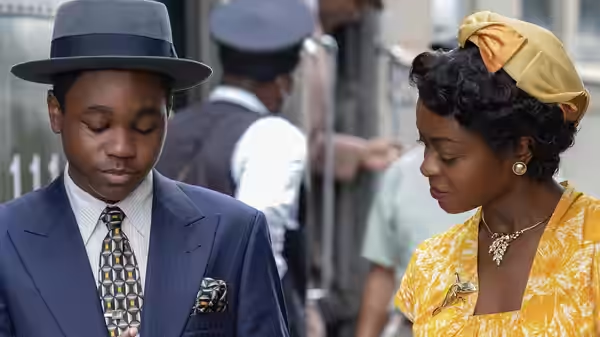
Jalyn Hall gives Emmett Till an openness that matters to everything around him. His pleasure in being young gives Deadwyler something to respond to besides the demands of the historical subject. We were moved by their ease together, particularly the way her watchfulness sits alongside his enjoyment of himself. These scenes allow a boy to occupy our attention without making every moment an announcement of the suffering associated with his name.
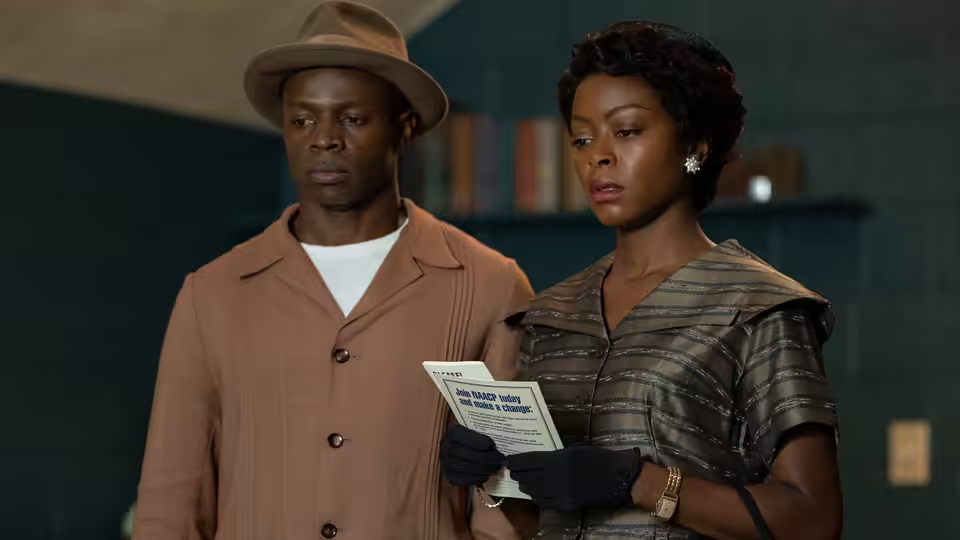
Deadwyler is equally persuasive when Mamie has to contain feelings she cannot put aside. Her restraint never looks effortless, and that is an important part of the performance. We remain aware that speaking publicly can require her to conceal feelings she cannot afford to let interrupt her. Chukwu’s attention to her face is justified by how much Deadwyler gives us to consider, including the uncertainty that a more straightforwardly heroic portrayal might have tidied away.
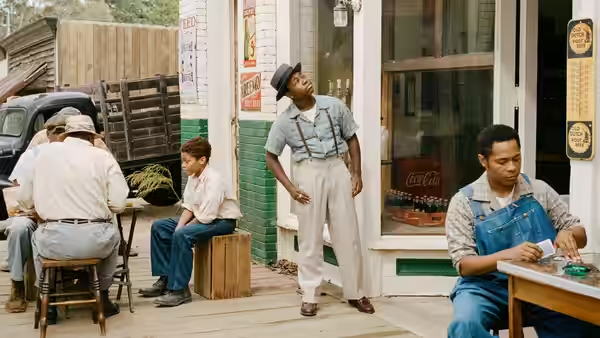
Bobby Bukowski’s cinematography gives the family scenes a warmth that helps us understand what Mamie values. The colour permits pleasure, and prevents the historical subject from determining the mood of every image. Curt Beech’s production design contributes to that sense of a life with comforts and interests of its own. The surroundings are handsome, occasionally a little too reassuring, but the domestic setting supports the actors without competing for our attention.
Ron Patane’s editing is most effective when it gives Deadwyler room to let a reaction develop. The scenes built around her have a patience that the music does not always share. Abel Korzeniowski’s score repeatedly presses the sadness harder than it needs to, reducing the space in which we can respond for ourselves. We can hear what it is trying to do, but an actor working with this much precision does not need such persistent assistance.
The screenplay by Chinonye Chukwu, Keith Beauchamp and Michael Reilly has a related difficulty with historical explanation. Some exchanges seem arranged to bring us up to date, and the people briefly sound as though they are addressing an audience beyond the scene. This is where Till settles into familiar biographical-drama habits, making its significance clear at the expense of its characters’ spontaneity. The family scenes have already shown that Chukwu can make the stakes understood without quite so much instruction.
Allow this film your attention rather than fitting it around other things. There is distress here, but also enough interest in affection and ordinary happiness to make the experience more than an exercise in endurance. Expect a familiar dramatic shape and some unnecessary prompting from the music. Watch for Deadwyler, especially when nobody is asking her to speak.