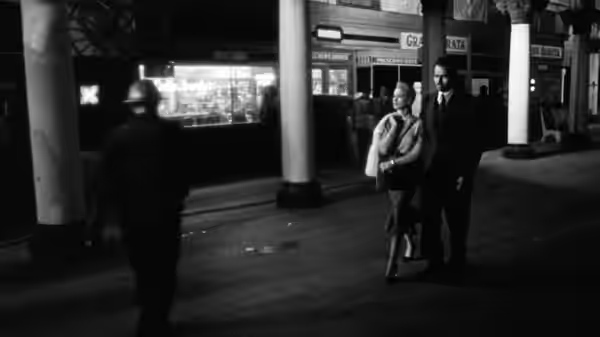
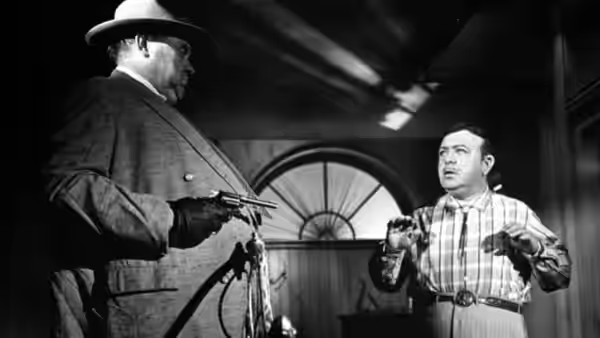
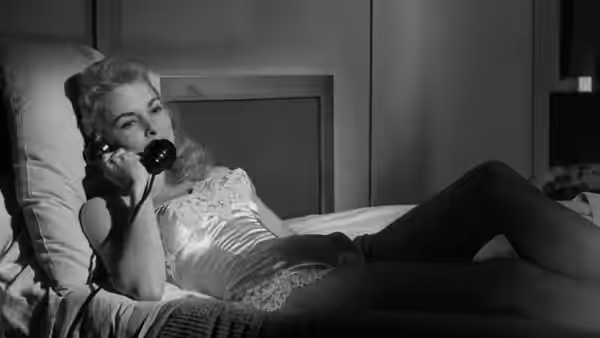
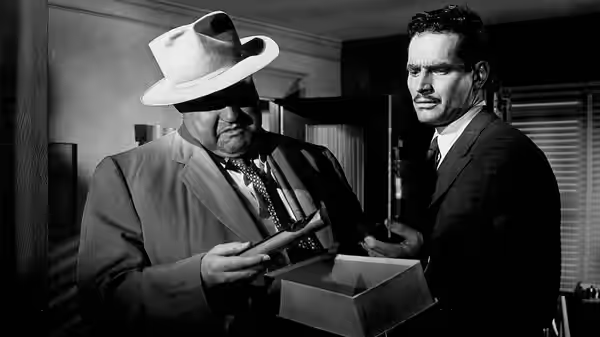
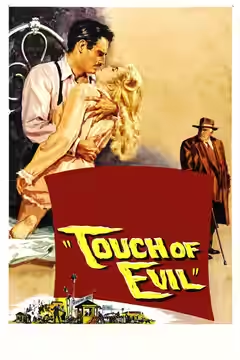
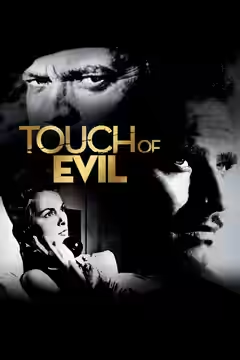
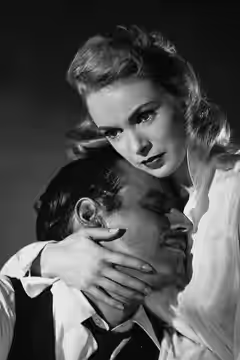
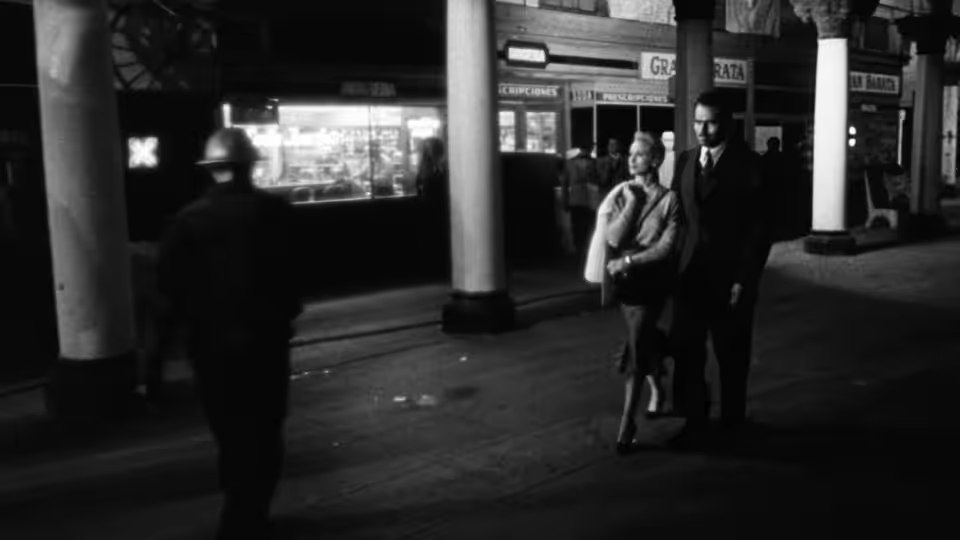
A woman and a suited man stand in a dim lobby as a shadowed figure approaches
Film review

Touch of Evil

1958 · Directed by Orson Welles · 1h 51m

In a sentenceWhen Orson Welles is wearing the badge, calling the police loses some of its appeal

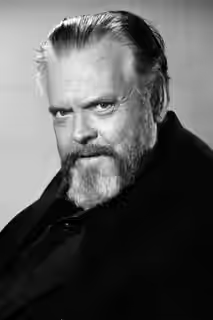
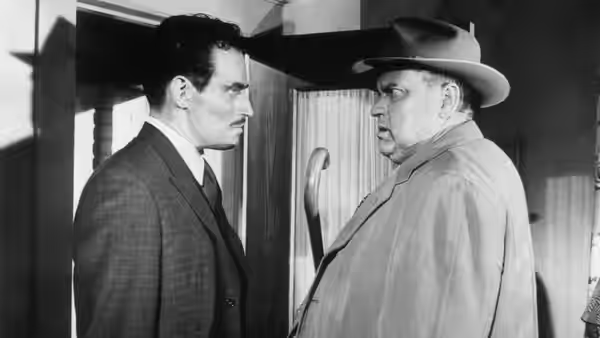
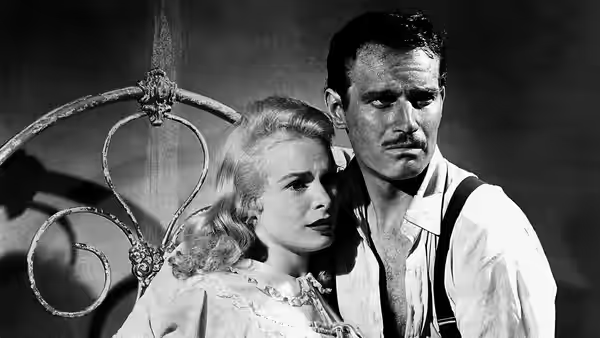
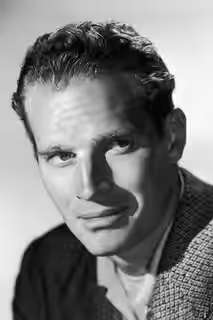
Ramon Miguel Vargas (Charlton Heston) and Susan ‘Susie’ Vargas (Janet Leigh) are at the centre of a crime story involving Police Captain Hank Quinlan (Orson Welles). The presence of a badge offers no simple guide to who deserves trust. Police Sergeant Pete Menzies (Joseph Calleia), District Attorney Adair (Ray Collins) and ‘Uncle’ Joe Grandi (Akim Tamiroff) are among the figures surrounding them. Legal authority and criminal behaviour sit uncomfortably close together, with Marcia Linnekar (Joanna Moore) and the Mirador Motel Night Manager (Dennis Weaver) also among the people caught up in the story.

Plays from YouTube when you press play; nothing loads from them until then.

Fi1m review

Orson Welles makes a police captain frightening enough to justify this crime thriller’s excesses. The plotting can feel manufactured, but the restless camerawork and crowded conversations keep it tense, strange and worth the occasional confusion.

Orson Welles makes Touch of Evil a gripping crime thriller by giving its police captain so much force that the other characters can seem secondary. We recommend it, with a reservation about the conspicuously arranged plotting. The film wants the freedom to be strange, overheated and occasionally difficult to follow, and mostly earns it. What holds our attention is the suspicion that official power has become inseparable from one man’s vanity. Quinlan is alarming company even before we try to work him out.

Russell Metty’s cinematography is crucial to that unease. The opening tracking shot holds our attention through sustained movement, and its length makes us conscious of how much a cut would let us relax. We felt tense because the camera kept moving without giving us that release. It is showy work, certainly, but the movement has a clear dramatic purpose. The expressionistic photography gives the film a feverish quality without making the people in it seem less dangerous.

Orson Welles, playing Police Captain Hank Quinlan, is equally unwilling to disappear politely into the story. The performance is broad enough to risk becoming an attraction in its own right, yet its force makes the captain’s authority believable. We can understand why other people might find him difficult to resist without being asked to excuse him. He is disturbing partly because he does not seem to need our approval. The film lets him be compelling without tidying him into a reassuringly simple villain.

Charlton Heston, as Ramon Miguel Vargas, has a less rewarding part, and Janet Leigh’s Susan ‘Susie’ Vargas cannot quite compete for our attention either. This is a cost of giving Quinlan so much room, rather than a failure of either performer. The supporting characters fare better because their eccentricity suits the film’s crowded, unsettled manner. Joseph Calleia’s Police Sergeant Pete Menzies and Akim Tamiroff’s ‘Uncle’ Joe Grandi make substantial impressions despite having less room than the leads. These performances help keep the film interesting when the mechanics of the story become too apparent.

The overlapping dialogue demands proper listening and makes the exchanges feel more contentious than orderly speeches would. The editing credited to Virgil W. Vogel and Aaron Stell contributes to that abrasive rhythm, though the bustle sometimes makes the plotting harder to follow. Henry Mancini’s music suits a thriller this emphatic, although the revised opening gains from leaving it out. There, the camera sustains the tension without a score pressing the point. The restraint is welcome in a film that otherwise finds so much pleasure in excess.

The screenplay, also by Orson Welles, is less persuasive when it needs us to accept another carefully placed complication. Some of the contrivances are hard to ignore, and admiring the photography does not make them convincing. Yet this is noir with a welcome interest in troublesome people, rather than merely in moving suspects into position. Its tension survives the untidy storytelling because the performances give us something more absorbing to consider than the next piece of information. Give it your attention, especially when several people are talking at once.
Critical consensus AI synthesised

86
Positive
12
Mixed
1
Negative
0

Most critics are strongly favourable, with praise clustering around the film’s visual craft, sustained tension and Welles’s performance as the corrupt Captain Quinlan. The opening tracking shot draws repeated attention for its control and suspense, while the expressionistic cinematography gives the noir melodrama much of its force. The reviews also value the moral ambiguity and depth of character, finding more than thriller mechanics beneath the elaborate staging.

Reservations are scattered rather than shared, and several concern particular versions or releases rather than the film itself. Little White Lies finds the story potentially contrived, while Variety welcomes the reconstruction’s greater clarity without seeing it as a change in the film’s artistic standing. The handling of music produces a smaller distinction: The AV Club praises the revised opening without music for increasing suspense, whereas Variety regrets the absence of Mancini’s theme over the end credits.

Little White Lies
10 July 2015 · 4/5/5 · David Jenkins
100

Jenkins praises the film as a soulful, baroque character study that upends conventional ideas of heroism and villainy. He singles out its eccentric supporting characters and surreal climax, while noting that the story can seem contrived.

Read the full review →
Radio Times
★★★★★ · Tony Sloman
100

Sloman regards the film as a major American masterwork and a culmination of film noir. He praises its enduring stature and its deeply disturbing melodrama.

Read the full review →
Time Out
5 July 2015 · ★★★★★ · Joshua Rothkopf
100

The review calls the film a masterclass in tension, visual panache and B-movie excess. It singles out the legendary three-minute tracking shot as a standout.

Read the full review →
Empire
1 January 2011 · Angie Errigo
90*

Errigo regards the film as a superb and influential noir masterpiece. She especially praises its audacious cinematography, including the celebrated opening shot and its complex set-pieces.

Read the full review →
Slant Magazine
25 April 2022 · ★★★★½ · Budd Wilkins
90

Wilkins treats the film as a landmark noir whose moral ambiguity remains potent. He praises the UHD transfers for their clarity and depth, especially in the night scenes.

Read the full review →
The Guardian
9 July 2015 · Peter Bradshaw
90*

Bradshaw praises the restored film as a brilliant, remarkable noir melodrama. He singles out Welles’s Shakespearean performance as the corrupt Captain Quinlan.

Read the full review →

Straight answers AI written, from our review

Is Touch of Evil worth watching?
Touch of Evil is well worth watching for those who enjoy tense, morally troubled crime thrillers, and we score it 88 out of 100. Orson Welles’s alarming police captain and Russell Metty’s restless photography keep us gripped, though the contrived plotting and overlapping conversations demand patience and close attention.
How long is Touch of Evil, and what is it rated?
Touch of Evil runs 1h 51m. It is a crime and thriller film.
Where can I watch Touch of Evil in Türkiye?
Touch of Evil is not on any streaming or rental service in Türkiye at the moment. It is available in 30 other countries; change your country at the top of the page to see where. Availability is checked daily.
How violent or frightening is Touch of Evil, and is it suitable for children?
Touch of Evil carries a UK 12A certificate, and its threatening police captain and sustained tension make it a cautious choice for children. The certificate permits under-12s with an accompanying adult, but we would steer younger or easily frightened viewers away: the unease comes from dangerous people and untrustworthy authority rather than anything reassuringly distant.
How does Touch of Evil compare to The Third Man?
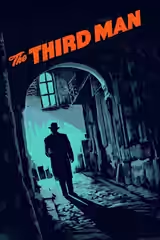
Touch of Evil is the stranger, more overheated companion to The Third Man, with both using expressive photography to make encounters feel suspect. We recommend The Third Man as the better choice for a gripping mystery with humour and a sympathetic centre; Touch of Evil suits those drawn to an overpowering central performance, despite conspicuously contrived plotting.
Is Touch of Evil based on a true story or a book?
Touch of Evil is adapted from a novel by Whit Masterson, rather than presented as a true story. We recommend it for Welles’s disturbing police captain and the tense photography, pleasures that do not depend on knowing the book; we make no claim for how faithfully the screenplay follows it.
What should I watch after Touch of Evil?
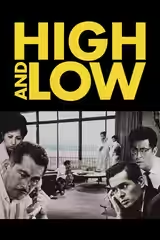
After Touch of Evil, try The Third Man (1949, Fi1m 92): Another morally compromised thriller where expressive photography makes every encounter feel suspect. Then High and Low (1963, Fi1m 90): Police procedure and social inequality share a thriller that keeps its people complicated; and Memories of Murder (2003, Fi1m 91): A murder investigation exposes police failings without sacrificing tension or uncomfortable humour.

Cast

If you liked this, try…

  1. The Third Man (1949, Fi1m 92)Another morally compromised thriller where expressive photography makes every encounter feel suspect.

  2. High and Low (1963, Fi1m 90)Police procedure and social inequality share a thriller that keeps its people complicated.

  3. The Hitch-Hiker (1953) · not on Fi1m yetA leaner crime nightmare, with menace concentrated into a few confined spaces.

  4. Le Corbeau (1943) · not on Fi1m yetSuspicion spreads through a community where respectable appearances provide little protection.

  5. Memories of Murder (2003, Fi1m 91)A murder investigation exposes police failings without sacrificing tension or uncomfortable humour.