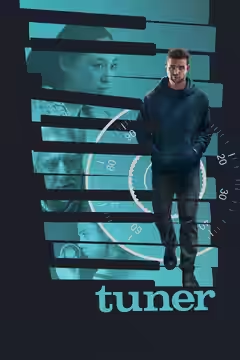
Daniel Roher’s first fiction film puts a piano tuner’s ears to work on locks, and the sound design makes every click count. The story is one we have heard before, but Woodall, Hoffman and Liu play it as if nobody had.
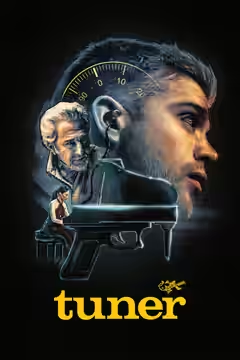
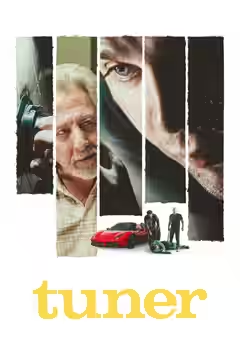
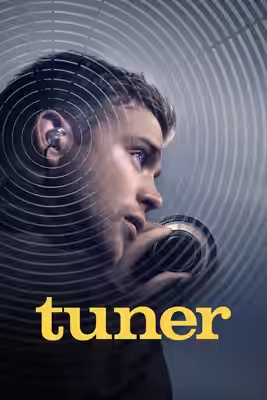
Daniel Roher has made a heist film about listening. Niki White (Leo Woodall) tunes pianos for a living because his hearing is too sharp for almost anything else; a restaurant is an assault, a subway platform a punishment. He works with Harry Horowitz (Dustin Hoffman), an old tuner with a lot of opinions and a shrinking client list, and somewhere in the first half hour it occurs to somebody that an ear which can catch a string drifting flat can also catch the wheels of a safe lock dropping into place. The film that follows is familiar in shape and made with real care, and we had a good evening in its company.
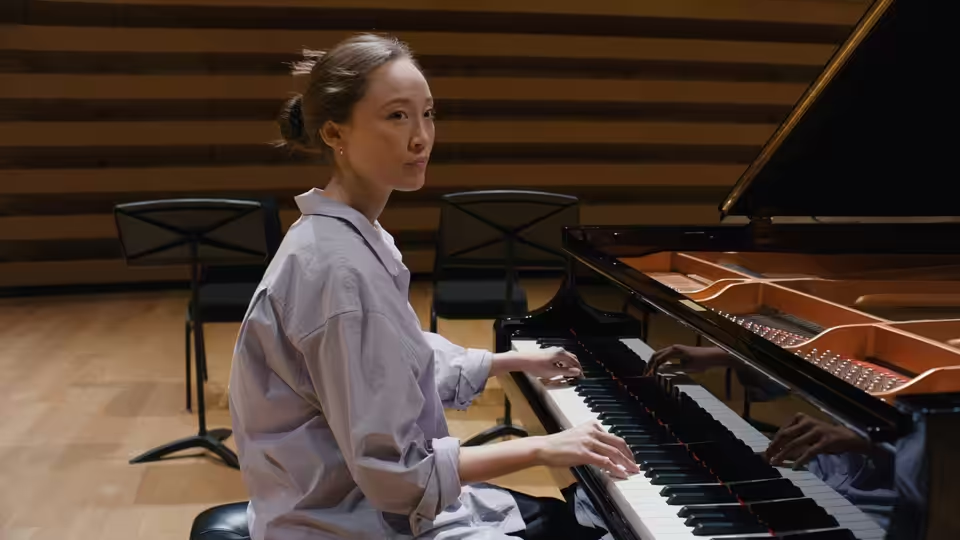
The best thing in it is the sound. Roher puts us inside Niki’s head, so that when he leans in to a piano everything else falls away and we hear the hum of one wire against another, and when he turns to a safe we hear the small metal sounds nobody else can. The first time a lock gave up its number to him we realised we had stopped breathing, and that nothing on screen had moved but a hand and a dial. Will Bates’s score knows when to stay out of this; his cues are spare around the safes and warmer around the piano work, and he lets the mechanisms make their own music.
Woodall plays Niki as a man who is always slightly braced, shoulders up, eyes narrowed against the next noise, and he is careful never to turn the condition into a party trick. The gift is a nuisance to him first and a talent second, and that order is what keeps the film honest. Hoffman has the good lines and knows it. Harry grumbles, corrects, complains about the customers and about Niki, and Hoffman does it with the timing of a man who has been funny on screen for a long time and sees no reason to stop. Havana Rose Liu gives Ruthie more than the script strictly writes for her, a quick intelligence that makes the romance feel like two adults rather than a subplot.
Lowell A. Meyer shoots the pianos and the safes the same way, close, from the side, with the light catching brass and felt and the inside of a lock, so the two trades look like one. Peter Cosco’s production design gives the film its texture: grand pianos in other people’s living rooms, a workshop full of tools with no obvious purpose, safes that look heavy enough to hurt. Sarah Millman dresses Niki in the clothes of a man who does not want to be noticed and Harry in the clothes of a man who stopped buying any some years ago. Greg O’Bryant cuts the tuning and the cracking together as montage, so that one skill flows into the other and we understand the argument without a line of dialogue.
The script, by Roher and Robert Ramsey, is where the film is ordinary. Every turn arrives on schedule. The man with the money, Uri (Lior Raz), is exactly the sort of man such films have, and Gil Cohen’s Yoni exactly the sort of associate. We could see the last act coming from a long way off, and when it came it was busier and louder than the film had been, which is an odd fault in a picture whose whole point is the value of quiet. The romance and the heist never quite decide which of them is in charge.
One complaint against it deserves an answer. There is a worry that a film about a hypersensitive man with a hidden talent is one more story in which an affliction turns out to be a superpower. We felt the pull of that, and we also felt the film resisting it, mostly through Woodall, who plays the hearing as something that costs him every day, and through Jean Yoon’s Dr Madeline Richard, who treats it as a medical fact rather than a marvel. It comes close to the cliché. It does not, to our ear, fall into it.
Roher comes from documentaries, and it shows in the patience of the early stretches, the way the camera sits and watches a man do a job properly. It is that patience, rather than the plot, that makes Tuner worth seeing. See it in a cinema, where the sound is the point, and forgive it for knowing less about surprise than it knows about listening. It runs 108 minutes and carries a 15.