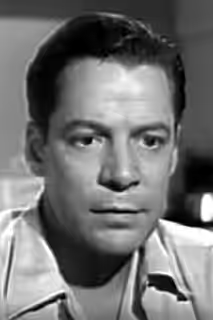
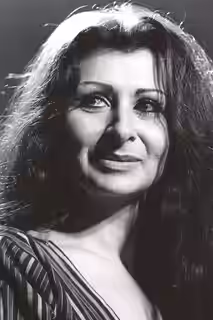
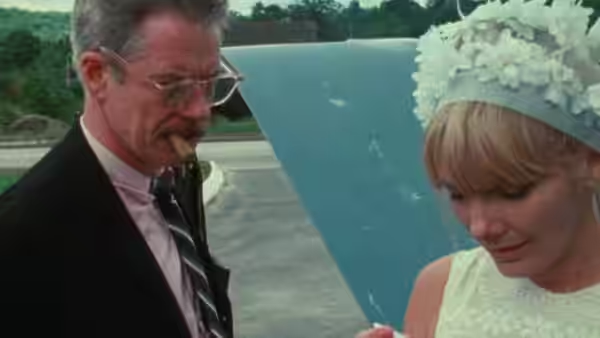
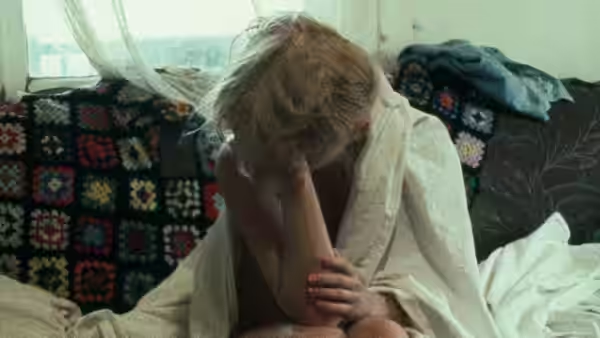
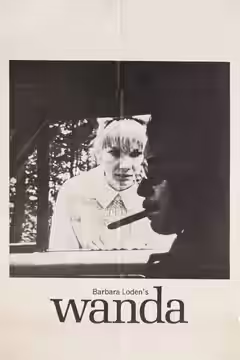
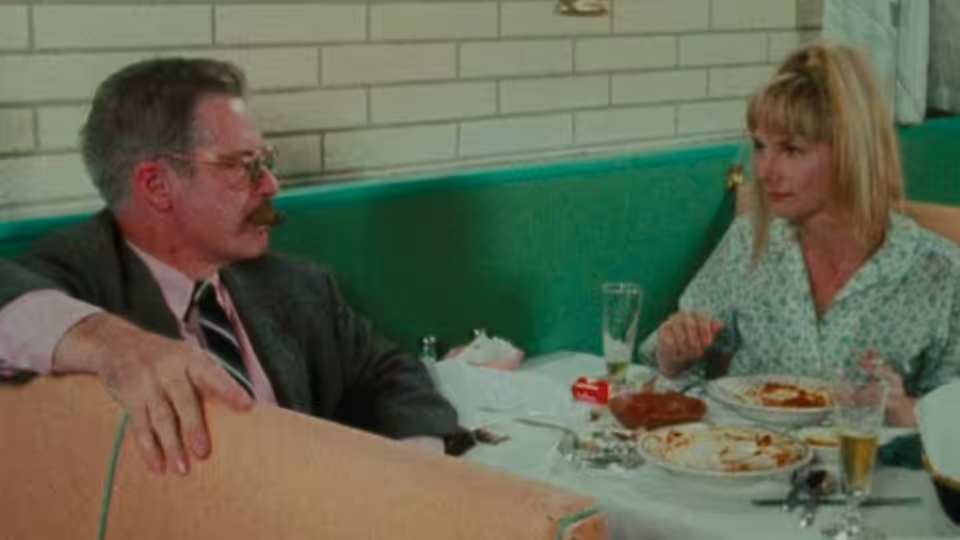
Wanda (Barbara Loden) sits across from Mr. Dennis (Michael Higgins) at a diner table
Film review

Wanda

1970 · Directed by Barbara Loden · 1h 43m · MPA PG

In a sentenceBarbara Loden makes us watch a woman most films would hurry past

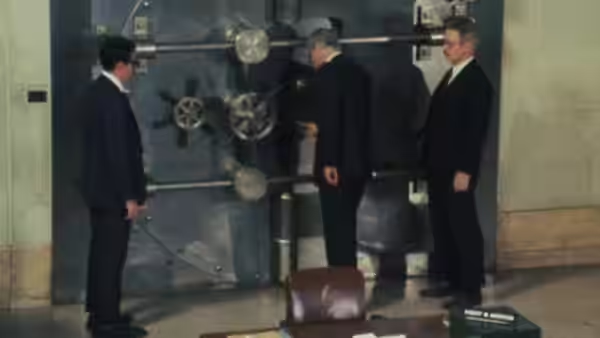
Wanda Goronski (Barbara Loden) moves through harsh surroundings, with hardship shaping her encounters. The people in her life include Mr. Dennis (Michael Higgins), her sister (Dorothy Shupenes) and her husband (Jerome Thier). As Wanda wanders, the story stays close to her experience, following a woman whose vulnerability does not entirely extinguish her resilience. Crime forms part of that experience, alongside the daily difficulty of getting by. The film follows her dealings with other people from one encounter to the next.

Fi1m review

Barbara Loden’s Wanda is a moving character study, carried by her unshowy performance and Nicholas T. Proferes’s rough, intimate photography. Its wandering pace occasionally tests patience, but we recommend staying with it.

Wanda is worth the patience it asks for, chiefly because Barbara Loden makes its central woman so difficult to dismiss. Her performance as Wanda Goronski gives this wandering crime drama its hold on us. There is nothing brisk or reassuring about the way it proceeds, and some stretches do drag. But the film takes hardship seriously without treating the person experiencing it as a specimen. We recommend it, with the warning that much of its force comes quietly.

Her acting is unusually free of the little signals that tell us a performance is under way. She lets Wanda be vulnerable without asking us to approve of her, and she never makes the character’s resilience a cause for applause. We were moved by how exposed she seems in those harsh surroundings. That unshowy acting made the hardship harder to shrug off. We kept attending to Wanda, even when she was difficult to understand.

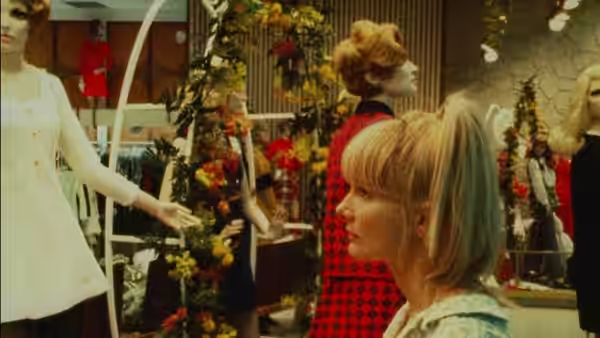
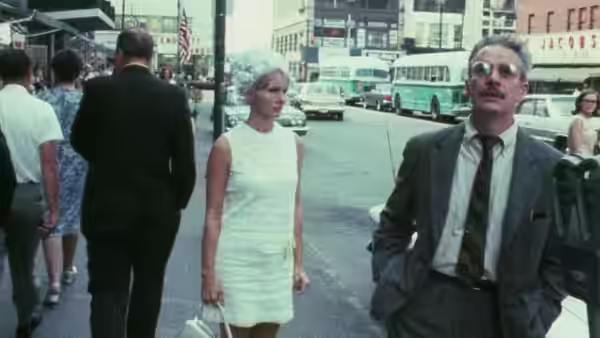
Nicholas T. Proferes’s handheld photography makes the surroundings hard to ignore. The grain keeps the image rough, while the camera’s movement gives it an unsettled closeness. There is beauty here, but it does not make hardship look like an appealing way to live. The photography works because it gives the woman and her surroundings equal weight. We are allowed to notice what is around Wanda without losing sight of the person trying to get through it.

He also edits, allowing the film’s wanderings to determine the pace rather than pushing us rapidly towards the next development. Barbara Loden’s unforced acting benefits from the time he gives it. The drawback is a slackness that becomes harder to overlook when Wanda herself is difficult to read. We can be left studying a performance without finding much new in it. A little tightening would have made the slow stretches more absorbing, without turning this into a different sort of film.

As writer and director, Barbara Loden keeps the attention firmly on Wanda, and that concentration has a cost. The people around her are less absorbing, including Michael Higgins’s Mr. Dennis. We are interested in what they bring out in her, but they do not stay with us in quite the same way. This makes the film feel narrower than it needs to. Still, the central performance has enough uncertainty in it to withstand such close attention without becoming a simple illustration of suffering.

Anyone coming to Wanda chiefly for the crime may find its priorities frustrating. It concentrates on following this woman and makes few concessions to an appetite for brisk plotting. At 103 minutes, it nevertheless feels longer than its running time suggests. That is the caveat we would give alongside a warm recommendation. Choose it for an evening when watching a person closely sounds like enough; Barbara Loden makes that attention worthwhile.
Critical consensus AI synthesised

77
Positive
5
Mixed
2
Negative
0

Most critics respond warmly to Wanda, with praise clustering around its close observation of hardship, Loden’s performance and the rough grain of its photography. The reviews describe a compassionate character study, finding vulnerability, resilience and unforced feeling in her acting. The New Yorker particularly values the physical force of the handheld cinematography, while other positive accounts praise the calm direction and the beauty found in harsh surroundings.

The recorded scores range from mixed to strongly positive, with five positive assessments and no negative ones, but the reasons for the lower ratings remain unclear. The New York Times review is only partially accessible, with no identifiable verdict, while The Playlist’s text is unavailable. Neither therefore supplies a confirmed objection to set against the praise. The available commentary suggests broad agreement; the incomplete sources prevent a reliable account of where reservations lie.

Los Angeles Times
3 August 2018 · Justin Chang
90*

Chang regards Loden’s film as an astonishing, still-vital landmark and a searingly honest character study. He especially praises its grainy visual texture, which finds unexpected beauty in Wanda’s harsh surroundings.

Read the full review →
The New Yorker
26 January 2010 · Richard Brody
90*

Brody gives the film an appreciative assessment, describing its approach as intimate and formally distinctive. He especially praises the jolting physical power of its textures and handheld cinematography.

Read the full review →
Slant Magazine
29 March 2019 · ★★★★ · Chuck Bowen
80

Bowen praises the film’s compassionate, finely observed portrait of hardship and its rough-and-tumble Criterion presentation. He singles out Loden’s performance for its expressive blend of naturalism and pathos.

Read the full review →
Variety
31 December 1969 · Variety Staff
75*

The review finds the film increasingly insightful and impactful. It praises Loden’s calm direction and her vulnerable, resilient performance.

Read the full review →
Time Out
· DP
70*

The review presents the film as subtly picaresque. It singles out its 16mm photography, blown up to 35mm, and the wanderings of its central character.

Read the full review →
The New York Times
12 September 2006
64*

The page appears to be a review of the 1970 film, but its verdict is unavailable. The accessible content does not reveal what the critic singled out for praise or complaint.

Read the full review →

Straight answers AI written, from our review

Is Wanda worth watching?
Wanda is worth watching for its moving central performance and rough, intimate photography, and we score it 83 out of 100. We recommend it to anyone drawn to patient character studies, with the caveat that its wandering pace sometimes drags and its interest in crime comes second to watching Wanda closely.
How long is Wanda, and what is it rated?
Wanda runs 1h 43m and is rated PG by the MPA in the US. It is a drama and crime film.
Where can I watch Wanda in the US?
Wanda is streaming on HBO Max, Hulu, Amazon Prime Video and The Roku Channel in the US. It leaves HBO Max on 30 September. Availability is checked daily; the links above go straight to each service.
How violent or frightening is Wanda, and is it suitable for children?
Wanda has a US PG certificate and no UK certificate supplied here, so parental guidance is the available age-rating advice. The certificate alone does not establish how violent or frightening individual scenes are; we would steer younger children towards something else because this slow drama concentrates on crime, vulnerability and hardship.
How does Wanda compare to Vagabond?
Wanda and Vagabond are both moving studies of difficult women, and we recommend both for their refusal to make their subjects easy to like. Wanda stays close to its central character but sometimes drags; Vagabond builds its portrait through a succession of witnesses that can feel too neatly arranged, making the choice more about approach than a clear difference in quality.
What should I watch after Wanda?
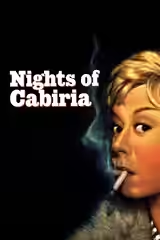
After Wanda, try Vagabond (1985, Fi1m 90): Another difficult woman on the road, observed without the usual consolations. Then Rosetta (1999, Fi1m 82): A young woman’s struggle for work gives hardship a different, urgent rhythm; and Nights of Cabiria (1957, Fi1m 88): Another vulnerable woman receives close attention, with more bustle, humour and spectacle.

Cast

If you liked this, try…

  1. Vagabond (1985, Fi1m 90)Another difficult woman on the road, observed without the usual consolations.

  2. Wendy and Lucy (2008) · not on Fi1m yetSmall practical setbacks become serious trouble in another patient study of hardship.

  3. Rosetta (1999, Fi1m 82)A young woman’s struggle for work gives hardship a different, urgent rhythm.

  4. Nights of Cabiria (1957, Fi1m 88)Another vulnerable woman receives close attention, with more bustle, humour and spectacle.

  5. Alice Doesn't Live Here Anymore (1974) · not on Fi1m yetA woman’s uncertain fresh start, with more humour and room to breathe.