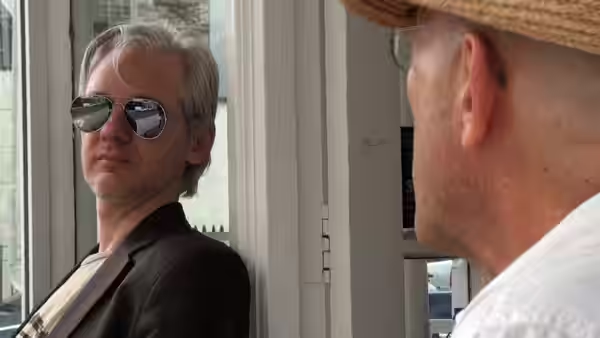
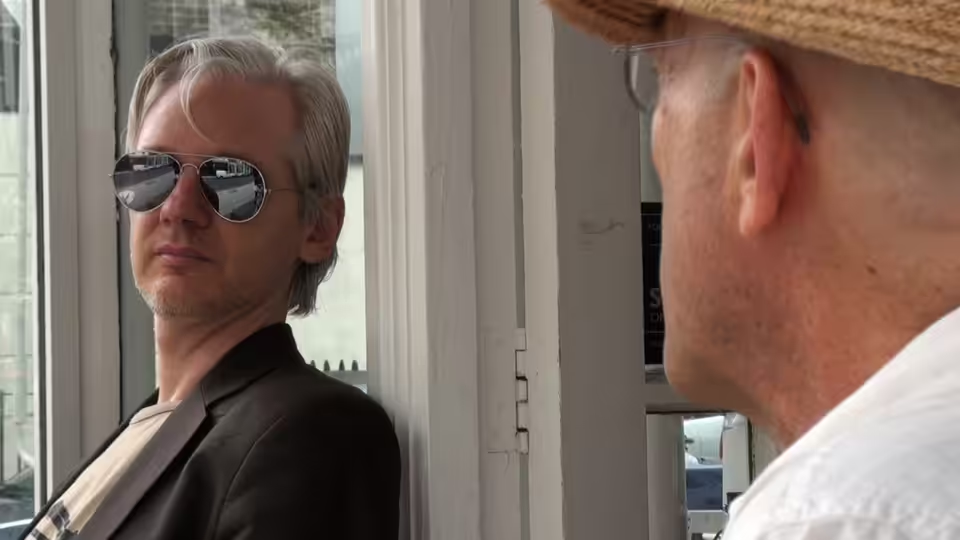
Julian Assange in sunglasses faces a man beside a window
Film review

We Steal Secrets: The Story of WikiLeaks

2013 · Directed by Alex Gibney · 2h 07m

In a sentenceA documentary about WikiLeaks that could have trusted us to read without so much decoration

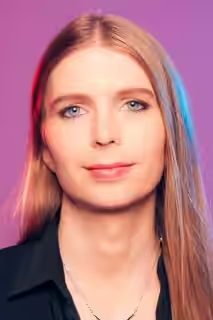
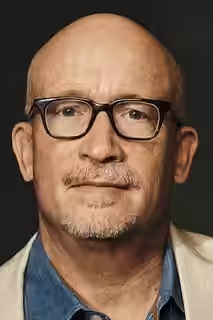
WikiLeaks founder Julian Assange appears in archive footage as Alex Gibney traces the people behind the organisation’s disclosures. Journalist Heather Brooke and former WikiLeaks spokesperson Daniel Domscheit-Berg offer perspectives on its work. Former NSA and CIA director Michael Hayden contributes the perspective of someone whose work involves keeping secrets. Chelsea Manning, a WikiLeaks source, also appears through archive material. Gibney follows the effort to bring confidential information into public view, using interviews and Manning’s online messages to introduce the people involved. The account moves between Assange’s public presence and a source’s private conversations, examining the demands that disclosure places on those doing it.

Fi1m review

Alex Gibney makes the WikiLeaks story accessible and gives Chelsea Manning’s messages proper attention. It is compelling, moving documentary work, held back by an uneven structure and too much fascination with Julian Assange.

Alex Gibney’s We Steal Secrets: The Story of WikiLeaks is a good introduction to a difficult subject, though it spends too long trying to make its founder explain the whole enterprise. It wants to understand how confidential information becomes public, who makes that happen and what it costs them. Gibney keeps the material accessible and allows conflicting views enough space to become interesting. The trouble is that the personal disputes become more absorbing than the questions about disclosure, and the film does too little to correct that drift.

Julian Assange is a compelling subject for this approach, and an awkward one. He appears through archive footage, so there is a limit to how directly Gibney can test the impressions supplied by other people. The glimpse of Assange dancing alone to disco music is welcome because it gives us something to look at beyond the public figure being discussed. It also shows the limitation: an unguarded moment can make someone more approachable without explaining their decisions.

Chelsea Manning is where the film becomes more attentive. The online chat messages bring the scale down to words sent by one person to another, and Gibney lets those words carry emotional weight that the larger account sometimes struggles to find. We were moved by Manning’s messages, because they make the distress of the person supplying the information impossible to overlook. They give us a reason to care about the source beyond the disclosures themselves.

Andy Grieve’s editing makes the movement between Assange and Manning clear, which matters when the film has so many voices to accommodate. The candid interviews keep that movement from feeling like a procession of official statements. Maryse Alberti’s cinematography serves those interviews well: the speakers hold our attention without needing the surrounding graphics to make their words interesting. The visual embellishments elsewhere are less persuasive, often giving us another thing to watch when we would rather think about what has just been said.

Will Bates’s music adds urgency, but urgency is not always what this material needs. At 127 minutes, the film has room to weigh its competing accounts more patiently. Instead, its embellishments sometimes hurry us past a question that deserves more time, while the portrait of Assange receives another pass. Grieve keeps individual passages moving, but the amount of attention given to each subject remains frustratingly uneven.

An investigative documentary needs to help us judge how much each interview actually establishes. Gibney is right to scrutinise the people handling secrets rather than assume their stated principles settle every question about their conduct. But the attention paid to Assange’s elusive personality does not always help us understand WikiLeaks. The broader account feels unfinished, and the confidence of the presentation can make that limitation easy to miss.

We would recommend it as an introduction, with a warning against accepting the portrait of Assange as a settled account. Allow room afterwards to question how much one person’s behaviour can explain about an organisation built around disclosure. And give Manning’s words your closest attention.
Critical consensus AI synthesised

71
Positive
11
Mixed
5
Negative
1

Most critics find Alex Gibney’s documentary compelling and informative, praising his ability to make the complexities of WikiLeaks accessible without avoiding their moral grey areas. The strongest agreement concerns Manning: the reviews repeatedly identify the emotional turmoil and on-screen chat messages as the film’s most affecting material. Gibney’s interweaving of Manning’s story with Assange’s also earns praise, though enthusiasm for the investigative storytelling is broader than confidence in the film’s conclusions.

Reservations centre on an unfinished story, uneven structure and an Assange portrait that leaves its subject elusive. Several broadly favourable reviews find the personal stories more satisfying than the political examination. The spread is substantial: Variety finds the central conflict dramatically weak while still singling out Manning as memorable. Slant Magazine offers the sharpest dissent, arguing that flashy graphics and superficial intrigue take the place of deeper political and psychological insight.

IndieWire
22 May 2013 · A- · Gabe Toro
90

Toro considers the documentary vital and compelling despite its unfinished feel. He praises its clear-eyed focus on Bradley Manning and the deaths revealed in leaked military footage.

Read the full review →
Los Angeles Times
23 May 2013 · Mark Olsen
90*

Olsen calls the documentary a gripping, ambitious major work. He praises how Gibney skillfully interweaves the stories of Assange and Manning, especially Manning’s emotional online chats.

Read the full review →
Empire
4 June 2013 · Philip Wilding
80*

Wilding finds the documentary a dynamic, smart and fine examination of the WikiLeaks story. He particularly praises its heartbreaking portrayal of Bradley Manning and its willingness to tackle the story’s grey areas.

Read the full review →
Time Out
8 July 2013 · ★★★★ · Trevor Johnston
80

The review is strongly positive about the documentary. It praises Alex Gibney’s skill at unpicking complex issues through investigative filmmaking.

Read the full review →
The AV Club
23 May 2013 · B · A.A. Dowd
77

Dowd finds the documentary informative but uneven, with Assange’s absence leaving it unbalanced. He praises its accessible overview and the human focus on Bradley Manning’s story.

Read the full review →
Vulture
24 May 2013 · B · David Edelstein
77

Edelstein finds the documentary enthralling and probing, with its personal story ultimately overtaking its political revelations. He praises Gibney’s interwoven account of Bradley Manning as especially affecting.

Read the full review →

Straight answers AI written, from our review

Is We Steal Secrets: The Story of WikiLeaks worth watching?
We Steal Secrets: The Story of WikiLeaks is worth watching as an accessible introduction to WikiLeaks, and we score it 74 out of 100. We were moved by Chelsea Manning’s messages, which make the source’s distress difficult to overlook, but the uneven structure and excessive attention to Julian Assange mean we recommend it with reservations about how fully it explains the organisation.
How long is We Steal Secrets: The Story of WikiLeaks, and what is it rated?
We Steal Secrets: The Story of WikiLeaks runs 2h 07m. It is a documentary and drama film.
Where can I watch We Steal Secrets: The Story of WikiLeaks in Slovakia?
We Steal Secrets: The Story of WikiLeaks is not on any streaming or rental service in Slovakia at the moment. It is available in 37 other countries; change your country at the top of the page to see where. Availability is checked daily.
How violent or frightening is We Steal Secrets: The Story of WikiLeaks, and is it suitable for children?
We Steal Secrets: The Story of WikiLeaks carries a US R certificate, so we would not recommend it for children. Manning’s online messages convey personal distress that can be upsetting, and the subject suits an adult audience interested in secrecy and disclosure; the certificate alone does not establish how much violence or other explicit content it contains.
How does We Steal Secrets: The Story of WikiLeaks compare to Citizenfour?
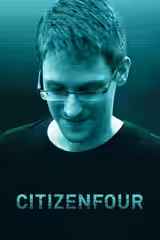
We Steal Secrets: The Story of WikiLeaks offers a broader introduction to an organisation, but we recommend Citizenfour as the more focused, less visually distracting documentary about people handling secrets. Citizenfour gains tension from Laura Poitras’s presence as Edward Snowden starts talking, though its surrounding material is thinner; Gibney’s film suits viewers specifically interested in WikiLeaks and Manning’s messages.
What should I watch after We Steal Secrets: The Story of WikiLeaks?
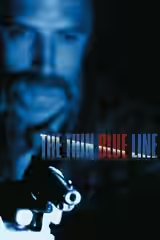
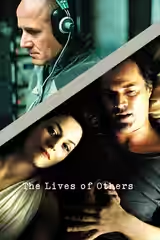
After We Steal Secrets: The Story of WikiLeaks, try Citizenfour (2014, Fi1m 83): Stays close to the people handling secrets, with less distracting decoration. Then The Thin Blue Line (1988, Fi1m 90): A patient examination of testimony, evidence and who gets to establish the facts; and The Lives of Others (2006, Fi1m 84): For the human cost of surveillance, explored through fiction and private loyalties.

Cast

If you liked this, try…

  1. Citizenfour (2014, Fi1m 83)Stays close to the people handling secrets, with less distracting decoration.

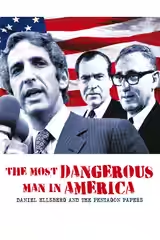
  2. The Most Dangerous Man in America: Daniel Ellsberg and the Pentagon Papers (2009) · not on Fi1m yetAnother source of government secrets, with more room for the political consequences.

  3. The Thin Blue Line (1988, Fi1m 90)A patient examination of testimony, evidence and who gets to establish the facts.

  4. The Lives of Others (2006, Fi1m 84)For the human cost of surveillance, explored through fiction and private loyalties.

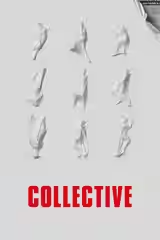
  5. Collective (2019, Fi1m 88)Follows investigative work closely enough to make each new finding matter.