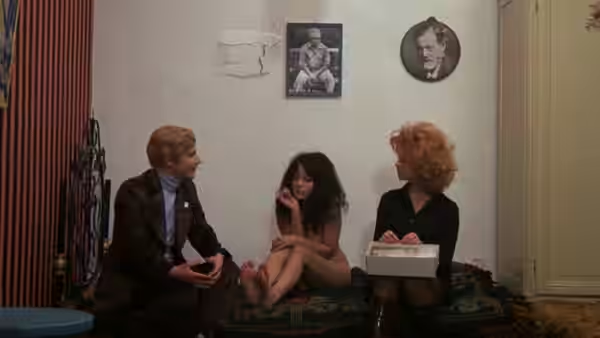
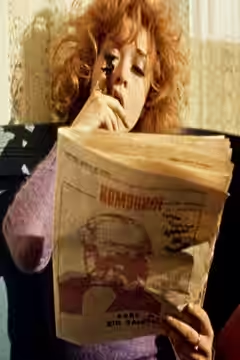
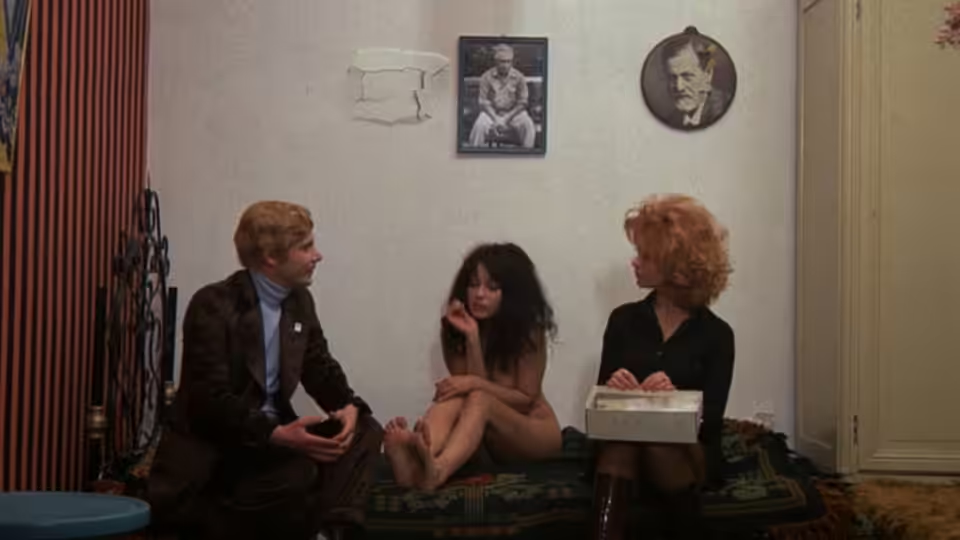
A seated man and two women gather on a low platform in a room
Film review

WR: Mysteries of the Organism

1971 · Directed by Dušan Makavejev · 1h 25m

In a sentenceA lecture that keeps losing control of the class, usually to our benefit

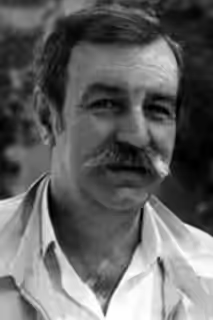
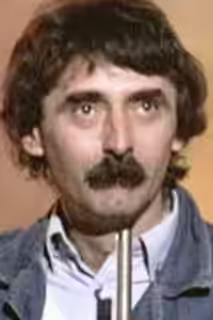
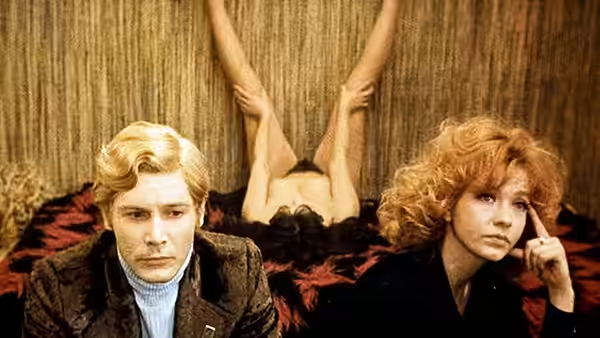
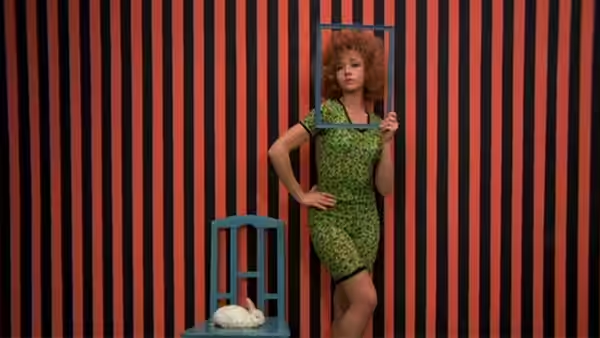
Milena (Milena Dravić), Vladimir Ilyich (Ivica Vidović) and Jagoda (Jagoda Kaloper) feature in the fictional episodes of a film built around Wilhelm Reich’s ideas. Interviews interrupt the acted material, and comic episodes sit alongside people speaking for themselves. Wilhelm Reich appears as himself, Jackie Curtis appears as Jackie Curtis, and Tuli Kupferberg plays a US Soldier. The interviews and fictional scenes do not unfold as separate programmes: they keep interrupting one another. The emphasis moves with each interruption, from the people on screen to the ideas being discussed and back again.

Fi1m review

Dušan Makavejev’s collage of interviews and acted episodes is funny, abrasive and occasionally too fond of explaining itself. Its restless editing makes the ideas worth following, even when the preaching becomes tiresome.

WR: Mysteries of the Organism asks us to follow a discussion that keeps changing its speaker and its form. Dušan Makavejev puts Wilhelm Reich’s ideas into a collage of interviews and acted episodes, with comedy interrupting the serious business. It is funny, demanding and worth an evening if tidy storytelling is not the requirement. Some of the preaching wears thin. The pleasure comes from watching the editing complicate statements that might otherwise sound rather pleased with themselves.

Ivanka Vukasović’s editing is the chief reason this works: the move from interview to acted episode changes how we listen as well as what we see. A speaker can hold our attention without acquiring the authority to explain everything that follows. We laughed at the interruptions of earnest discussion, because the changes of form make solemnity difficult to sustain. The humour depends on where a passage stops and what comes next, rather than simply on somebody delivering a funny line.

Aleksandar Petković’s cinematography serves the acted episodes well, though their place within the collage matters more than any single image. The images need to survive abrupt changes of context, and they do. Milena Dravić, Ivica Vidović and Jagoda Kaloper give us people to attend to when the discussion threatens to become all propositions. The constant interruptions make sustained attachment difficult, however, and we sometimes want to stay with someone just when the film is ready to move on.

Dragoljub Ivkov’s production design is less memorable than the way the material is assembled, though that is hardly a serious failing here. The fictional scenes need enough substance to hold their own beside interviews; they have it. Bojana Marijan’s music helps sustain the unruliness, but does not give the disparate passages quite the momentum of Ivanka Vukasović’s cuts. The editing remains the strongest reason to keep watching, particularly when a passage has begun to exhaust its welcome.

The weakness is that Dušan Makavejev does not always trust the connections between passages to be enough. The discussion can become insistent, as if the force of a proposition should excuse hearing it at length. There are stretches where the film seems satisfied simply to have introduced a radical idea, leaving us waiting for it to do something more. Then the next comic interruption has to recover attention that the talking has lost, and the effort occasionally shows.

As a comedy, it makes useful space for uncertainty: an idea can be worth listening to and still be funny. That keeps the mixture from becoming a procession of worthy statements, despite the stretches of preaching. The documentary passages give the comedy something to push against, while the fictional episodes stop the interviews dictating the whole film’s pace. We need not find every proposition persuasive to enjoy the way it is presented, and the film is better company when it allows that freedom.

At 85 minutes, this is a manageable demand on an evening, although its abrupt changes do not prevent some slow patches. We recommend it for the humour, with a warning that the talking occasionally gets ahead of the jokes. Its strongest passages justify following a film that will not explain every change of direction. Choose it when there is still enough energy left in the evening for an unruly argument.

Critical consensus AI synthesised

73
Positive
3
Mixed
2
Negative
0

With only 5 reviews in so far, the available criticism leans positive, with praise clustering around Makavejev’s humour and montage. The reviews with accessible verdicts find the film’s unconventional assembly of ideas and episodes engaging, particularly in its comic treatment of radical thought. Slant Magazine supplies the clearest reservations, finding it dated and occasionally preachy while still entertaining; The Guardian is more emphatic about its achievement. Two entries lack accessible review text, so the extent of agreement remains uncertain: the readable reviews support a favourable account, but not a complete picture of the dissent.

The Guardian
3 June 1999 · Derek Malcolm
85*

Malcolm regards the film as a unique, audacious landmark and laments that Makavejev never again matched its achievement. He particularly praises the film’s humorous, magisterial use of dialectical montage.

Read the full review →
Empire
21 July 2006 · David Parkinson
75*

The review regards the film as a fascinating, underappreciated exploration of Reich’s ideas. It especially praises Makavejev’s comic and artistic assurance, particularly his use of associational montage.

Read the full review →
Slant Magazine
12 May 2008 · Chris Gisonny
75*

The critic finds the film dated and occasionally preachy, but ultimately a worthwhile and entertaining counterculture artifact. He praises its amusing presentation of radical ideas and its lively, unconventional collage of interviews and episodes.

Read the full review →
RogerEbert.com
68*

The URL identifies this as a Great Movies piece about the specified film, but the page content is blocked. I cannot verify the critic’s verdict or what the article singles out for praise or complaint.

Read the full review →
Time Out
23 January 2013
64*

The accessible page does not reveal the critic’s verdict or specific praise or criticism. It identifies the film but provides no review text.

Read the full review →

Straight answers AI written, from our review

Is WR: Mysteries of the Organism worth watching?
WR: Mysteries of the Organism is worth watching for its abrasive humour and restless editing, provided orderly storytelling is not essential; we score it 75. Its interviews and acted episodes keep interrupting one another to comic effect, though the preaching sometimes wears thin and the constant changes make attachment to its characters difficult.
How long is WR: Mysteries of the Organism, and what is it rated?
WR: Mysteries of the Organism runs 1h 25m. It is a drama and fantasy film.
Where can I watch WR: Mysteries of the Organism in Ireland?
WR: Mysteries of the Organism is not on any streaming or rental service in Ireland at the moment. Availability is checked daily.
How does WR: Mysteries of the Organism compare to Daisies?
WR: Mysteries of the Organism is more talk-driven than Daisies, building its comedy around interviews and acted episodes rather than colour filters, scissors and enormous meals. We favour Daisies for comic abandon, despite its repetition; WR suits an evening when there is more appetite for ideas, with the caveat that its earnest discussion sometimes outstays its welcome.
What should I watch after WR: Mysteries of the Organism?
After WR: Mysteries of the Organism, try Daisies (1966, Fi1m 85): For another comic assault on good behaviour, orderly storytelling and respectable appetites. Then The Discreet Charm of the Bourgeoisie (1972, Fi1m 83): For patient absurdity aimed at people convinced their privileges are perfectly reasonable.

Cast

If you liked this, try…

  1. Daisies (1966, Fi1m 85)For another comic assault on good behaviour, orderly storytelling and respectable appetites.

  2. Love and Anarchy (1973) · not on Fi1m yetFor political conviction complicated by desire, with tenderness amid the provocation.

  3. Funeral Parade of Roses (1969) · not on Fi1m yetFor interviews and acted scenes that keep unsettling each other.

  4. The Discreet Charm of the Bourgeoisie (1972, Fi1m 83)For patient absurdity aimed at people convinced their privileges are perfectly reasonable.

  5. The Watermelon Woman (1996) · not on Fi1m yetFor a warmer, more inviting mixture of desire, performance and documentary enquiry.