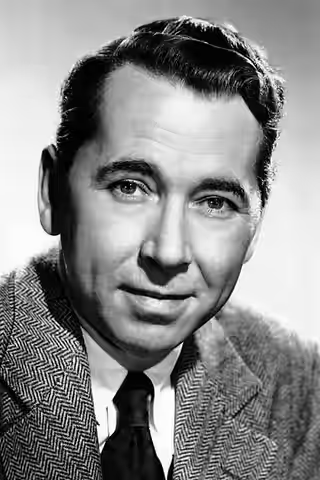
Alexander Knox spent his career as the reasonable man at the table: the president, the priest, the spymaster who has read the file. He was precise, dry and easy to believe, and he deserved more films that let him be wrong.
Fi1m perspective
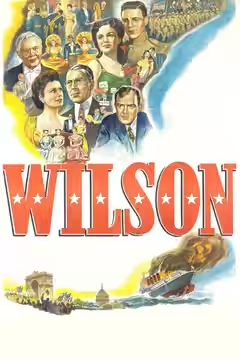
Alexander Knox at a desk. Alexander Knox at a lectern. Alexander Knox at the back of a train, telling a crowd something it does not want to hear in a voice that never rises. That is a good deal of Wilson (1944), and it is a fair picture of what he did for the rest of his career: the reasonable man at the table, the one who has read the papers and is waiting for everybody else to catch up. He had a clear, level voice made for speeches and a face that looked as though it had already thought the matter through. Directors cast him as presidents, priests and men of principle for decades.
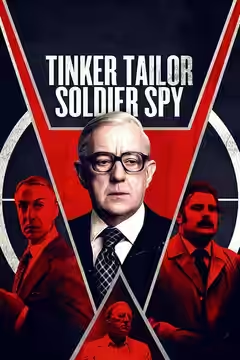
He came to it from the stage, in Boston from 1929 and then in England in the 1930s, where he worked with the Old Vic and turned up in early films, The Four Feathers (1939) among them. The war sent him back across the Atlantic. His Hollywood debut was The Sea Wolf (1941), opposite Edward G. Robinson, and three years later Darryl F. Zanuck put him at the centre of Wilson, 154 minutes of Technicolor and brass bands. It made his name and fixed his type. He settled in Britain for good and worked there as a character actor into the mid-1980s: Father Godwin in The Vikings (1958), two films for Joseph Losey including The Damned (1963), and Control in the BBC's Tinker Tailor Soldier Spy (1979).
Wilson is the performance we have written up, and we liked him a good deal more than the film. Henry King, directing Lamar Trotti's script, has decided before the first scene that the president was never wrong, which leaves Knox with a man to play and no faults to play him with. So he keeps everything small: a raised eyebrow at a party boss, a hand on Ellen's arm, a schoolmaster's patience with a room that has not done the reading. During the League speeches we found ourselves watching his hands, because the speeches went on and the hands were doing the acting. We were bored by the second half and then annoyed at being bored, and none of the annoyance was his. The real Wilson was stubborn to the point of ruin. Knox could plainly have played that man. Nobody asked him to.
That is the shape of the career. Sincerity and reserve got him the lead in a monument, and then got him cast as the same fellow, in smaller rooms, for the next forty years. We have not reviewed the later parts, so we will only say that a le Carré spymaster and a Joseph Losey picture are where a man with that voice belongs, and that he got there late. Start with Wilson, and watch him rather than the parade. Then look for him at the edges of British films and television, usually behind a desk, usually the only person in the scene who has read the file.
Biography
Alexander Knox (1907–1995) was a Canadian actor and writer. Born in Strathroy, Ontario, he graduated from the University of Western Ontario and began his stage career in Boston before joining the Old Vic company in England. He later worked in Hollywood and, following difficulties during the McCarthy era, spent much of his later career in Britain.
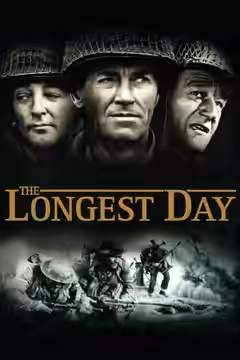
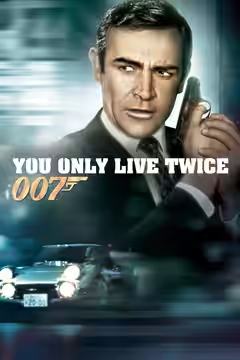
He is best known for playing Woodrow Wilson in the 1944 biopic Wilson, for which he received an Academy Award nomination for Best Actor and won the Golden Globe Award for Best Actor in a Motion Picture – Drama. Other notable film and television roles include The Sea Wolf (1941), The Vikings (1958), The Longest Day (1962), Khartoum (1966), Accident (1967), You Only Live Twice (1967) and Tinker Tailor Soldier Spy (1979). Knox also wrote plays and adventure novels.
He was married to actress Doris Nolan from 1944 until his death.